

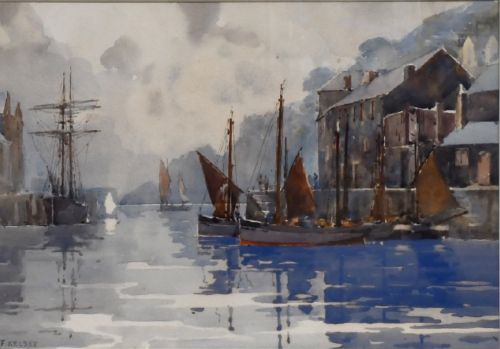


Original Watercolour Harbour Scene
An original watercolour harbour scene captures coastal life through pigment on paper, prized by collectors for bringing authentic maritime history directly into domestic spaces.

Original Watercolour Harbour Scene
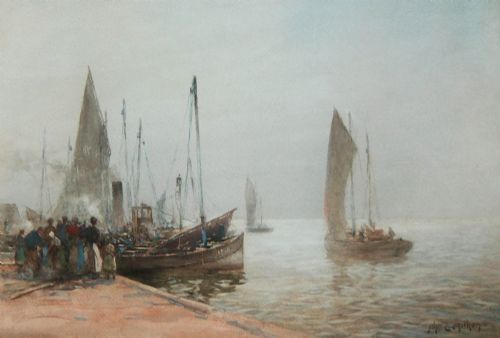
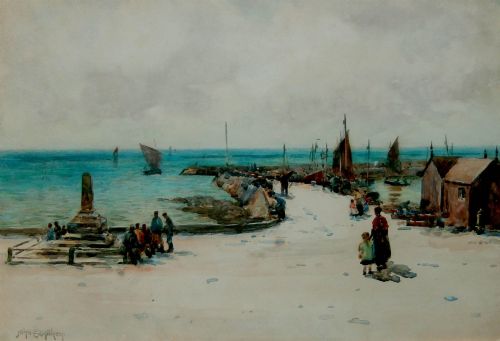
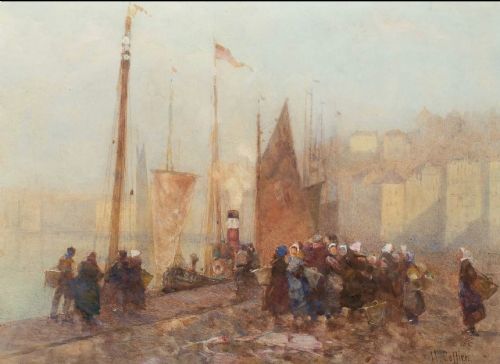
An original watercolour harbour scene brings together coastal topography and maritime commerce through traditional paper-based painting. These works record busy fishing ports, quiet estuaries, and tidal moorings from the nineteenth and twentieth centuries.
The most common examples on this page date from the Edwardian era and the interwar decades, reflecting strong British and French regional traditions. Artists favoured coastal subjects in Cornwall, Yorkshire, and northern European ports.
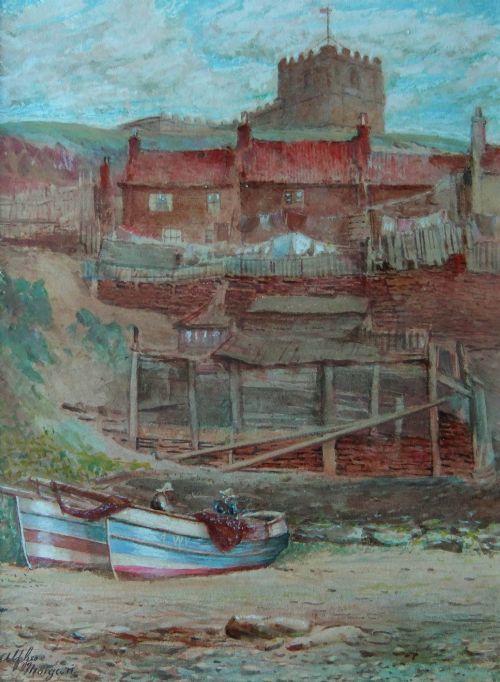
Compositions range from detailed topographical views of Whitby or St Ives to atmospheric studies of trawling luggers and dockside shipping. Most pieces appear preserved behind glass within timber and gilt frames.
How they were made
Artists applied watercolour pigment onto paper support, sometimes incorporating ink lines to define architectural structures and rigging. Pigments were thinned with water to create translucent washes that rendered shifting coastal light and sea spray.
Brushwork combined fine details for boats and buildings with broader applications of colour for sky and water. Finished works were sealed behind glass within wooden frames, occasionally embellished with gilt or hand-enamelled decoration to protect the fragile paper surface.
Listings feature works from the Victorian era through the nineteen-fifties, created in watercolour, ink, and glass-fronted frames.
What varies in quality
Quality rests upon the artist's handling of light, atmospheric perspective, and spatial depth within the harbour setting. Superior works display confident, expressive brushwork that captures movement in water and weather without relying on rigid outlines.
Condition and sheet preservation significantly influence a piece, particularly the absence of heavy fading in fugitive pigments. The harmony between the watercolour and its original framing also distinguishes finer examples from later assemblies.
James E. Aitken·John E. Aitken·William Banks Fortescue·Hector Caffieri·Alfred G. Morgan·Frank Kelsey·George F Pennington·Richard Harry Carter·William Lee Hankey·Fred Lawson·William Tuck·James Thomas Watts·Kate E Booth·Jan van Couver·Frederick Stuart Richardson·Rowland Henry Hill·Frank W. Scarborough·Thomas Clavering Alder·Walter Henry Sweet·Frank Rousse·William Collins·Yves Brayer·Robert Leslie Howey·John D. Walker·Frank William Scarbrough
The Original Watercolour Harbour Scene Glossary
- Watercolour pigment
- Finely ground colour particles mixed with a water-soluble binder, applied in translucent layers onto paper. This medium allows artists to build luminous effects by letting the white of the paper reflect through.
- Coble
- A traditional type of open fishing boat native to the north-east coast of England, featuring a flat floor and high bow. These vessels frequently appear in regional harbour paintings.
- Lugger
- A small sailing vessel rigged with lugsails, historically used for coastal fishing in Devon and Cornwall. Artists recorded them crowding into West Country ports.
- Gilt wood
- Timber framing coated with a thin layer of gold leaf or metallic gilt, used historically to finish and elevate framed watercolours. Such frames often show age-appropriate patina and construction methods.
Original Watercolour Harbour Scene: Frequently Asked Questions
How do I date an early twentieth century harbour watercolour?
Dates often rely on artist signatures, exhibition records, or stylistic markers tied to Edwardian and interwar British art movements. Details like vessel types and clothing styles depicted in the docks also help narrow the period.
Paper stock and framing methods provide further clues, though conservation history can sometimes complicate physical examination. Comparing signed examples from known working decades offers the most reliable chronological placement.
Where should I hang a watercolour painting at home?
Watercolours require careful placement away from direct sunlight to prevent pigment fading and paper degradation over time. Stable indoor humidity levels protect both the paper support and the historical wooden frame.
Positioning pieces at eye level in low-to-moderate ambient light allows the delicate washes and paper texture to be appreciated safely. Using UV-protective glazing offers an extra layer of preservation for domestic display.
What is the difference between an etching and a watercolour harbour scene?
An original watercolour is a unique painting created directly by hand using pigment and water on paper. Each stroke is singular, making every composition a one-off record of the artist's view.
Etchings and prints involve a mechanical or chemical printing process that allows multiple impressions to be produced from a single plate. Examining the paper surface under magnification usually reveals brush textures rather than printed ink lines.
How were these coastal scenes used historically?
These watercolours served primarily as framed fine art for domestic decoration, recording familiar coastal spots for middle-class collectors and travellers. Many captured the bustling reality of working fishing ports before industrial modernisation changed the coastline.
Some works functioned as preparatory studies or finished pieces intended for regional art society exhibitions. They preserved a romantic yet observant record of maritime labour and daily life in British and European harbours.