
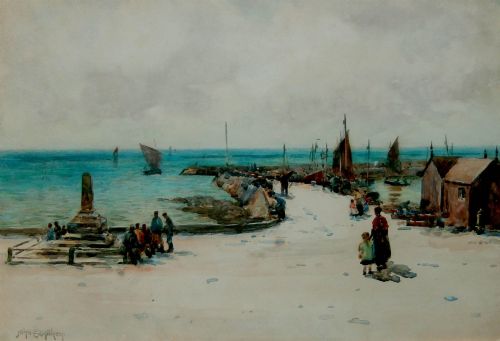


Grey Sea Watercolour Painting
These grey sea watercolour painting works capture coastal weather and maritime movement with fluid pigment on paper.
Grey Sea Watercolour Painting
A grey sea watercolour painting presents maritime and coastal scenes through translucent washes of pigment on paper. These works document harbours, lighthouses, and sailing vessels across varied British coastal locations.
Most examples originate from the Victorian period through to the mid-twentieth century, spanning movements such as British Impressionism, the Staithes School, and Edwardian marine art. Artists utilise the natural white of the paper to render light bouncing off grey waves and overcast skies.
Materials and methods
Watercolour pigment is applied directly to paper support, sometimes enhanced with bodycolour to build opacity in the breaking waves and clouds. The technique relies on controlled washes to capture the transient effects of coastal weather and sea spray.
Framing typically involves gilded wood and protective glass to shield the paper from environmental moisture and light damage.
Current listings feature watercolours spanning from the Victorian era up to 1950, executed on paper with gilded wood framing.
Judgement of quality
Quality rests upon the artist's handling of pigment and water to convey the weight and movement of choppy waters without overworking the paper. A confident, fluent application separates evocative coastal interpretations from stiff compositions.
Condition of the paper and the integrity of the pigment remain central, as prolonged exposure to light can diminish delicate grey and blue tones.
John E Aitken·Frederick Stuart Richardson·Thomas Bush Hardy·Percy Brooke·William Kay Blacklock·Joseph Newington Carter·William Boyce·Edward Wesson
The Grey Sea Watercolour Painting Glossary
- Watercolour
- A paint consisting of a pigment suspended in a water-soluble vehicle. It is applied in translucent washes to paper to achieve luminous effects.
- Bodycolour
- Watercolour paint mixed with a white pigment to make it opaque. This technique adds highlights to turbulent grey waves and frothing sea foam.
- Gilded wood
- Timber frames treated with a gold-leaf finish. They provide traditional framing for nineteenth and twentieth-century works on paper.
- British Impressionism
- A painting style focusing on light and atmosphere. Artists working in this manner captured fleeting coastal moments outdoors.
Grey Sea Watercolour Painting: Frequently Asked Questions
What periods do these paintings come from?
The works span the late nineteenth century through the mid-twentieth century, encompassing Victorian, Edwardian, and later modern periods.
Artists during these eras captured coastal scenes using traditional watercolour techniques on paper.
How should I frame a watercolour?
Watercolours require protection under glass with acid-free mounts to prevent the paper from touching the glazing.
This preservation stops moisture and light from degrading the delicate pigment over time.
Where were these coastal scenes painted?
Locations range from British fishing ports like Whitby and Polperro to international coastal spots such as Portugal.
Artists often travelled to working harbours to record maritime activity and changing weather.
How do I identify a marine watercolour?
These pieces focus primarily on maritime subjects, including ships, lighthouses, harbours, and choppy seas.
They rely on paper supports and fluid pigment rather than oil paint on canvas.