



Cornish Coastal Watercolour Painting
These cornish coastal watercolour painting works capture harbour scenes and fishing villages across the south-west peninsula.
Cornish Coastal Watercolour Painting
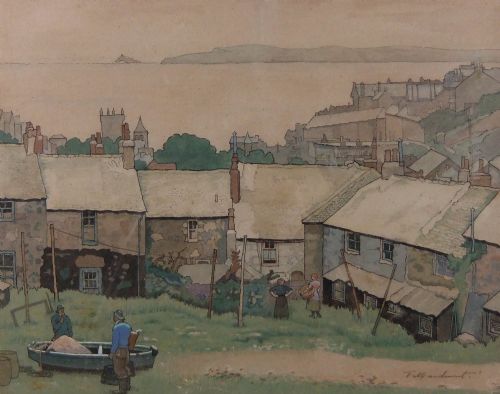
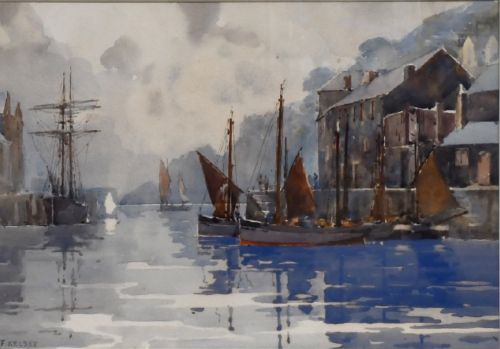
A cornish coastal watercolour painting captures the harbours, fishing boats, and rugged cliffs of the south-west peninsula, produced across the nineteenth and twentieth centuries. These works document specific locations such as St Ives, Newlyn, Mousehole, Looe, and Polperro through the eyes of artists drawn to the maritime light and local communities.
The pieces appearing on this page span the Victorian era, the Edwardian period, and the early twentieth century, reflecting movements like the Newlyn School and St Ives School. Buyers encounter framed waterpaintings on paper depicting trawling luggers, harbour walls, and whitewashed cottages by the shore.
Most examples rely on watercolour pigment applied to paper, frequently presented behind glass within wood or gilt wood frames. The selection ranges from topographical views of local anchorages to character studies of fisherfolk along the coast.
Materials and technique
Artists deployed watercolour pigment mixed with water upon paper sheets, sometimes incorporating ink lines to define architectural details and rigging on boats. This aqueous medium permitted rapid recording of shifting light over sea and stone.
Surviving examples are preserved behind protective glass within wooden or gilt wood frames that isolate the paper from atmospheric moisture. The support materials typically consist of stiff watercolour paper or card stock suitable for absorbing fluid pigment.
Listings feature works executed on paper using watercolour pigment and ink, predominantly originating from the nineteenth and twentieth centuries.
Distinctions in quality
Quality rests upon the artist's ability to handle the fluid medium of watercolour to convey the distinct luminosity of the western seaboard and the atmosphere of working harbours. Stronger works demonstrate confident brushwork and precise draughtsmanship in rendering vessels and stone quays.
The prominence of the maker within regional art history also shapes the standing of a piece, alongside the clarity of the composition and the preservation of the original pigments against fading. Framing materials and historical documentation further distinguish exceptional examples from standard topographical records.
William Banks Fortescue·Thomas Maidment·Frank Kelsey·George F Pennington·Richard Harry Carter·Ernest F Hill·Frederick Stuart Richardson·Ralph Todd·William Lee Hankey·Walter Sweet·S J Lamorna Birch·Cuthbert Crossley
The Cornish Coastal Watercolour Painting Glossary
- Watercolour
- A painting method in which the paints are made of pigments suspended in a water-based solution. The paper surface remains partially visible through translucent washes.
- Newlyn School
- An art colony movement based in Cornwall during the late nineteenth and early twentieth centuries. Artists painted plein air scenes focusing on local fisherfolk and coastal life.
- St Ives School
- A group of artists associated with the Cornish port town who explored maritime subjects and early modernism. The movement gathered momentum from the early twentieth century onwards.
- Trawling lugger
- A traditional two-masted fishing vessel common around the south-west coast of England. These boats frequently appear anchored in historical maritime art.
Cornish Coastal Watercolour Painting: Frequently Asked Questions
What subjects appear in these watercolours?
The compositions focus on Cornish fishing harbours, coastal villages, and maritime vessels such as trawling luggers. Artists recorded specific locations including St Ives, Mousehole, and Newlyn.
Many works also depict local inhabitants, including fisherfolk and domestic scenes set against the backdrop of the south-west coast.
How should I frame and display them?
These works on paper require protection behind glass to prevent atmospheric damage and fading from direct sunlight. Displaying them away from humid environments preserves the paper and the pigment.
Original wood or gilt wood frames often accompany the pieces and provide historical context for the artwork.
How do I identify the period of a painting?
Dating relies upon artist signatures, stylistic movements such as the Newlyn School, and framing materials characteristic of the nineteenth and twentieth centuries. Biographical dates of the painters provide a clear timeframe for execution.
Inscribed titles on the reverse or front of the paper frequently note specific locations and dates from the era.
Who were the artists working in Cornwall?
Numerous British artists joined colonies in coastal towns like St Ives and Newlyn to paint the local landscape and maritime subjects. Painters recorded the daily routines of fishing communities directly from life.
Figures such as Ralph Todd, William Lee Hankey, and S. J. Lamorna Birch captured the distinct atmosphere of the region.