


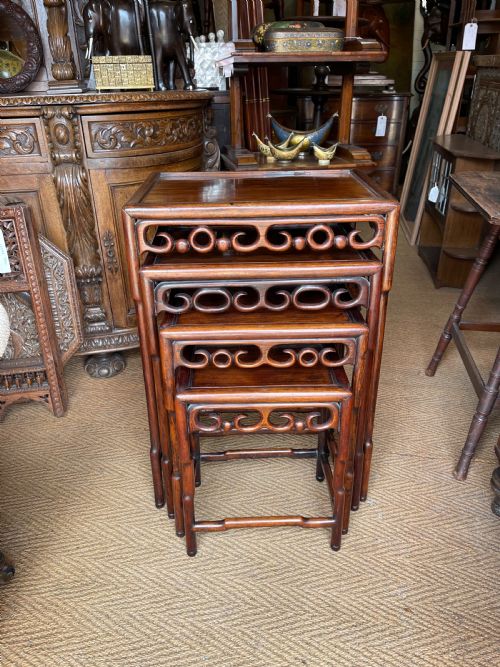


Oriental Nesting Coffee Tables
Oriental nesting coffee tables bring together multiple graduated surfaces for flexible living, spanning Chinoiserie lacquer and carved hardwood.
Oriental Nesting Coffee Tables
When you search for oriental nesting coffee tables, you encounter sets of graduated tables designed to slide neatly beneath one another when not in use. These pieces serve as versatile side or coffee tables in a room, expanding when extra surface area is needed and compacting to save space.
The versions most commonly met on this page span the nineteenth century through the 1930s, taking forms such as nests of three or four tables. They draw on styles including Chinoiserie, Chinese export, Queen Anne style, Art Deco, and Anglo-Indian designs.
Origins stretch across Chinese and Asian export traditions, utilising woods and decorative finishes typical of these workshops. Buyers select them for their practical stacking capability combined with decorative surface work.
How they were made
These tables rely on solid timbers such as hardwood, rosewood, teak, and Hongmu, often paired with burrwood veneers for contrasting grain patterns. Joinery is structured to allow smaller frames to clear the aprons and legs of the larger tables above them.
Surface decoration involves black lacquer, gold leaf, and gilding, alongside detailed hand carving depicting motifs like elephants and traditional oriental scenes. Finishes range from smooth painted lacquer to deeply carved timber relief.
Several sets feature hand-carved elephants standing guard beneath the tabletops.
What varies in quality
Quality separates in the crispness of the hand carving and the precision of the graduating dimensions, which allow the tables to nest smoothly without binding. Finer sets display deep, well-defined relief work on the teak and hardwood frames rather than soft or shallow moulding.
The execution of surface ornament also defines the grade of a piece, distinguishing skilfully applied Chinoiserie lacquer and gold leaf detailing from simpler painted decoration. The choice of dense timbers like rosewood and Hongmu elevates the structural integrity and weight of the set.
The Oriental Nesting Coffee Tables Glossary
- Chinoiserie
- European decorative style in the Chinese taste, frequently featuring painted lacquer, figures, and landscapes. This technique appears widely on nineteenth and early twentieth-century nests.
- Hongmu
- A dense, dark traditional Chinese hardwood valued for its strength and rich natural grain. It provides a robust structure for carved tables.
- Graduated
- Describing tables made in decreasing sizes so that each smaller piece slides completely beneath the preceding one. This scaling is essential to the function of a nest.
- Lacquer
- A durable resin finish applied in multiple layers and often polished to a smooth gloss. Black lacquer serves as the foundation for detailed gilt ornamentation.
Oriental Nesting Coffee Tables: Frequently Asked Questions
How do I use a nest of tables?
These tables stack together to occupy the floor space of a single small table when space is tight. Pull the individual pieces out around a room to hold drinks or books when guests arrive.
They slide back into a single compact column once entertaining finishes, keeping rooms tidy while remaining ready for daily use.
Are these tables sturdy enough for daily use?
Hardwood and teak construction provides the structural strength needed for regular placement of coffee cups and objects. The interlocking sizes distribute weight evenly across the frames when stacked.
Care should be taken with delicate lacquered surfaces, using coasters to protect the decorative finish from heat and moisture.
How do I tell Chinoiserie from plain carved tables?
Chinoiserie relies on painted or gilt decoration depicting figures, pagodas, and landscapes against a dark lacquer background. Carved tables instead showcase three-dimensional relief work directly into timbers like teak or rosewood.
Both styles originate from similar periods, but their visual impact depends entirely on surface paint versus carved wood depth.
What does Hongmu mean in a listing?
Hongmu translates as red wood in Chinese, denoting heavy, durable hardwoods traditionally used in high-grade furniture making. Tables built from this material offer exceptional weight and structural permanence.
Over decades of handling, Hongmu retains its deep colour and resists warping better than lighter secondary timbers.