




Oriental Famille Rose Vases
Oriental famille rose vases bring rich enamel palettes and historic Qing Dynasty craftsmanship straight into a room.
Oriental Famille Rose Vases
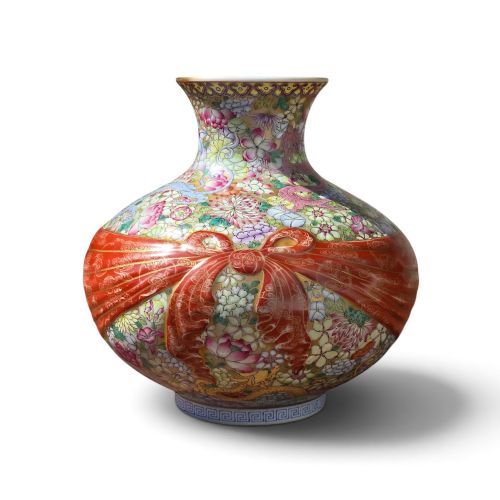
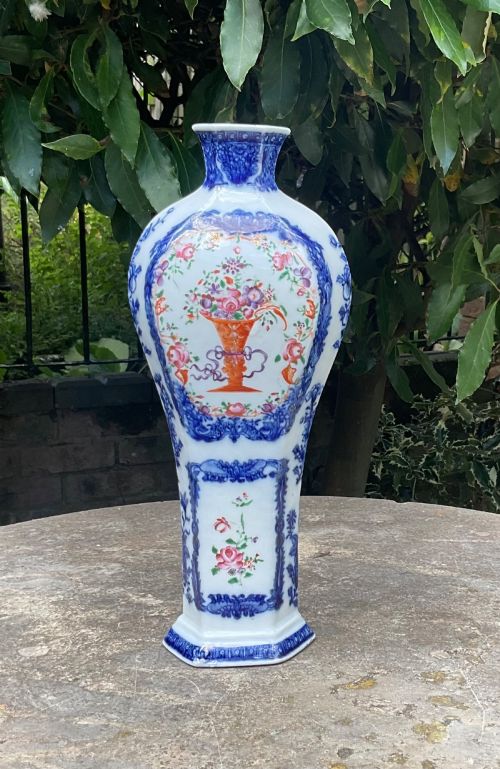
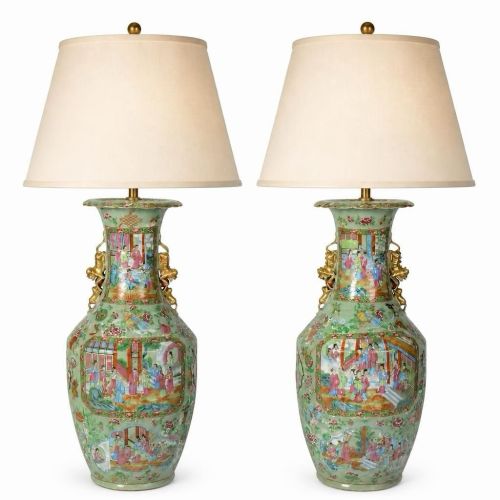
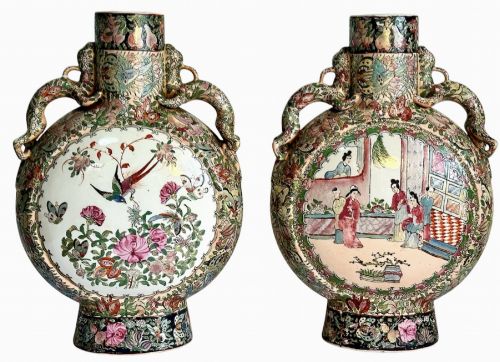
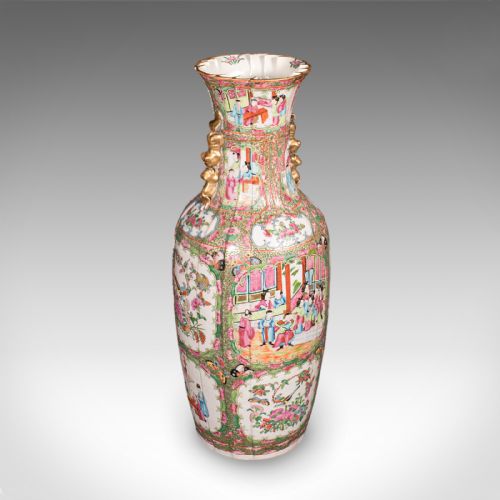
Oriental famille rose vases are ceramic vessels distinguished by an opaque pink enamel derived from gold, which forms the signature palette alongside greens, yellows and iron-reds. Buyers browsing this page encounter numerous pieces originating from the nineteenth century, including grand Cantonese floor vases, pairs adapted into table lamps, and moon flasks.
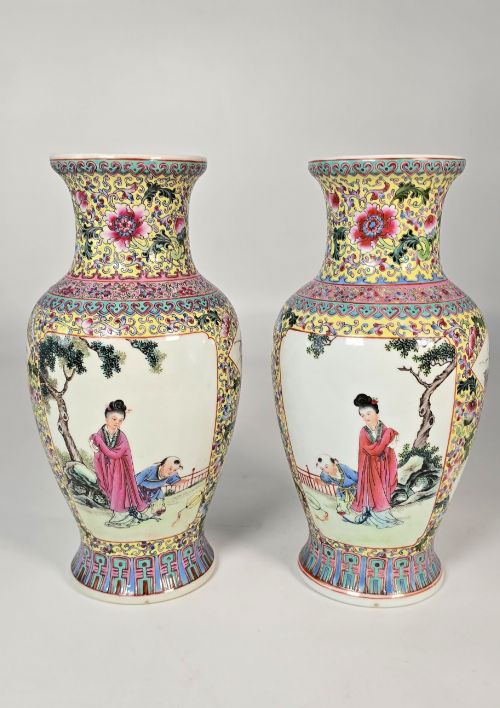
The selection spans various production eras, from Qing Dynasty workshops to the later Republican period. Many examples display narrative figural scenes, birds, flowers or formal panels, reflecting both domestic Chinese tastes and export markets.
Materials and construction
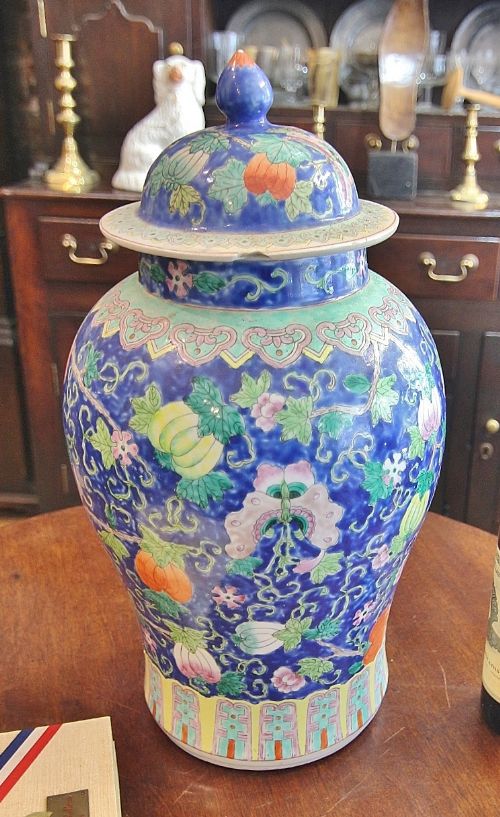
The foundation of these pieces is white porcelain shaped into baluster forms, jars, ginger jars or moon flasks. Artisans then applied hand-painted enamel colours directly onto the glazed surface before secondary firing.
Some later or European-market adaptations incorporate added brass and ormolu mounts, silk fabric shades, and wooden bases to transform the ceramic bodies into functional lighting.
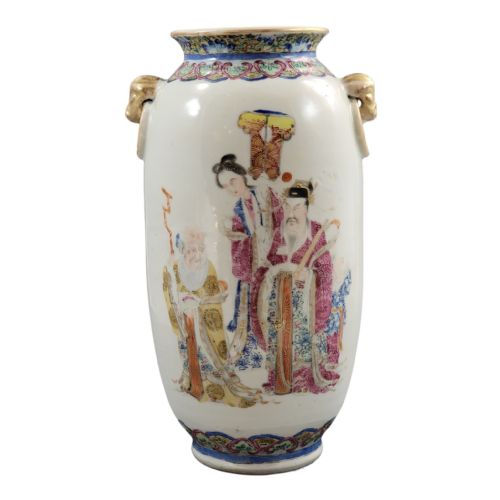
Immortal figures and dual dragons gaze across nineteenth-century enamel surfaces, watching the room from their porcelain perches.
Assessing quality
Quality rests upon the precision of the hand-painted brushwork and the complexity of the enamel composition. Superior examples exhibit intricate detailing in figural scenes and dense botanical motifs such as millefleurs.
The crispness of mark and period indicators, alongside the fineness of the porcelain body, distinguishes standard export wares from monumental floor vases and pieces bearing imperial or workshop signatures.
Gao Hengsheng·Samson Porcelain
The Oriental Famille Rose Vases Glossary
- Famille Rose
- A ceramic palette defined by the use of opaque pink enamel. This grouping emerged during the Qing Dynasty and dominated porcelain decoration.
- Canton
- A major production centre in southern China associated with heavily decorated export porcelain. Pieces often feature panels filled with figures and birds.
- Baluster
- A vase form with a rounded body that tapers toward the foot and flares at the neck. This shape provides a stable canvas for expansive enamel decoration.
- Moon Flask
- A flattened circular flask with a narrow neck and small loop handles. They frequently display symmetrical floral or symbolic designs on both sides.
- Ormolu
- Gilded bronze used for mounts on decorative objects and lamps. European makers often added these metal fittings to imported porcelain during the nineteenth century.
Oriental Famille Rose Vases: Frequently Asked Questions
What periods do these vases come from?
The pieces span the eighteenth, nineteenth and early twentieth centuries, covering the Qing Dynasty and the subsequent Republic period.
Nineteenth-century examples, particularly from the Cantonese export tradition, appear most frequently alongside later twentieth-century interpretations.
How do I identify a Qing Dynasty piece?
Qing Dynasty examples often feature imperial marks, specific reign periods like Daoguang or Guangxu, and traditional motifs such as scholars or immortals.
Stylistic markers include dense enamel work, hand-painted botanical panels, and the characteristic rose-pink ground typical of the era.
Why are some mounted as lamps?
Many nineteenth-century and later vases were converted into table lamps by adding brass, ormolu mounts, and electrical fittings.
This adaptation allowed period ceramics to function as domestic lighting while retaining their hand-painted porcelain bodies.
What is Rose Medallion?
Rose Medallion is a specific style of Cantonese export porcelain featuring alternating panels of figures, birds, and flowers.
These patterns are densely arranged around a central medallion, creating a vibrant multi-coloured visual effect across the surface.
Are these vases hand-painted?
The antique pieces utilise hand-painted enamel designs applied directly over the glazed porcelain body by skilled artisans.
Brushwork detail varies from simple floral sprays to intricate narrative scenes depicting historical figures or mythological immortals.