


Oriental Centre Table
An oriental centre table brings rich carving, exotic timbers and distinct regional craftsmanship directly to the middle of a room.
Oriental Centre Table
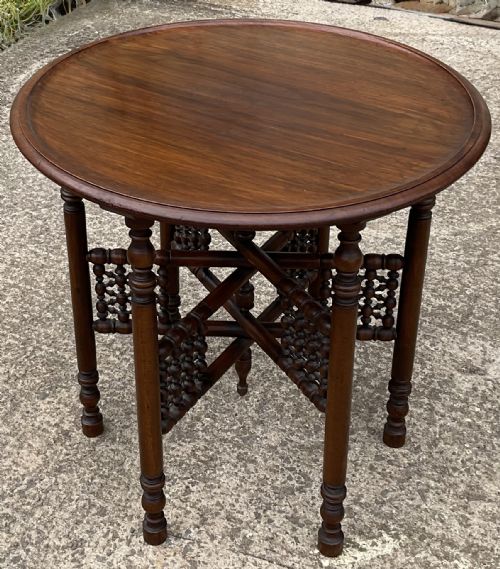
An oriental centre table serves as a striking freestanding focal point, designed to be viewed from all sides rather than pushed against a wall. The pieces found here span the nineteenth and early twentieth centuries, encompassing diverse regional aesthetics from Chinese Qing Dynasty workshops to Anglo-Indian and Anglo-Burmese traditions.
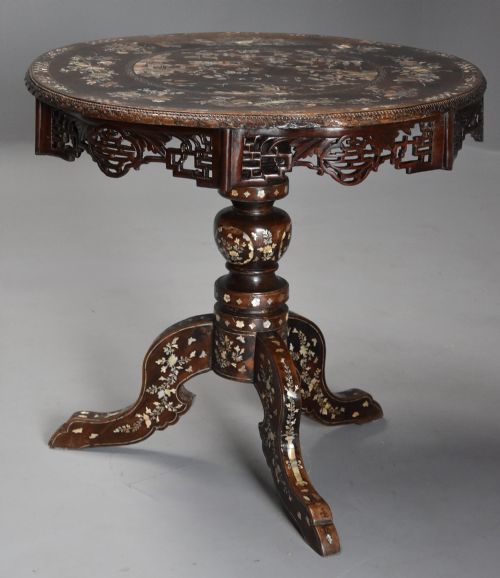
Most examples you will encounter take the form of heavy carved hardwood tables, often featuring circular or rectangular tops. Many incorporate inset panels of marble, lacquer, mother-of-pearl or cloisonné enamel, reflecting both traditional domestic uses and export markets of the period.
How they were made
Joinery relies on dense timbers such as rosewood, teak, and general hardwoods, selected for their ability to hold deep, intricate relief carving without splitting. Woodworkers utilised traditional framing methods to construct stable tables capable of supporting heavy stone inserts.
Surface decoration involves contrasting techniques, from hand-applied lacquer and gilt highlights to intricate mother-of-pearl inlay embedded directly into the timber. Inset tops utilise smooth slabs of rouge marble or detailed cloisonné enamel work, demonstrating high levels of specialised craft.
Certain tables feature hidden compartments or clever tilt mechanisms designed to surprise guests after dinner.
What varies in quality
The depth and crispness of the carving separate standard production from finer pieces, as skilled carvers achieved deep undercut relief with sharp detailing on dragons and foliage. The quality of the timber selection and the precision of the joinery also dictate how well the structure endures.
Inlaid elements reveal distinctions in craftsmanship, where tightly fitted mother-of-pearl or flawless marble and enamel panels indicate superior workshop standards. Finer tables maintain balanced proportions and harmonious integration between the decorative surface and the structural frame.
The Oriental Centre Table Glossary
- Hardwood
- Dense, durable timber derived from angiosperm trees, chosen for structural stability and fine carving capabilities. It forms the primary chassis for most oriental tables.
- Cloisonné
- An enamelwork technique where metal wire creates raised barriers on a surface, filled with coloured paste and fired. This appears as decorative panels on specific tables.
- Tilt Top
- A table mechanism allowing the top to hinge vertically for storage or convenience when not in use. This practical design is common in nineteenth-century examples.
- Japanned
- European imitation of East Asian lacquerwork, using layered varnishes and metallic powders to achieve a dark, glossy finish. Pieces exhibiting this style reflect cross-cultural design exchange.
Oriental Centre Table: Frequently Asked Questions
Where should I place a centre table?
These tables work best positioned centrally in a large room, hallway or library where their detailed carving can be appreciated from every angle.
Because they are designed as freestanding pieces, ensure there is adequate walking space around the perimeter to showcase the form properly.
How do I clean marble top tables?
Wipe the stone surface gently with a soft, damp cloth and mild, neutral soap, avoiding harsh chemical cleaners that can etch the polish.
Dry the marble thoroughly afterwards to prevent water spots and protect the surrounding hardwood frame from moisture damage.
Are tilt top tables stable?
Tilt top tables rely on a sturdy pedestal base and a secure locking catch to keep the surface firm during everyday use.
When locked flat, they function identically to fixed tables, though the release mechanism requires careful handling when pivoting the top.
How do I identify a Qing Dynasty piece?
Qing Dynasty tables typically exhibit deep, formal hardwood carving, often featuring traditional motifs like dragons, geometric borders or prunus blossoms.
Construction methods usually adhere to traditional joinery without modern metal fasteners, pointing to nineteenth-century workshop origins.