
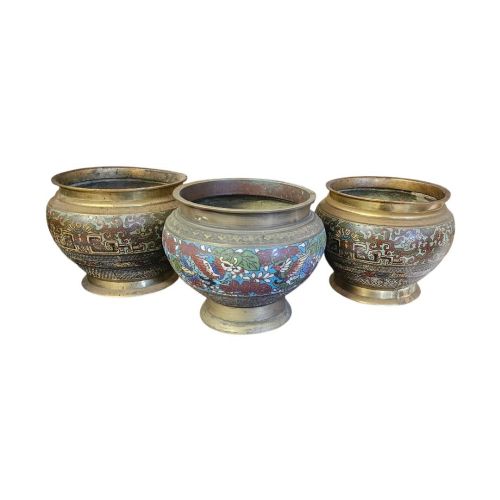
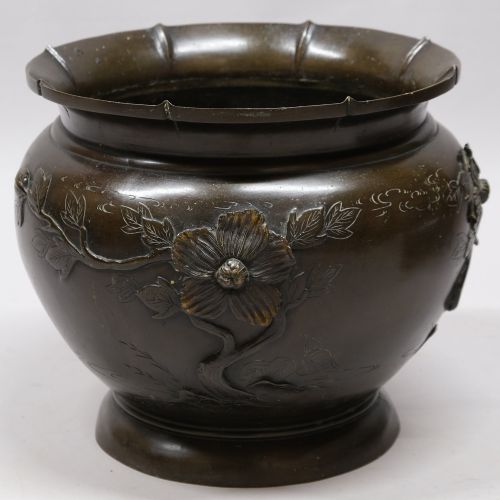


Oriental Bronze Cachepot
An oriental bronze cachepot brings heft and intricate design to a room, holding plants or standing alone as a substantial decorative bowl.
Oriental Bronze Cachepot
When you search for an oriental bronze cachepot, you encounter heavy vessel forms catalogued variously as jardinières, planters, and decorative bowls. These pieces emerge predominantly from nineteenth-century Japanese and Chinese workshops, spanning periods from the Edo and Meiji eras through the late Qing dynasty.
You are most likely to meet pieces cast in heavy bronze or brass, often finished with detailed surface work such as champlevé or cloisonné enamel. Their primary historical function was to house potted plants or serve as grand decorative bowls within domestic interiors.
Materials and Technique
The foundation of these vessels relies on metal casting, principally utilising bronze and occasionally brass to achieve sturdy, weighty walls. Artisans then applied decorative treatments directly onto the metal surface.
Enamel work appears frequently, utilising cloisonné and champlevé techniques where vitreous pastes fill wire compartments or carved recesses before firing. Gilt bronze accents also supplement the raw metal surfaces to enhance depth and contrast.
Several pieces are heavy enough to double as doorstops, though their enamel work suggests a gentler indoor life.
Qualities of Construction
Mass and wall thickness separate substantial vessels from lighter productions, with heavier pieces demonstrating greater structural ambition in the casting process. The precision of the bronze work and the crispness of any applied surface detail indicate the maker's level of skill.
The execution of enamel decoration dictates the upper tier of the range, where smooth, flush fillings and complex geometric or floral motifs require considerable technical mastery. Finer examples display harmonious integration between the cast metal body and the ornamental surface schemes.
The Oriental Bronze Cachepot Glossary
- Cachepot
- An ornamental container used to hold a flowerpot and conceal its utilitarian appearance. These vessels are frequently water-tight or designed with solid bases.
- Jardinière
- A large ornamental pot or stand for plants, often used interchangeably with planter in nineteenth-century contexts. They form the majority of the vessel types found in this category.
- Cloisonné
- An enamelling technique where thin metal wires are soldered to a metal base to create compartments for coloured paste. The piece is subsequently fired and polished to a smooth finish.
- Champlevé
- A method of enamelling where troughs or cells are carved directly into the thick bronze surface to hold the vitreous enamel. This technique results in robust, defined linear patterns.
- Meiji Period
- The era of Japanese history lasting from 1868 to 1912, characterised by extensive artistic production for export. Many bronze planters on this page originate from these decades.
Oriental Bronze Cachepot: Frequently Asked Questions
What is an oriental bronze cachepot used for?
These vessels were historically designed to hold potted plants, serving as decorative outer containers for interior greenery.
Today, they function equally well as standalone decorative bowls or desk pots within a room.
How do I identify a Meiji period cachepot?
Meiji period vessels typically date from the late nineteenth or early twentieth century and originate from Japanese workshops.
They frequently exhibit characteristic bronze casting methods alongside traditional decorative motifs specific to that era.
What is the difference between cloisonné and champlevé?
Cloisonné involves soldering thin metal wires onto the surface to form cells that hold the enamel paste.
Champlevé relies on carving or sinking the design directly into the thick bronze body to create the compartments for the enamel.
How do I care for a bronze cachepot?
Dust the surface regularly with a soft, dry cloth to prevent the accumulation of particles in the recessed details.
Avoid using harsh chemical polishes that can strip away patination or damage delicate enamel work.