
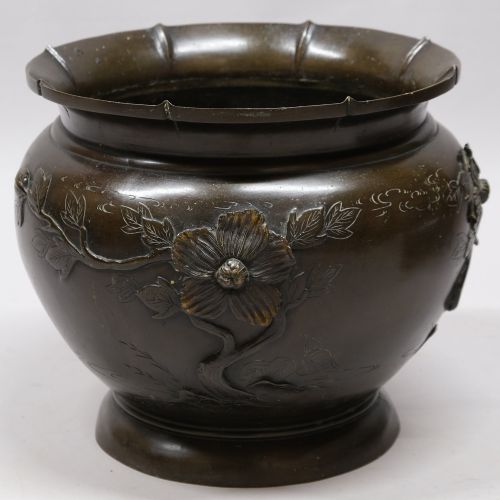


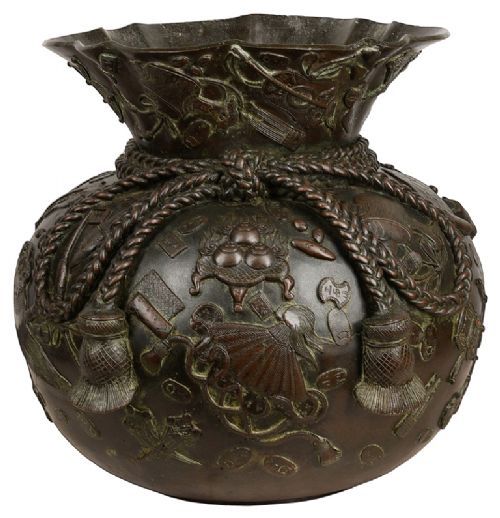
Carved Bronze Jardiniere
These carved bronze jardiniere vessels bring weight and intricate detail into a room, offering a distinct focal point for interior planting.
Carved Bronze Jardiniere
A carved bronze jardiniere serves as a substantial decorative vessel designed to hold plants and floral arrangements. The examples found here span the nineteenth century, including Georgian and Victorian periods, alongside specific Eastern Asian periods.
The forms encompass Japanese Meiji and Edo periods as well as Chinese Qing Dynasty origins. Buyers will encounter both compact desk pots and large decorative planters intended for prominent placement.
How they were made
These items rely primarily on cast bronze, occasionally accompanied by brass variants. The construction involves traditional metalworking techniques that allow for elaborate surface decoration and robust vessel walls.
The exterior surfaces feature detailed carving and relief work characteristic of Oriental and Victorian craftsmanship. This combination of heavy metal casting and manual surface ornamentation ensures long-lasting structural integrity.
Several pieces double efficiently as heavy desk pots, proving that nineteenth-century administrators took their desk foliage very seriously.
What varies in quality
Quality rests upon the crispness of the cast ornamentation and the overall weight of the bronze vessel. Superior examples display deep, sharp relief carving and balanced proportions without weakness in the metal wall.
Origin and period execution also influence the standing of a piece. Finely rendered Meiji or Qing Dynasty work typically exhibits greater artistic depth than standard decorative production.
The Carved Bronze Jardiniere Glossary
- Jardiniere
- A decorative pot or stand for holding plants or flowers. These vessels sit upon tables or floors depending on their scale.
- Meiji Period
- A phase in Japanese history lasting from eighteen sixty-eight to nineteen twelve. Pieces from this era often showcase exceptional metallurgical skill.
- Qing Dynasty
- The final imperial dynasty of China, spanning from sixteen forty-four to nineteen twelve. Items attributed to this time display distinct traditional motifs.
- Edo Period
- The period of Japanese history running from sixteen oh three to eighteen sixty-seven. Metalwork from this time emphasises refined decorative arts.
Carved Bronze Jardiniere: Frequently Asked Questions
What is a bronze jardiniere used for?
These heavy metal vessels function primarily as ornamental planters for indoor greenery and floral displays.
They also serve as standalone decorative objects on desks, tables, or pedestals within period interiors.
How do I care for antique bronze?
Bronze requires minimal intervention beyond gentle dusting with a soft, dry cloth to preserve its finish.
Avoid using harsh chemical polishes that can strip away desirable historical patinas developed over the centuries.
How do I identify a Meiji period piece?
Meiji period items often feature intricate Japanese iconography and high-relief casting techniques typical of late nineteenth-century metalwork.
These pieces frequently align with the broader Victorian era in Europe due to international trade and artistic exchange.
Are these vessels waterproof?
Most antique metal planters were made to hold potted plants rather than direct soil and water.
Using a hidden inner liner protects the interior bronze surface from moisture damage and mineral accumulation over time.