
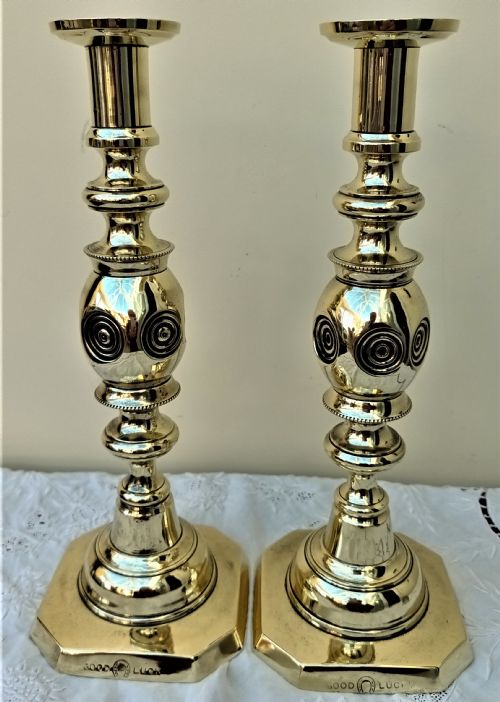
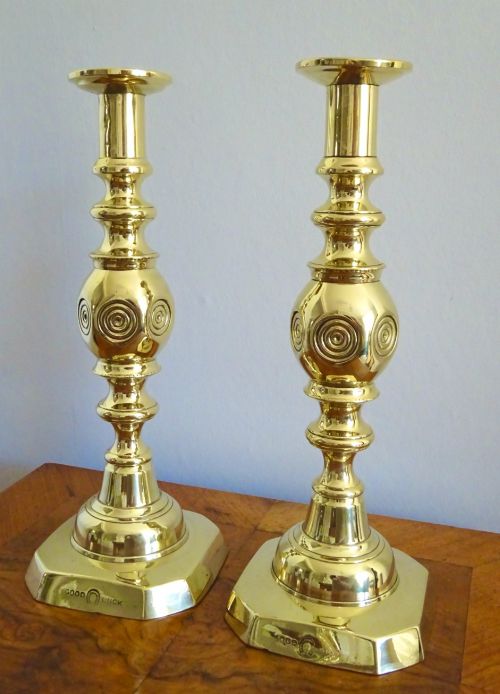


Octagonal Base Brass Candlesticks
Octagonal base brass candlesticks provide sturdy, geometric illumination across Georgian and Victorian interiors.
Octagonal Base Brass Candlesticks
Octagonal base brass candlesticks combine geometric footing with durable metal construction, appearing frequently across 18th century, Georgian, and Victorian periods. Buyers seeking these items will encounter pairs fashioned with distinct column styles, ranging from teardrop designs to the characteristic king of diamonds motif.
The inventory on this page spans early 18th century examples through to late Victorian production, reflecting shifting domestic lighting requirements over two hundred years. Georgian pieces often display simpler, heavier proportions, whereas Victorian counterparts introduce decorative variations like good luck symbolism.
Manufacturing and Materials
These pieces are constructed entirely from brass and cast brass, utilising traditional metal founding techniques suited to creating multi-faceted bases and upright columns. The casting process allows for sharp angles on the octagonal footings and distinct profiles along the stems.
Artisans formed components separately before joining them, resulting in solid constructions designed to support tall wax candles safely on domestic tables and mantelpieces.
Some Victorian examples carry good luck motifs, ensuring your dining table gains both illumination and supernatural endorsement.
Assessing Quality
Quality in these items is determined by the crispness of the casting around the eight-sided base and the proportional harmony between the foot, stem, and drip pan. Superior examples retain sharp geometric edges and substantial weight, showing little softening of detail from wear or polishing.
The presence of specific column variations, such as teardrop formations or king of diamonds patterns, distinguishes standard utility lighting from more ambitious decorative work produced by period workshops.
The Octagonal Base Brass Candlesticks Glossary
- Octagonal base
- A foot piece shaped with eight distinct sides, providing both stability and a clean geometric profile to the candlestick.
- Cast brass
- An alloy of copper and zinc poured into a mould to form solid, durable components of period lighting.
- King of diamonds
- A specific decorative motif or facet pattern found on the stems of certain Victorian candlesticks.
- Teardrop column
- A stem design featuring bulbous, drop-shaped elements integrated into the upright shaft of the candlestick.
- Georgian
- The period spanning the reigns of the four Georges, noted in these listings for robust proportions and functional elegance.
Octagonal Base Brass Candlesticks: Frequently Asked Questions
What periods do these candlesticks come from?
The pieces span the 18th and 19th centuries, taking in Georgian and Victorian eras.
Dates range from early 18th century examples up to late Victorian production around the turn of the twentieth century.
How were octagonal bases used?
They served as stable platforms for holding wax candles to illuminate rooms before electric lighting.
Their eight-sided shape offered a wider footprint to prevent tipping on tables and sideboards.
Are they sold as pairs?
Many listings consist of matched pairs designed for symmetrical placement on mantelpieces or dining tables.
Individual sticks also appear occasionally from earlier Georgian and 18th century periods.
What styles of columns exist?
Columns vary from plain upright shafts to decorative forms including teardrop shapes and king of diamonds motifs.
Earlier pieces tend towards simpler architectural lines while Victorian versions introduce more ornate detailing.