


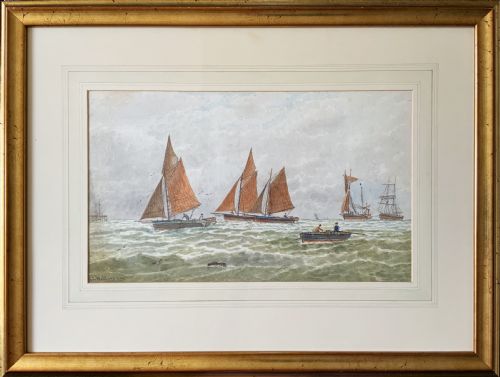
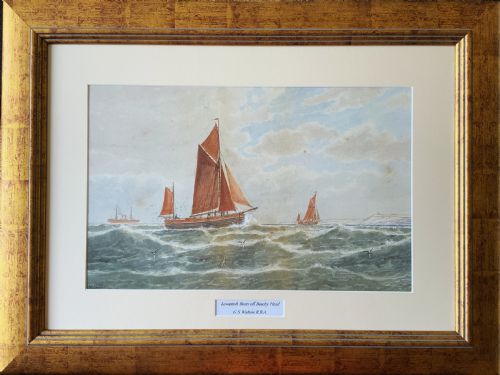
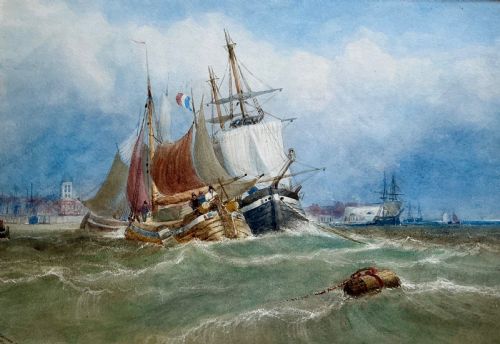
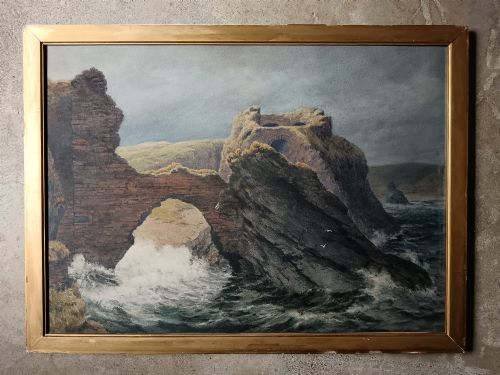


Ocean Marine Watercolour
When you search for ocean marine watercolour, you are looking at original maritime paintings on paper depicting coastal scenes, harbours and ships.
Ocean Marine Watercolour
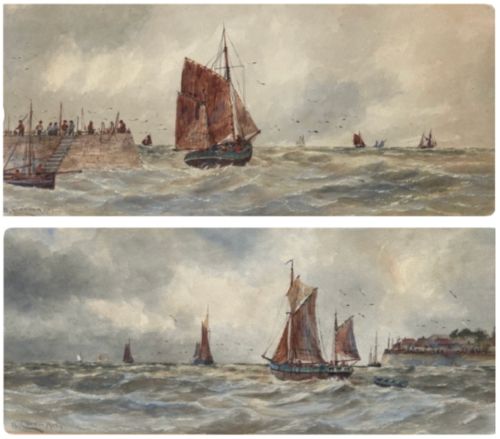
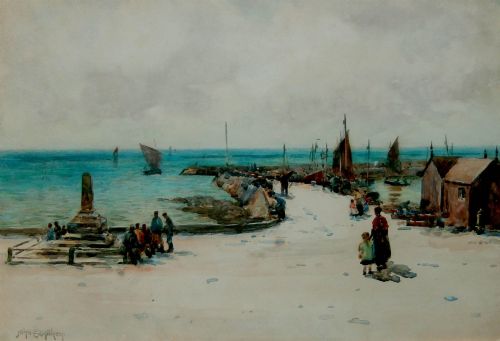
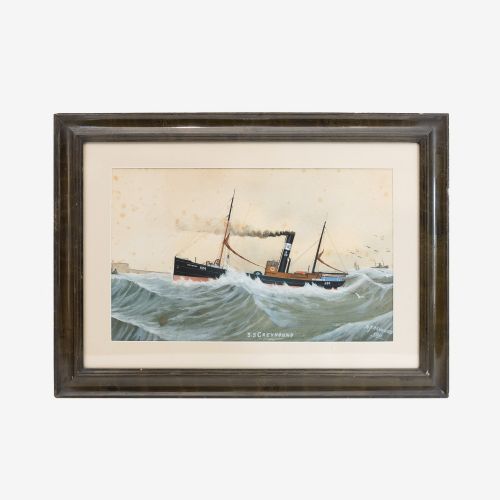
The ocean marine watercolour selection on this page centres primarily on nineteenth-century and early twentieth-century works, spanning the Victorian and Edwardian periods up to mid-century examples. These pieces typically depict fishing boats, coastal harbours, lighthouses and tall-masted ships across British and European waters.
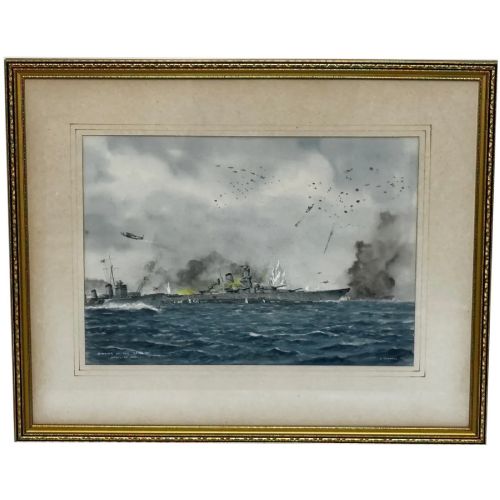
Buyers will encounter framed artworks ranging from intimate depictions of Cornish fishing communities to dramatic scenes of vessels in choppy seas. The forms include finished exhibition paintings as well as atmospheric coastal sketches signed by notable maritime artists.
Materials and Technique
These works are executed using watercolour pigment applied to paper, occasionally combined with gouache to build opacity in highlights such as breaking waves and cresting foam. Supports are typically housed behind glass within wooden frames, sometimes accented with gold leaf or gilt wood mouldings.
Artists utilised the translucent qualities of watercolour to capture shifting light on the sea, employing fine brushwork for rigging and washes for expansive skies and water.
Some Victorian artists braved gale-force North Sea winds armed with little more than paper, watercolours, and a stubborn umbrella.
Evaluating Quality
Quality in these maritime works rests upon the artist's command of light, atmospheric perspective and anatomical accuracy of the vessels depicted. Superior examples demonstrate a confident handling of water movement and meteorological conditions rather than merely mechanical precision.
The strength of composition, preservation of the paper support, and the vibrancy of the remaining pigment relative to the period of creation further separate exceptional marine paintings from standard topographical records.
William Cannon·Charles Edward Dixon·John E. Aitken·Eric Tufnell·William Banks Fortescue·Alexander Harwood·George Stanfield Walters·Henry Barlow Carter·John Moxon·Charles William Adderton·Thomas Bush Hardy·Frank H. Mason·Samuel Owen·Kate E Booth·Frederick Stuart Richardson·Percy Brooke·John McDougal·Frank Wood·Joseph Newington Carter·William Boyce·S. J. Lamorna Birch·Samuel Edward Kelly·Edmund Gouldsmith·J Syer
The Ocean Marine Watercolour Glossary
- Watercolour
- A painting method in which the paints are made of pigments suspended in a water-based solution. It is traditionally applied to paper supports to achieve translucent washes of colour.
- Gouache
- An opaque water-based paint often used alongside watercolour to create dense highlights and solid areas of colour. It allows artists to add sharp details to crashing waves and ship hulls.
- Barque
- A sailing rig with three or more masts having the fore-and-aft sails only on the mizzenmast. This vessel type frequently appears in late nineteenth and early twentieth-century marine art.
- Seascape
- A work of art depicting the sea, coastal views, or maritime activities. It forms the primary subject matter for the paintings found within this category.
Ocean Marine Watercolour: Frequently Asked Questions
What periods do these watercolours date from?
The selection spans from the late nineteenth century through the Edwardian era and into the mid-twentieth century. Most examples cluster around the Victorian period and the early nineteen-hundreds.
Artists during these decades documented the final commercial eras of sail and the transition to steam power along British and European coasts.
How should I frame and display them?
Watercolours require careful conservation framing behind glass with acid-free mounts to prevent paper degradation from environmental humidity. Direct sunlight must be avoided to protect the pigments from fading over time.
Displaying them in stable indoor conditions ensures the paper support and original wooden frames remain well preserved.
How do I identify different maritime vessel types?
Ships are identified by their rigging and mast configurations, such as four-masted barques or two-masted fishing smacks. Artists often recorded specific vessel classes and commercial lines operating during the nineteenth and twentieth centuries.
Consulting shipping records alongside the signatures and titles can reveal the exact identity of the vessels portrayed.
Are these works original paintings?
Every piece listed is an original watercolour painting executed by hand on paper rather than a modern reproduction or print. Many bear the original artist signature, date, or inscription naming the specific coastal location.
Hand-applied brushwork and pigment texture distinguish these unique works from mass-produced imagery.