



Oak Mirror Back Dresser
An oak mirror back dresser brings profound depth to a dining room, combining heavy timber storage with a reflecting glass top that lifts the entire space.
Oak Mirror Back Dresser
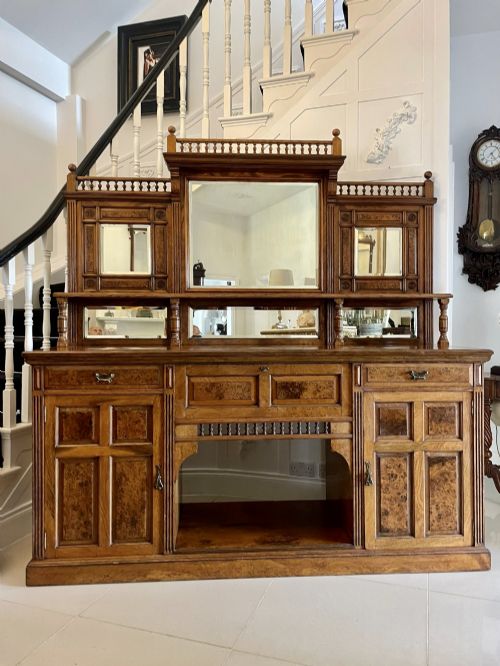
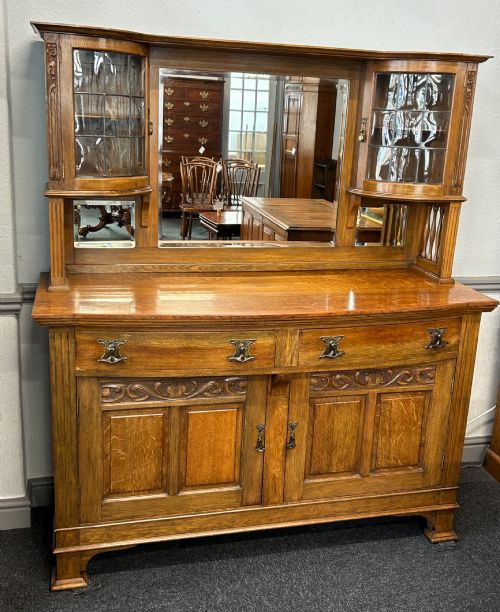
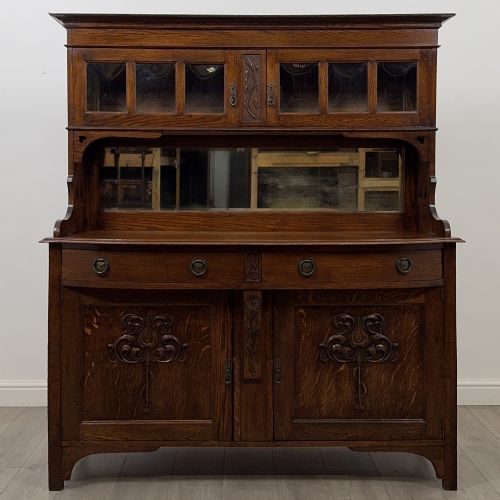
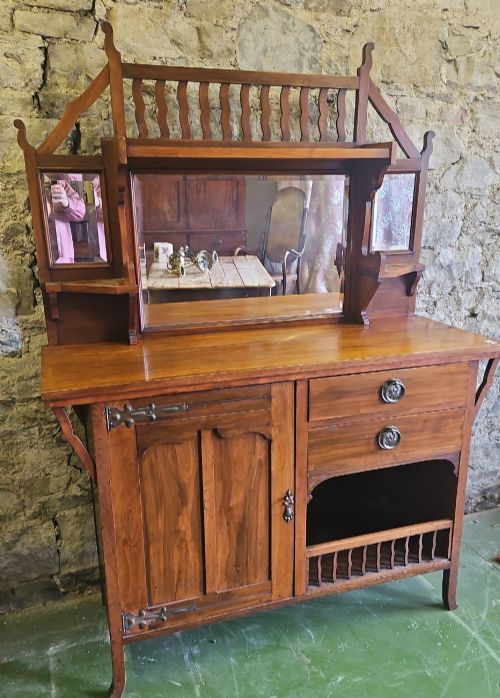
An oak mirror back dresser serves as both a grand serving station and a display piece, uniting a substantial lower cabinet with an upper section incorporating a plate rack or shelving framed around a large mirror. These pieces emerge predominantly from the Victorian and Edwardian eras, spanning from the mid nineteenth century through to the early decades of the twentieth century.
The heavy timber presence defines the form, most frequently rendered in solid oak or figured pollard oak, often accented with brass hardware and bevelled mirror glass. While some examples lean towards the restrained linearity of the Arts and Crafts movement or Art Nouveau, others display exuberant Gothic Revival or Renaissance Revival carving.
Buyers frequently encounter variations that blend sideboard and buffet proportions with tall, architectural mirror frames. The regional British workshops and larger cabinet makers of the period utilised these configurations to anchor dining rooms with functional display space.
Construction and Materials
Cabinet makers relied heavily on solid oak for the structural carcass and drawer linings, frequently selecting pollard oak veneers or burls for the principal display surfaces to create swirling, mottled grain patterns. Iron and brass drop handles, strap hinges, and key escutcheons provided functional contrast to the dark or golden timber.
The integration of the mirror required robust framing to support heavy bevelled glass, which was often secured behind panelled mouldings or flanked by carved pilasters and small display shelves. Carving was executed entirely by hand, utilising deep relief techniques for motifs such as the Green Man or stylized flora characteristic of the Arts and Crafts aesthetic.
Listings feature oak mirror back dressers and sideboards spanning from the 1860s through to the 1930s, encompassing Victorian, Edwardian, and Arts and Crafts aesthetics.
Judging Quality and Execution
The distinction between ordinary production and superior craftsmanship rests in the selection of the timber and the depth of the carving. Exemplary pieces display tightly figured pollard oak and crisp, undercut manual carving rather than shallow, machine-routed decoration.
Structural integrity of the mirror frame and the weight of the base reveal the maker's intent. Superior examples maintain original bevelled mirror glass and heavy brass mounts that have aged uniformly alongside the timber.
T Simpson and Son
The Oak Mirror Back Dresser Glossary
- Pollard oak
- Timber taken from trees that have been pollarded, producing highly figured, gnarled grain patterns prized for veneers. Cabinet makers utilised these sections on drawer fronts and doors to create dramatic visual movement.
- Green Man
- A sculptural architectural ornament depicting a human face disgorged from foliage. This motif appears frequently in the carved woodwork of nineteenth century revival sideboards and dressers.
- Bevelled mirror
- Glass featuring an edge that has been ground and polished to an angled slope. This traditional technique catches the light and adds a decorative border to the reflecting surface.
- Arts and Crafts
- A design movement emphasising handcraftsmanship, simple forms, and traditional guild methods. Pieces in this style eschew heavy historical revivalism in favour of structural honesty.
Oak Mirror Back Dresser: Frequently Asked Questions
Where should I place an oak mirror back dresser?
These substantial pieces demand a wall with sufficient width and weight to anchor their proportions, making the dining room or a spacious hallway the traditional setting. The integrated mirror naturally reflects natural light from opposing windows, brightening darker corners.
Ensure the floor is level to support the heavy timber base and prevent the tall mirror frame from putting uneven strain on the joints. Positioning the piece away from direct heat sources protects the antique oak and original polishes from drying out.
How do I care for the oak and mirror glass?
Maintenance requires simple dusting with a soft, dry cloth and occasional application of traditional beeswax to nourish the timber grain. Avoid modern silicone sprays that build up and dull the antique finish over time.
The mirror glass should be cleaned using a minimal amount of glass cleaner applied directly to the cloth rather than the glass, preventing moisture from seeping behind the antique silvering at the edges.
How do I date an oak mirror back dresser?
Dating relies on observing stylistic markers, construction methods, and hardware choices across the piece. Victorian examples often feature dark finishes and heavy Gothic or Renaissance carvings, while Edwardian and later pieces tend towards lighter golden oak and cleaner Arts and Crafts lines.
Examining the drawer construction, screw types, and the method used to bevel the mirror glass provides further chronological clues. Machine-sawn timber and plate glass point firmly towards the later nineteenth and early twentieth centuries.
What is pollard oak?
Pollard oak comes from trees that were cut back close to the trunk to promote a dense growth of branches, resulting in timber with tightly swirled, mottled grain. Craftsmen valued this wood for its decorative properties, using it as veneer on prominent surfaces like cabinet doors.
Because of its distinct appearance, pollard oak surfaces catch the eye immediately and denote a higher grade of cabinet making.