


Oak Cased Barometer
When you seek an oak cased barometer, you find reliable weather instruments housed in durable timber cabinets made to record atmospheric pressure.
Oak Cased Barometer
An oak cased barometer is a domestic or scientific instrument designed to measure atmospheric pressure for weather prediction, housed within a timber enclosure. These instruments appear frequently in Victorian, Edwardian, and early twentieth-century formats, ranging from simple wall-hanging banjo designs to complex recording barographs with multiple glass panels.
Buyers encountering this phrase often meet banjo barometers, aneroid variants, and recording barographs featuring brass fittings and paper charts. The selection includes domestic stick barometers alongside specialised weather stations and shop display pieces originating from British makers.
Materials and Construction
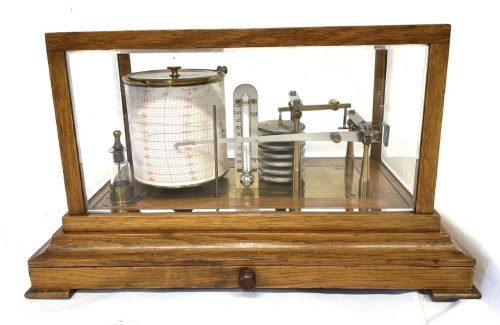
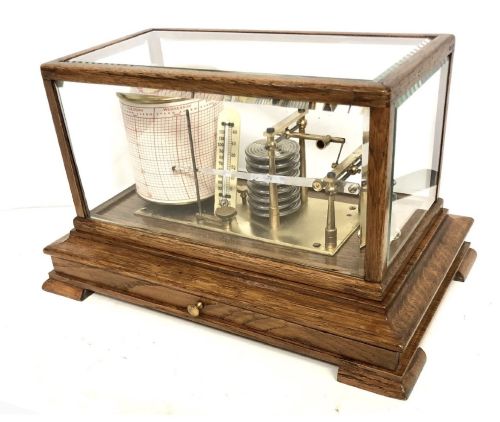
Makers utilised solid and turned oak for the protective housings, frequently incorporating bevelled glass panels to showcase the internal mechanisms and paper recording charts. Brass components provide structural support and bezel framing for the dials, while steel and paper complete the recording movements of the barographs.
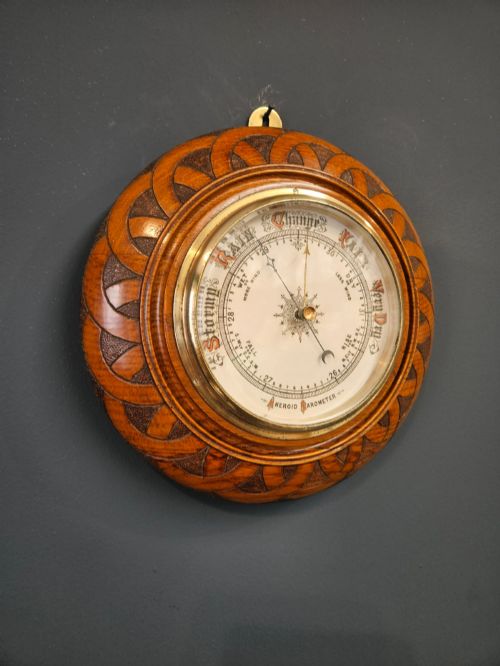
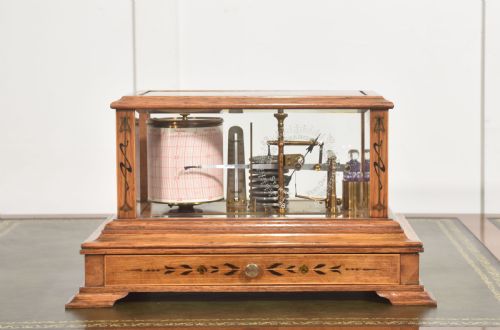
Cabinetmakers applied carving, geometric designs, and Art Nouveau inlay to the timber surfaces, alongside rope twist motifs and acorn carvings. Instrument makers fitted paper scales, steel needles, and mercury or aneroid capsules to translate atmospheric changes into legible readings.
Some weather stations doubled as snooker awards.
Factors of Quality
Quality rests upon the precision of the scientific movement inside and the crispness of the cabinetwork on the outside. Pieces bearing signatures from established scientific instrument makers demonstrate superior mechanical execution compared to unmarked domestic items.
Finer examples display intricate timber carving, sound joinery, and well-preserved paper charts or enamelled dials, while simpler versions rely on plain turned oak bezels and standard domestic scales.
Hezzanith·Short & Mason·Negretti & Zambra·Jules Richard·Dobbie son and Hutton·Mappin & Webb·R & J Beck·Dollond of London·Ross London·CW Dixey London·Louis Casella London·Henry Hughes·J Hicks of London·Aitchison
The Oak Cased Barometer Glossary
- Barograph
- A self-recording aneroid barometer that plots atmospheric pressure onto a rotating paper chart driven by a clockwork mechanism. These units sit inside multi-glass oak cases.
- Aneroid
- A type of barometer that measures pressure utilising a flexible metal box without liquid. This mechanism expands and contracts as the weather shifts.
- Banjo Barometer
- A wall-mounted instrument shaped like a banjo, featuring a circular dial at the base and a thermometer or hygrometer along the vertical stem.
- Stick Barometer
- A tall, vertical barometer containing a glass tube filled with mercury, mounted directly onto a wooden backboard.
- Bevelled Glass
- Glass panes with angled edges set into the brass frames of barograph cases to enhance the visual display of the interior dials.
Oak Cased Barometer: Frequently Asked Questions
What is a barograph?
A barograph is a mechanical weather instrument that records continuous changes in atmospheric pressure onto a revolving paper chart. It combines a barometer mechanism with a clockwork drum.
These devices sit inside protective wooden enclosures with glass panels so the inked arm remains visible while recording weekly weather patterns.
How do aneroid and mercury barometers differ?
Aneroid barometers utilise a sealed metal vacuum capsule that flexes with air pressure changes to move a dial pointer. They contain no liquid.
Mercury barometers rely on a column of liquid metal balancing against atmospheric pressure within a vertical glass tube mounted on the timber backboard.
Where were these instruments placed?
Victorian and Edwardian households placed these instruments in hallways, libraries, or studies where family members could check daily weather trends before travelling. Large examples also stood in marine offices and shop displays.
Wall-hanging versions required secure mounting near eye level to allow easy reading of the circular dials and thermometer scales.
How do I date an oak barometer?
Dating relies on stylistic clues in the timber case, such as heavy Victorian carvings, Edwardian geometric inlays, or later Art Nouveau motifs. Maker signatures and patent dates marked on the metal dials or paper charts provide further chronological evidence.
Changes in glass bevelling and the complexity of the internal barometer movement also help narrow down the decade of manufacture.