


Oak Barograph Instrument
An oak barograph instrument records atmospheric pressure onto paper charts, offering a tangible link to historical meteorology.
Oak Barograph Instrument
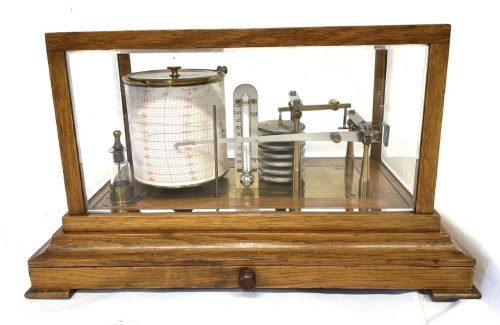
An oak barograph instrument represents a specialised class of weather-recording apparatus housed in wooden cabinetry, spanning Victorian, Edwardian, and twentieth-century periods. These mechanical devices track barometric pressure continuously, often incorporating a thermometer alongside the main recording drum.
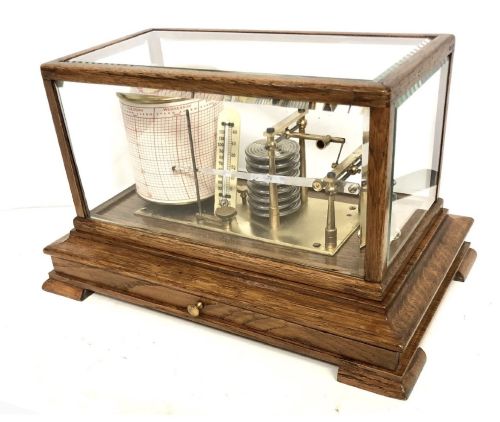
Most examples encountered here feature five glass panels set into oak frames to protect the sensitive brass and steel mechanism within. Such instruments frequently include a lower chart drawer designed to store spare recording papers and spare ink bottles.
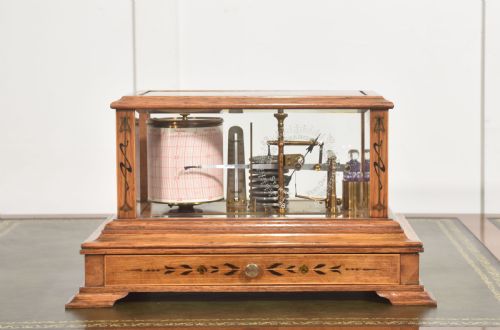
Originating largely from British makers across the nineteenth and twentieth centuries, these scientific instruments combine practical utility with cabinetry styles ranging from plain Edwardian oak to pieces with Art Nouveau inlay.
How they were made
The construction relies on seasoned oak for the exterior housing, shaped into glazed five-glass cases that allow continuous observation of the movement. Bevelled glass appears frequently in the better-finished cabinets, secured neatly within timber rebates.
Inside the case, the mechanism employs brass and steel linkages connected to stacked aneroid vacuum diaphragms that respond to barometric fluctuations. A delicate arm carries an ink nib across a rotating paper chart secured to a clockwork-driven drum.
What varies in quality
Quality differences emerge in the precision of the clockwork drum movement and the robustness of the brass linkages driving the recording arm. Finer examples display crisper finishing on the metal components and superior cabinet joinery.
The choice of exterior timber and decorative additions, such as subtle Art Nouveau inlay or integrated barometer dials by notable makers, distinguishes standard utility weather stations from finer meteorological pieces.
Hezzanith·Short & Mason·Negretti & Zambra·Baines Harrogate·Jules Richard·Dobbie Son And Hutton
The Oak Barograph Instrument Glossary
- Barograph
- A self-recording barometer that traces atmospheric pressure onto a rotating paper chart over a week. This mechanical apparatus translates barometric shifts into a visible ink line.
- Aneroid
- Containing no liquid, operating instead through flexible metal vacuum chambers that expand or contract with air pressure. These diaphragms power the internal linkages of the instrument.
- Bevelled glass
- Glass panes finished with an angled, polished edge around the perimeter. This treatment adds a decorative touch to the viewing windows of the wooden case.
- Chart drawer
- A small storage compartment built beneath the main recording mechanism. It provides a convenient place to keep replacement recording papers and accessories.
Oak Barograph Instrument: Frequently Asked Questions
How does a barograph work?
A stack of metallic vacuum chambers expands and contracts as atmospheric pressure rises and falls outdoors. These subtle movements transfer through brass levers to an arm holding an inked nib.
The nib rests against a paper chart wrapped around a clockwork drum that rotates once a week. This continuous mechanical tracing creates a historical graph of local weather patterns.
Where should I place a barograph?
Keep the instrument on a stable, level surface away from direct sunlight, radiators, and draughty open windows. Sudden temperature changes can affect the internal mechanical response.
Positioning it in a principal room allows you to observe the rotating drum and monitor daily weather trends comfortably.
Can I still buy charts for them?
Replacement paper charts designed for weekly mechanical recording drums remain available through specialist suppliers and meteorological enthusiasts. These papers must match the specific drum circumference and calibration scale.
Using correct replacement charts ensures the historical recording arm aligns accurately with standard pressure graduations.