




Desk Barometer in Case
These desk barometer in case examples are precision weather instruments housed in timber or brass, prized by collectors for their blend of Victorian utility and mechanical beauty.
Desk Barometer in Case
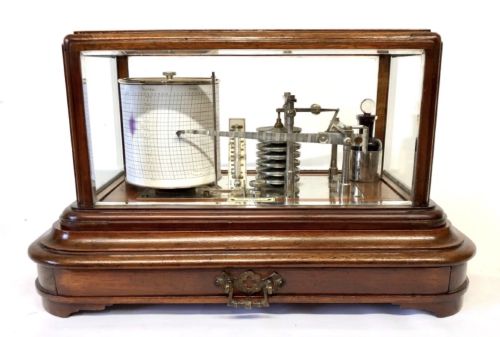
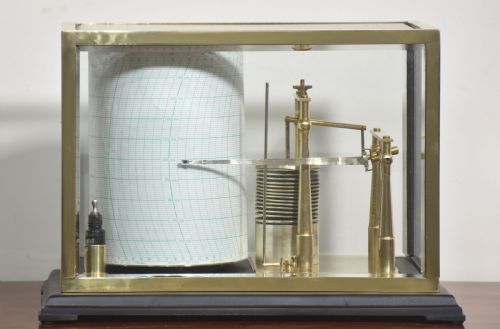
When you search for a desk barometer in case, you are looking at scientific instruments designed to measure atmospheric pressure from a desktop or table. These pieces combine functional weather recording with cabinetry, ranging from simple brass housings to elaborate weather stations.
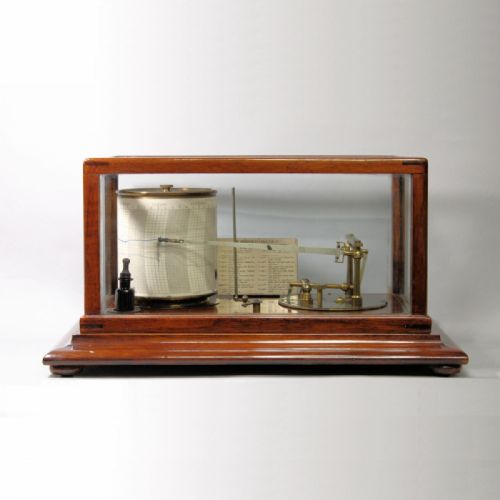
The versions most likely to meet you on this page are mahogany, oak, and walnut cased barographs and aneroid barometers. They date primarily from the nineteenth century through the Edwardian period, often featuring multiple glass panels to display the internal mechanics.
Makers housed these instruments in timber boxes complete with recording drums, ink arms, and occasionally thermometers or clock faces. Some examples incorporate fitted drawers for spare charts, reflecting their practical use in homes and offices of the period.
How They Were Made
Cabinetmakers constructed the cases using dense timbers like mahogany, oak, walnut, and burr walnut, sometimes adding brass mounts or inlay. These woods were chosen for stability and finished to display the grain beneath glass panels.
Instrument makers integrated brass, steel, and glass components to form the barometer movements and recording mechanisms. Paper charts printed with grid lines were mounted on rotating drums driven by clockwork movements.
Some models included a small drawer specifically to store spare ink bottles and spare paper charts for the recording drum.
What Varies in Quality
The distinction between standard and superior pieces rests on the quality of the timber housing and the reputation of the maker. Master opticians and instrument makers produced movements with finer adjustments and more robust brass components.
Cabinet work separates the basic production from the exceptional, visible in five-glass mahogany cases, carved oak details, and inlaid woodwork. Signed dials and engraved maker plates elevate the standing of an instrument.
GAUPP & CO HONGKONG & SINGAPORE·Short & Mason·R Fuess·Robson of Newcastle·RICHARD FRERES·CW Dixey London·Negretti & Zambra
The Desk Barometer in Case Glossary
- Barograph
- A self-recording barometer that graphs atmospheric pressure onto a paper chart over a set period. It uses a series of vacuum metal boxes connected to an inked arm.
- Aneroid Barometer
- A barometer that measures pressure without liquid, using a flexible metal capsule that expands or contracts as pressure changes. This movement is transferred by levers to a dial indicator.
- Five-Glass Case
- A desk instrument housing featuring glass panels on the top and all four sides to allow light into the mechanism and visibility from any angle. It is typically framed in brass or fine timber.
- Weather Station
- A desk combination instrument uniting a barometer with related devices such as a thermometer or hygrometer in a single case. These provide a broader overview of meteorological conditions.
Desk Barometer in Case: Frequently Asked Questions
What is a barograph?
A barograph is a mechanical weather instrument that records barometric pressure continuously onto a paper chart fitted to a rotating drum.
Inside the case, vacuum chambers expand and contract with atmospheric changes, moving a pen arm across the paper.
How do I maintain the mechanism?
These instruments require careful handling and placement away from direct heat sources and dampness to protect the timber case and metal parts.
Clockwork recording drums need periodic winding, and paper charts must be replaced regularly if the instrument remains active.
Are these instruments accurate today?
While many barometers can still track local pressure changes after calibration, they are primarily valued as historical scientific antiques.
Small adjustments via a calibration screw can align the reading to current local pressure standards.