


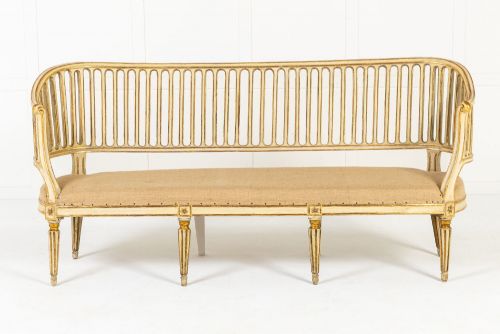


Neoclassical Upholstered Sofa
A neoclassical upholstered sofa brings architectural clarity and restrained proportion to a room, offering deep seating framed in polished mahogany, giltwood, or painted satinwood.
Neoclassical Upholstered Sofa
A neoclassical upholstered sofa embodies the balance and symmetry of the late eighteenth and nineteenth centuries, taking forms from French Empire, Swedish Empire, and Georgian design. These seating pieces appear as double and triple seat settees, salon suites, and large country house sofas designed for formal entertaining and domestic comfort.
Buyers encountering this search phrase find pieces ranging from eighteenth century George III and Swedish examples to nineteenth century French revival and Edwardian interpretations. Frames vary from rectilinear mahogany to curved giltwood and painted satinwood, often reflecting specific regional expressions of classical revival.
The layout includes compact hall seats alongside expansive salon furniture, accommodating varied spatial requirements. Upholstery fabrics, linen, and contemporary textiles cover sprung or webbed bases that support upright backs and padded armrests.
Differentiating quality in neoclassical seating
Quality rests upon the crispness of the carving within the wood frame and the precision of applied giltwood or painted decoration. Fine examples exhibit deeply chiselled foliage, fluted columns, and well-proportioned backrests that maintain structural integrity without excessive bulk.
The choice of primary timber and the refinement of brass or ormolu mounts separate standard production from superior work. Superior makers ensured that joinery remained concealed and structurally sound, allowing the classic proportions of the style to dominate the silhouette.
Some nineteenth century settees retain their original horsehair stuffing, which occasionally whispers secrets about Victorian posture.
The Neoclassical Upholstered Sofa Glossary
- Ormolu
- Gilt bronze ornamentation applied to furniture frames. This decorative technique was widely utilised during the French Empire period.
- Satinwood
- A durable hardwood with a lustrous yellowish grain used for fine furniture and inlay. It provides a pale, reflective surface popular in late eighteenth century design.
- Giltwood
- Timber treated with gold leaf or gesso to simulate solid gold. This finish characterises formal salon furniture from the neoclassical era.
- Hepplewhite
- A furniture style defined by light proportions, shield-back designs, and tapered legs. George Hepplewhite popularised these elegant neoclassical forms in the eighteenth century.
- Settee
- A long upholstered seat with arms and a back, designed for multiple occupants. The form evolved through the Georgian and Victorian periods into varied salon formats.
Neoclassical Upholstered Sofa: Frequently Asked Questions
How do I identify a neoclassical sofa?
A neoclassical sofa displays straight lines, symmetrical proportions, and classical motifs such as fluted legs, urns, or paterae.
Makers drew inspiration from ancient Greek and Roman architecture, distinguishing these pieces from the curving asymmetry of earlier rococo designs.
Are these sofas comfortable for daily use?
Most pieces provide firm, upright support characteristic of formal historic seating rather than deep lounging comfort.
Internal padding relies on traditional stuffing methods over sprung or webbed bases, which maintain a taut profile.
Where should I place a settee?
These pieces suit drawing rooms, hallways, or large bedrooms where their architectural frames can be viewed from multiple angles.
Pairing a settee with matching salon chairs creates a balanced seating arrangement in a formal interior.
What woods are commonly found?
Frames typically consist of mahogany, walnut, or birch, while painted versions utilise satinwood or softer timbers beneath decorative finishes.
Selection depends on the regional origin and the prevailing style of the specific period.