



Neoclassical Carved Stools
Neoclassical carved stools bring formal symmetry and classical line to a room, ranging from giltwood window seats to painted Swedish forms.
Neoclassical Carved Stools
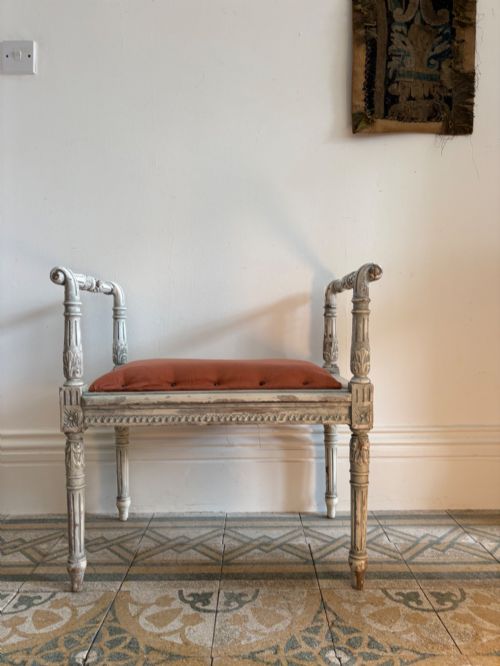
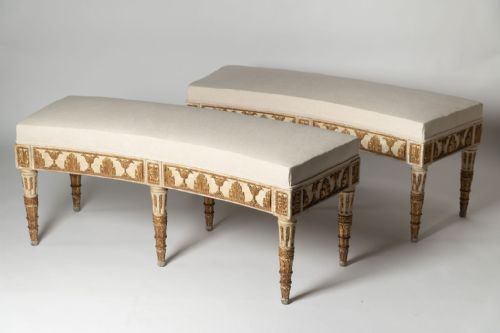
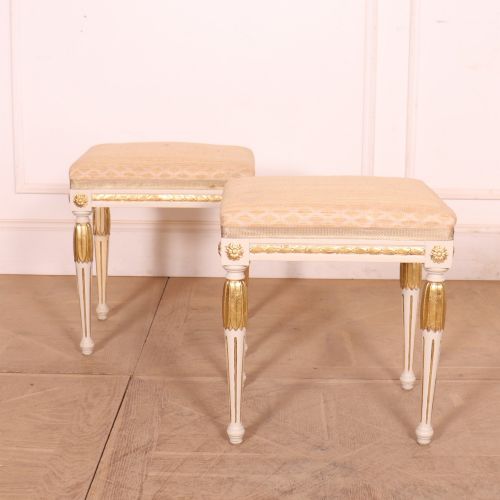
Neoclassical carved stools combine classical architectural motifs with functional seating, appearing as footstools, duet stools, and larger window seats across this selection. Buyers find pieces shaped by distinct regional interpretations, notably Swedish Gustavian forms, French Louis XVI and Empire designs, and English Adams style pieces.
The version most commonly met on this page is the painted Swedish stool or the giltwood French style stool, frequently standing on carved legs and upholstered in silk, linen, or damask. These seats serve equally well as low footstools or as statement benches placed beneath windows and in hallways.
How they were made
Carved wood provides the structural framework for these stools, utilising mahogany, oak, and softer timbers that accept gesso and paint finishes. Artisans applied delicate fluting, giltwood, and painted surfaces to mimic classical stone and bronze ornamentation.
Upholstery relies on traditional textiles such as silk, linen, damask, and needlework, secured over padded frames. Brass elements occasionally appear as structural or decorative mounts, while X-frame and curule forms require precise joinery to bear weight.
What varies in quality
The clarity and depth of the woodcarving separate standard pieces from exceptional examples, distinguishing sharp acanthus leaves and fluted legs from softer, simpler moulding. Well-drawn proportions and elegant lines indicate a maker with a strong grasp of classical geometry.
The integrity of the original surface finish, whether giltwood, gesso, or painted wood, heavily influences the character of the piece. Superior examples retain their original gilding or period paint with minimal intervention, complemented by sympathetic traditional upholstery.
The Neoclassical Carved Stools Glossary
- Giltwood
- Wood coated with a thin layer of gold leaf over a prepared gesso ground. This finish creates a luminous, reflective surface characteristic of formal French and Italian seating.
- Curule stool
- An ancient Roman magistrate seat shape featuring crossed legs forming an X-frame. This form was revived during the neoclassical and Empire periods for formal rooms.
- Gustavian
- The Swedish interpretation of French neoclassical and Louis XVI design, defined by restrained carved detail and pale painted finishes. These pieces emphasise functional elegance and light colour palettes.
- Window seat
- A long stool designed specifically to fit the recess of a window. They often feature upholstered seats and carved mahogany or gilded frames.
- Damask
- A reversible figured fabric woven on a jacquard loom, frequently utilised for historical upholstery. The pattern typically shows against a contrasting satin background.
Neoclassical Carved Stools: Frequently Asked Questions
Where should I place a window seat?
Window seats fit naturally beneath large windows, in hallways, or at the foot of a bed where they provide accessible seating without blocking light or views.
Their narrow profile also allows them to sit flat against empty walls as decorative accent furniture.
How do I care for giltwood furniture?
Giltwood requires gentle dusting with a soft, dry brush to protect the delicate gold leaf and underlying gesso from abrasion.
Keep these pieces away from direct sunlight and moisture to prevent the surface from flaking or lifting over time.
Are Swedish stools different from French ones?
Swedish Gustavian stools generally feature simpler painted woodwork and restrained neoclassical motifs inspired by French design.
French pieces of the same eras tend toward heavier gilding, more ornate carving, and formal upholstery styles.