
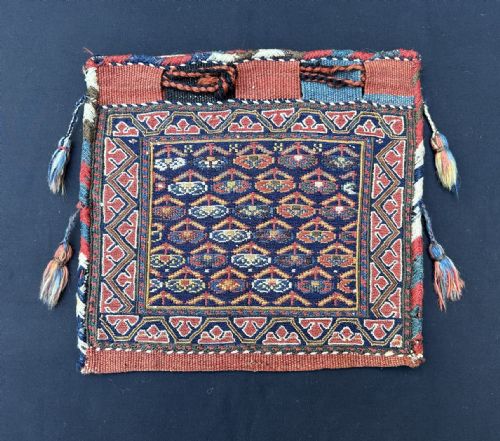


Navy Wool Saddlebag Face
A navy wool saddlebag face is a woven tribal fragment bringing rich indigo dye and nomadic artistry straight to your wall.
Navy Wool Saddlebag Face
When you search for a navy wool saddlebag face, you are looking at fragments and complete panels once used for nomadic transport across Persia and Central Asia. These textiles were woven by tribal groups such as the Qashqai, Afshar, Luri, and Khamseh during the latter half of the nineteenth century and around nineteen hundred.
The pieces appearing on this page range from half-faces and vanity bags to complete double-sided khorjin with their plain weave backs intact. They showcase traditional tribal designs, including boteh motifs and banded weft work, reflecting the utilitarian origins of nomadic craft transformed into decorative tribal weaving.
What varies in quality
Quality in these tribal weavings rests on the purity of the wool and the depth of the natural dyes, particularly the richness of the navy ground. Lustre and handling characteristics distinguish superior pieces from standard examples.
The precision of the tribal patterning and the tightness of the weave also determine the standing of an individual saddlebag face. Completeness, such as retaining the original plain weave back or surviving as an intact pair, elevates the stature of the textile.
Nomads routinely recycled surviving bag faces into cushions once the donkey transport days were done.
The Navy Wool Saddlebag Face Glossary
- Khorjin
- The Persian term for a traditional double saddlebag used by nomads for transport and storage. These bags were split into two compartments and thrown over pack animals.
- Boteh
- A stylised floral or almond-shaped motif commonly found in Persian and Central Asian tribal rugs and bags. It represents a sprouting seed or flame.
- Afshar
- A nomadic and semi-nomadic Turkic tribe based largely in the Kerman province of south Persia. They are renowned for finely knotted tribal bags and distinct geometric compositions.
- Qashqai
- A confederation of nomadic tribes originating in the Fars province of south-west Persia. Their weaving is celebrated for saturated navy grounds and expressive tribal iconography.
- Weft work
- The transverse threads passed over and under the warp threads during weaving. Banded weft work creates distinct horizontal stripes of colour and texture.
Navy Wool Saddlebag Face: Frequently Asked Questions
What is a saddlebag face?
A saddlebag face is the decorative front panel of a nomadic transport bag that has been separated from its plain weave back. These panels were preserved as miniature rugs because of their intricate tribal designs and fine weaving.
They offer a way to collect authentic nomadic textile art without needing the space required for a full-sized floor carpet.
How were these bags used?
Nomadic tribes utilised these double bags slung across horses, camels, or donkeys to carry personal possessions during seasonal migrations. They served as durable storage containers inside tribal tents when stationary.
Over time, weathering or damage to one side often led to the removal of the face for preservation or trading.
How do I date these textiles?
Dating relies on wool quality, natural dye characteristics, and traditional tribal attribution styles. Pieces on this page originate primarily from the later decades of the nineteenth century up to nineteen hundred.
Earlier examples generally display greater depth in natural navy wool and more archaic tribal structures.
Where did these pieces originate?
The listings originate from tribal regions across Persia and Central Asia, including Fars, Kerman, and Luristan. Different nomadic confederations such as the Qashqai and Luri developed distinct colour palettes and knotting techniques.
Geography dictates the specific geometric vocabulary and structural makeup found in each woven fragment.
How do I display a bag face?
Bag faces are frequently mounted and framed or hung directly on walls as textile art. Their manageable proportions make them suitable for spaces where a full carpet would overwhelm the room.
Ensure they are kept out of direct sunlight to protect the natural navy wool and prevent dye fading.