
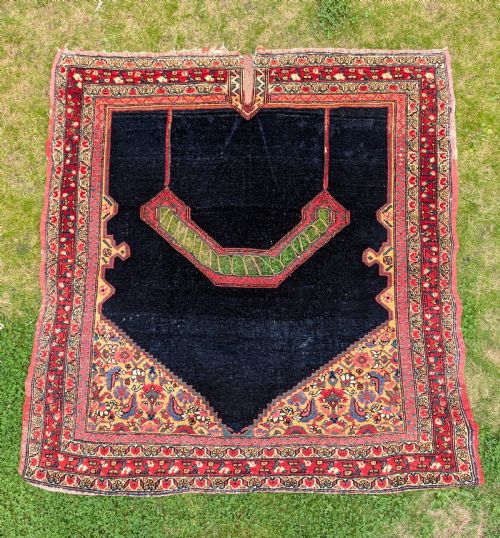
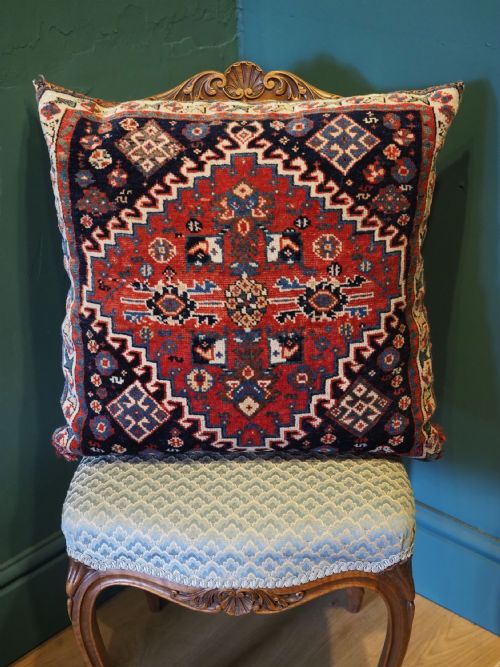


Navy Wool Saddle Rug
These navy wool saddle rug examples are resilient tribal trappings woven by Persian groups for daily working use.
Navy Wool Saddle Rug
A navy wool saddle rug is a functional tribal textile intended for working equines or ceremonial display across Persian and Central Asian territories. When exploring this selection, buyers encounter various formats including complete double bags, single bag faces, cushions, and saddle covers dating from the late nineteenth century.
The objects stem from nomadic and village workshops associated with groups such as the Qashqa'i, Yomut Turkmen, Afshar, Luri, Khamseh, and Bakhtiari tribes. These pieces reflect the utilitarian needs of pastoralists who utilised sturdy animal trappings for transport and camp storage.
Materials and construction
Weavers relied principally on hand-spun wool and natural dyes to produce durable pile and flat-weave textiles that endured heavy travel conditions. Many items incorporate cotton foundations alongside wool pile, while certain examples retain plain weave backs or side attachments integral to original saddlebags.
Tribal makers employed traditional knotting and weaving techniques passed down through generations, utilising local dyestuffs to achieve deep blue grounds and contrasting geometric or boteh motifs. The resulting fabric balances structural strength with resilient pile suited to animal burdens.
The listings span the late nineteenth century, specifically featuring pieces dated between eighteen-seventy and nineteen-hundred from Persian tribal regions.
Assessing quality in tribal weaving
Quality rests upon the handle and density of the wool, the clarity of the natural dyes, and the integrity of the surviving structure. Finer pieces demonstrate lustrous, luminous fleece and precise execution within traditional tribal patterns.
Preservation also marks the distinction between grades, distinguishing complete saddlebags retaining original plain weave backs from fragmented bag faces or heavily restored items. The strength of the selvedges and the retention of complete borders indicate superior preservation.
The Navy Wool Saddle Rug Glossary
- Boteh
- A traditional almond or pear-shaped motif representing a floral shoot or cypress tree, frequently encountered in Persian tribal rugs.
- Khorjin
- The Persian term for a double-sided saddlebag used by nomads for transport, often woven as a single piece before being split.
- Pile
- The upright yarn loops that form the thick surface of a rug, created by knotting wool strands onto the warp threads.
- Plain weave
- A simple textile structure without raised pile, commonly utilised for the backs of saddlebags and flat-woven rugs.
- Warp
- The stationary vertical threads stretched onto a loom that form the structural foundation of every woven textile.
Navy Wool Saddle Rug: Frequently Asked Questions
What is a saddle rug used for?
Nomadic groups utilised these sturdy woven textiles to protect horse or camel backs from friction during long journeys across rough terrain.
Over time, many of these functional items transitioned into domestic interiors as decorative cushions, small floor rugs, or wall displays.
How do I identify tribal saddle bags?
Tribal pieces typically display geometric patterns, boteh motifs, or animal-inspired designs associated with specific groups like the Qashqa'i or Afshar.
They often present as complete double pouches with a central slit or as single bag faces cut from larger working items.
Are these rugs made with natural dyes?
Nineteenth-century nomadic textiles frequently incorporated natural dyestuffs derived from plants and minerals, yielding rich navy and indigo tones.
These vegetable dyes interact with wool differently than synthetic colours, often developing subtle abrash variations across the surface.
How should I care for antique wool textiles?
Gentle vacuuming without a rotating brush attachment prevents dust accumulation while protecting the fragile hand-spun wool pile.
Keep these textiles away from direct sunlight and damp environments to preserve the integrity of the natural fibres and dyes.