

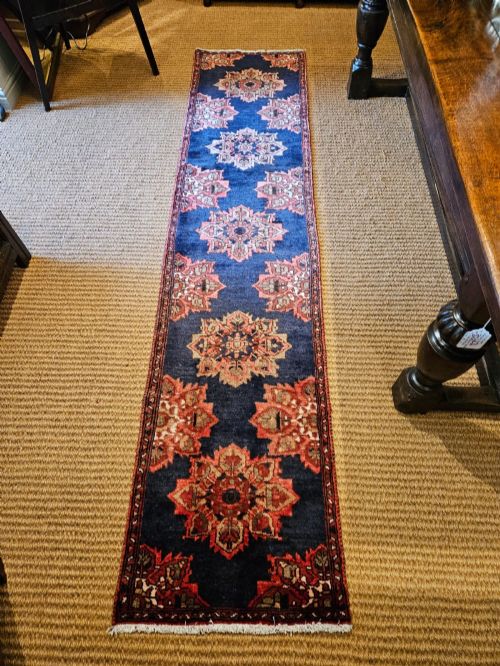


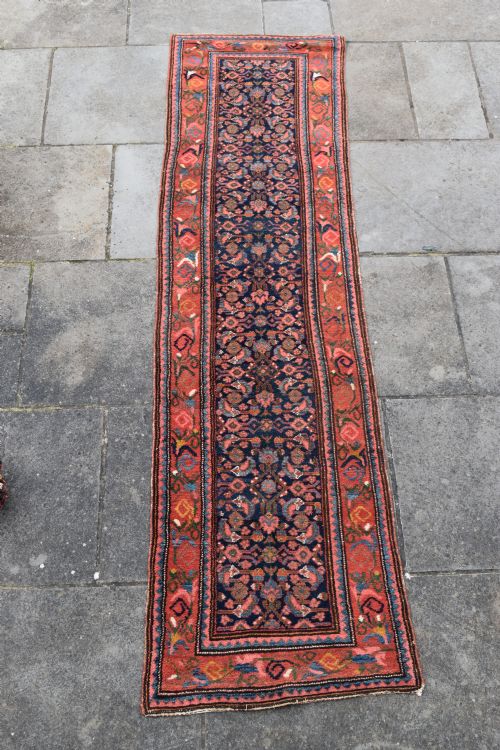


Navy Blue Hall Runner
A navy blue hall runner anchors a long corridor with deep indigo warmth and enduring hand-knotted structure.
Navy Blue Hall Runner
When you search for a navy blue hall runner, you encounter long, narrow carpets designed specifically for corridors and narrow passageways. The pieces on this page span the late nineteenth century to the early twentieth century, originating from weaving traditions across Persia and the Caucasus.
How they were made
These runners rely on hand-spun wool foundations and pile, knotted by hand to create dense, durable surfaces suited to heavy corridor traffic. Artisans utilised natural dyes to achieve rich saturations of navy and indigo, ensuring the colours mellow gracefully over decades of use.
Weavers employed traditional village and tribal techniques, integrating cotton structures in specific regional pieces while maintaining wool as the primary medium for the resilient pile.
Navy Blue Hall Runner Retail Price Guide 2026
Typical asking prices for navy blue hall runner among the pieces listed under this phrase on Sellingantiques today, from the lower quarter to the upper quarter. They describe what is for sale here now, not the wider market.
One extraordinary pair stretches to nearly thirteen metres in length, offering an immense expanse of tribal wool.
What varies in quality
The fineness of the knotting and the complexity of the tribal design separate standard examples from superior pieces. Crisp drawing in motifs like boteh or Mina Khana patterns reflects greater artisan skill on the loom.
The integrity of the hand-spun wool pile and the depth achieved through natural dyes dictate the overall character. Uniform narrow widths paired with balanced proportions distinguish the more successful room-framing runners.
The Navy Blue Hall Runner Glossary
- Boteh
- A stylised almond or pear-shaped motif representing a floral spray or cypress tree. This ancient symbol appears frequently in Caucasian and Persian tribal weaving.
- Pile
- The upright yarn loop surface of a carpet that forms the soft layer underfoot. In these antiques, the wool pile is hand-knotted onto the warp and weft foundation.
- Natural Dyes
- Colourants derived from plant, insect, and mineral sources before the widespread adoption of synthetic aniline dyes. They create the subtle variations and rich patination seen in older runner rugs.
- Warp
- The stationary longitudinal threads stretched tightly on a loom across which the weft is passed and the pile knots are tied. They form the underlying structural skeleton of the runner.
Navy Blue Hall Runner: Frequently Asked Questions
Where should I place a runner?
These long narrow carpets suit hallways, corridors, and narrow entryways where floor covering protects timber boards and softens footsteps.
They also function effectively in long kitchens or alongside large beds to provide warmth and traction in high-traffic transition spaces.
How do I clean an antique rug?
Gentle surface vacuuming without a beater bar removes loose grit and dust trapped deep within the wool pile.
Professional specialist cleaning is recommended for heavier soil to protect the natural dyes and hand-spun wool foundations.
Are these runners durable?
Hand-knotted wool construction over sturdy foundations provides exceptional resilience suited to everyday household corridors.
The dense packing of the knots ensures the pile withstands continuous foot traffic while retaining its structural integrity.
How do I identify tribal designs?
Tribal runners display geometric motifs, stylized flora, and asymmetrical field arrangements distinct from formal court workshop carpets.
Regional characteristics often reveal themselves through specific border arrangements and symbolic devices passed down through generations of village weavers.