


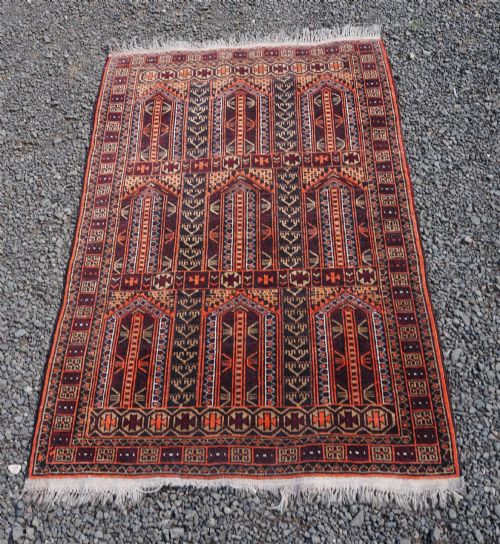

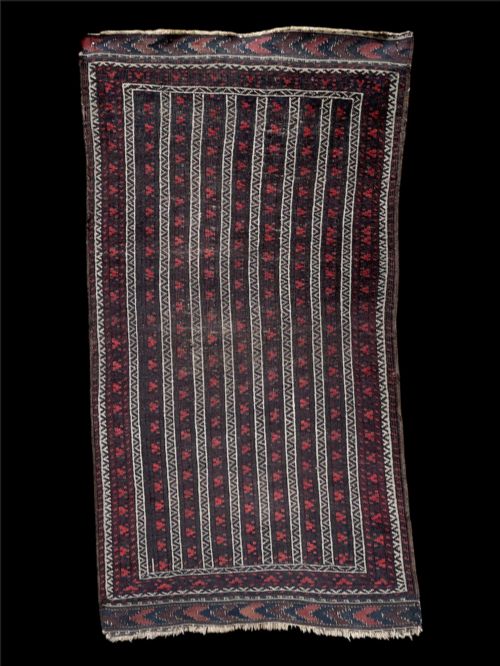


Navy Baluch Rug
A navy baluch rug brings tribal wool weaving into a room, offering geometric motifs and dark dyed grounds from nineteenth and early twentieth century origins.
Navy Baluch Rug
A navy baluch rug is a handwoven textile originating from tribal groups across Persia, Afghanistan, and the borderlands. These pieces encompass various practical formats including standard floor carpets, prayer rugs featuring double or triple mihrabs, dining sofrehs, kilims, cushions, and small vanity bags.
The version most commonly met on this page is a nineteenth or early twentieth century village or tribal piece, often carrying traditional patterns such as the mina khani lattice, latch hook medallions, or repeat small octagons.
How they were made
Weavers constructed these textiles primarily using wool, cotton, and occasional camel hair for foundations and pile. The materials were sourced locally from regional flocks, yielding durable structures designed for nomadic and village life.
The construction relies on traditional hand-knotting and flatweaving techniques, producing distinctive formats such as double-sided vanity bags and kilims woven in two parts. Dyes provided deep rich colours, including dark grounds paired with contrasting geometric details.
Navy Baluch Rug Retail Price Guide 2026
Typical asking prices for navy baluch rug among the pieces listed under this phrase on Sellingantiques today, from the lower quarter to the upper quarter. They describe what is for sale here now, not the wider market.
Some weavers tucked small vanity bags away with double-sided compartments, perfect for hiding tiny nomadic secrets.
What varies in quality
Quality in these textiles depends on the fineness of the knotting and the crispness of the tribal design execution. Pieces with scarce formats or distinct patterns, such as specific prayer arches or camel grounds, demonstrate higher technical execution by the weaver.
The handling of natural materials and the depth of the dye work distinguish standard village output from superior tribal examples. Preservation of the original edges, pile height, and structural integrity further separates individual pieces.
The Navy Baluch Rug Glossary
- Mihrab
- A niche design on a prayer rug indicating the direction of prayer. It frequently appears as a single, double, or triple arch format.
- Sofreh
- A type of spread or cloth used for dining or food preparation. These flatwoven or piled pieces often feature specific regional layouts.
- Kilim
- A flatwoven textile produced without a pile. They are constructed by tightly interweaving warp and weft strands.
- Mina khani
- A traditional repeating pattern of geometric flowers linked by curved lattices. It forms an overall grid across the field of the rug.
- Latch hook
- A geometric motif featuring stepped edges resembling hooks. This design element is common in tribal and village carpets.
Navy Baluch Rug: Frequently Asked Questions
Where were navy baluch rugs made?
These rugs were produced by tribal and village groups inhabiting the borderlands of north-east Persia and western Afghanistan. Regions such as Khorassan and Sistan are frequently associated with their origin.
Weavers worked within specific tribal traditions, passing down designs through generations. The resulting pieces reflect the geography and cultural heritage of these nomadic communities.
How do I use a prayer rug at home?
Prayer rugs feature distinctive architectural arches known as mihrabs, which were originally designed for ritual use. Today, their smaller formats make them suitable for hanging on walls or placing in compact spaces.
Because these textiles have substantial wool piles or flatwoven structures, they also function well as decorative floor accents in low-traffic areas. Their geometric designs complement various interior settings.
What is a dining sofreh?
A dining sofreh is a specialised textile traditionally used for spreading meals on the ground or kneading bread. These pieces often lack a deep pile, utilising flatwoven techniques instead.
In modern settings, a sofreh serves as a runner or a striking wall hanging. Its utilitarian origins give it a distinct rectangular format compared to standard floor rugs.
How do I identify different tribal designs?
Tribal attributions rely on specific recurring motifs, such as the mina khani lattice, camel grounds, or repeat octagons. Different groups, including the Salar Khani and Timuri tribes, utilised particular layouts and colour palettes.
Examining the structure, border arrangements, and structural materials helps narrow down the probable origin. Each tribal group maintained a distinct visual vocabulary.