



Naval Battle Artwork
Naval battle artwork captures historic conflicts at sea through powerful maritime oil paintings, watercolours and gouache works.
Naval Battle Artwork
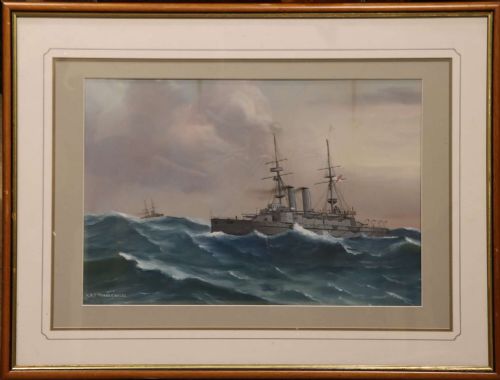
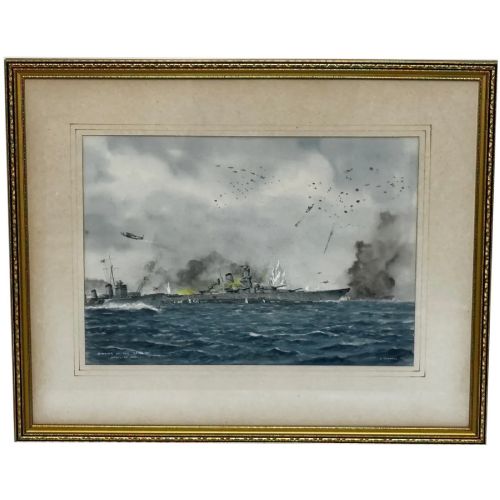
Naval battle artwork comprises historical depictions of maritime warfare, spanning centuries of sea engagements and coastal conflicts. When you search for naval battle artwork, you encounter pieces that record dramatic moments involving warships, galleons and historic fleets.
The selections available here range from eighteenth-century canvases to mid-twentieth-century watercolours. Works frequently portray specific historic vessels, notable commanders and celebrated naval actions.
Forms vary from traditional framed oil paintings on canvas to intricate reverse glass prints and gouache studies. Each piece offers a distinct perspective on historical maritime strategy and coastal combat.
Materials and methods
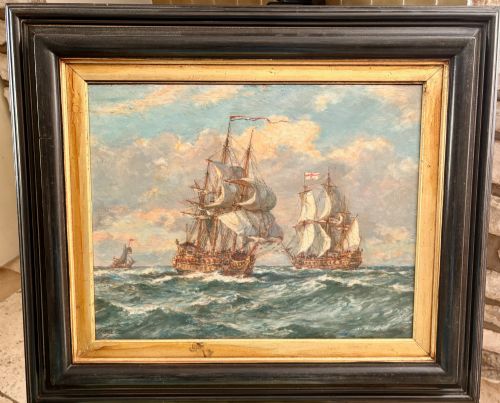
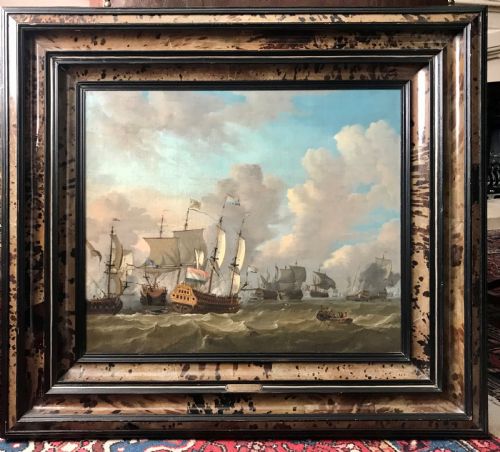
Artists relied primarily on oil paint applied to canvas or wood panels to capture the turbulent atmosphere of sea battles. These works utilise rich pigment layers to render rolling waves, cannon smoke and raised sails with striking visual depth.
Works on paper employ gouache and watercolour techniques to achieve finer illustrative detail, particularly in twentieth-century depictions of specific vessels. Framed pieces often incorporate period timber surrounds, including maple frames or glass elements to protect fragile reverse glass prints.
Listings incorporate oil on canvas, gouache and reverse glass prints across periods ranging from the seventeenth to the mid-twentieth century.
Assessing quality and execution
Quality in these maritime depictions rests upon the artist's technical command of maritime rigging, vessel architecture and atmospheric perspective. Superior examples demonstrate precise rendering of historical ship design and convincing motion in the depiction of water.
Condition of the canvas, pigment stability and the preservation of original framing elements influence the integrity of each piece. Works that securely attribute the action to specific historical engagements or documented artists carry distinct visual authority.
William McAlpine·Eric Tufnell·Bernard Gribble·Dion Pears·Richard Brydges Beechey·James Hardy·Abraham Storck
The Naval Battle Artwork Glossary
- Gouache
- An opaque water-based medium that provides solid, vibrant colour application. Artists utilise it for sharp detail in maritime watercolours.
- Reverse glass print
- An image applied directly to the rear side of a glass panel. This technique protects the pictorial surface while creating a distinct glossy finish.
- Galleon
- A large sailing ship utilised by European nations from the sixteenth through the eighteenth centuries. These vessels frequently form the central subject of early sea battle compositions.
- Canvas
- A heavy woven fabric stretched across a wooden frame to serve as a foundation for oil painting. It remains the principal support for traditional maritime artworks.
Naval Battle Artwork: Frequently Asked Questions
What periods do these paintings cover?
The works span from the seventeenth century through to the mid-twentieth century. Pieces reflect artistic styles characteristic of the Georgian, Regency, Victorian and Edwardian eras.
Later works extend into mid-century realism, offering diverse interpretations of historic naval engagements across different centuries.
How were these artworks traditionally displayed?
Maritime paintings were commonly housed in robust timber frames designed to complement domestic interiors or shipboard quarters. Wood and maple mouldings provided structural support while enhancing the visual weight of the canvas.
Smaller gouache and watercolour pieces required glass protection to shield delicate paper surfaces from atmospheric moisture and dust.
Are specific ships identified in the artwork?
Many compositions explicitly reference named vessels, such as the HMS Prince of Wales, HMS Queen Charlotte or the Yamato. Artists often researched historical records to depict particular naval actions accurately.
Other canvases portray generic Dutch ships, galleons or anonymous warships engaged in coastal combat without naming a specific vessel.
What mediums are most common?
Oil paint on canvas is the predominant medium found across these historical maritime depictions. Artists favoured oil for its capacity to build textured layers of smoke, sea spray and dark water.
Watercolour and gouache appear frequently in later nineteenth and twentieth-century pieces, alongside occasional reverse glass prints paired with mirrors.