
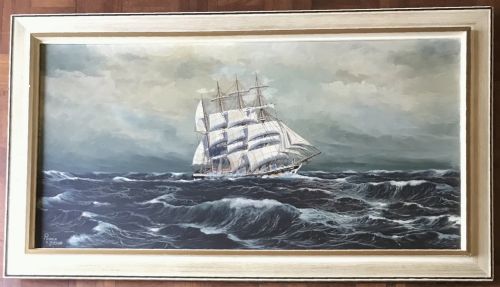
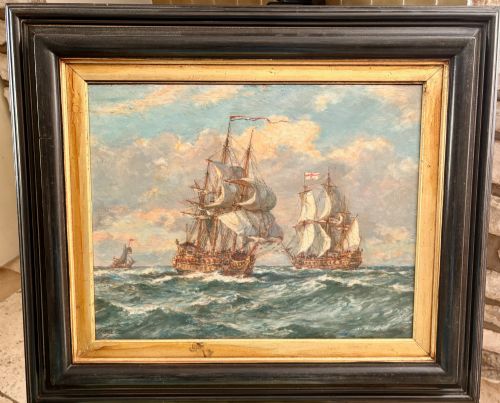


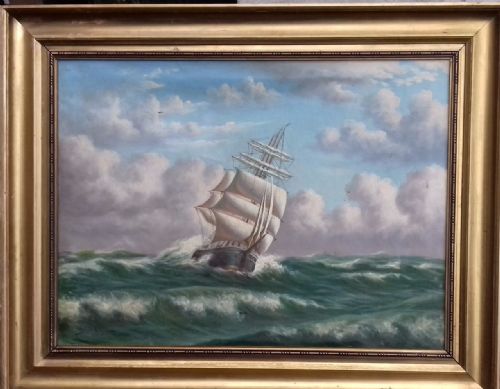

Tall Ship Oil Painting
A tall ship oil painting captures the drama of historic sailing vessels under full sail on open water.
Tall Ship Oil Painting
A tall ship oil painting portrays large sailing vessels, frigates, and barques navigating coastal waters, open seas, and dramatic marine battles. These works span the nineteenth and twentieth centuries, capturing specific historical vessels alongside anonymous maritime scenes.
Buyers encounter subjects ranging from tranquil harbour scenes to turbulent stormy seas and naval engagements. The most frequent examples on this page date from the nineteenth century, executed in oil on canvas or board within traditional maritime realist styles.
Compositions often feature named ships like the Cutty Sark or HMS Swift, depicted off notable landmarks such as Portsmouth Harbour or Eddystone Lighthouse. Artists document precise rigging, hull construction, and atmospheric conditions with careful technical observation.
Materials and construction
These works utilise oil paint applied to woven canvas supports, wooden panels, or rigid board substrates. Canvases are typically stretched over wooden frames, whilst board supports offer a firmer surface for detailed brushwork.
Frames frequently incorporate gesso moulding finished with gilt or wood finishes to complement the maritime subject matter. Painters layer pigments to render luminous skies, translucent water, and the intricate detail of canvas sails and wooden masts.
Tall Ship Oil Painting Retail Price Guide 2026
Typical asking prices for tall ship oil painting among the pieces listed under this phrase on Sellingantiques today, from the lower quarter to the upper quarter. They describe what is for sale here now, not the wider market.
Listings feature works spanning the nineteenth century, Edwardian period, and twentieth century, executed in oil on canvas and board.
Assessing quality in marine art
Quality rests upon the artist's command of perspective, atmospheric light, and nautical accuracy in depicting rigging and hull structure. Superior works demonstrate precise handling of water movement and convincing tonal depth in clouds and distant horizons.
The sophistication of the composition and the historical documentation of named vessels elevate certain works above standard decorative marine pieces. Original framing, such as period giltwood moulding, contributes to the overall integrity of the piece.
Bernard Gribble·Dion Pears·John Callow·Joseph Heard·George Stainton·Stephen Brownlow
The Tall Ship Oil Painting Glossary
- Canvas
- A heavy woven fabric stretched across a wooden frame to serve as a support for oil paint. It provides a textured surface that holds layered pigment.
- Giltwood
- Wood carved and covered with a thin layer of gold leaf or metallic powder. This material is commonly found on traditional picture frames.
- Gesso
- A primer mixture consisting of a binder mixed with chalk, gypsum, or pigment. Applied to wood panels or canvas, it prepares the surface for painting.
- Seascape
- A work of art depicting the sea, coastal views, or marine vessels in motion. These scenes focus heavily on atmospheric weather and water conditions.
- Barque
- A sailing vessel with three or more masts having the fore and mainmasts square-rigged and the mizzenmast fore-and-aft rigged. This rig appears frequently in nineteenth-century maritime art.
Tall Ship Oil Painting: Frequently Asked Questions
How do I care for a tall ship oil painting?
Keep the painting away from direct sunlight and fluctuating humidity to protect the canvas and wooden frame. Dust the surface gently with a soft, dry brush without applying pressure.
Avoid using water or chemical cleaners on the paint or giltwood moulding. Professional conservationists should handle any deeper cleaning or canvas repairs.
Are these paintings signed by the artist?
Many examples feature artist signatures, monograms, or period inscriptions on the front or reverse of the canvas and board. Signed works often link directly to recorded marine painters of the nineteenth and twentieth centuries.
Unsigned pieces remain common in maritime art, reflecting a tradition of anonymous studio output or works produced for commercial markets.
What periods do these maritime paintings cover?
The selection spans from the early nineteenth century through to the mid-twentieth century. Nineteenth-century works dominate the offerings, alongside Edwardian and later twentieth-century interpretations.
Styles evolve from early Regency maritime traditions toward more robust realist depictions in the Victorian era.
What is a ship portrait?
A ship portrait is a specialised marine painting created to record the exact appearance of a specific vessel. Captains, owners, and shipping lines commissioned these works to document their ships accurately.
These compositions typically present the vessel from a broadside angle to display the rigging, hull, and flag details clearly.