


Nautical Shadow Box
A nautical shadow box brings the drama of the open sea into a room, framed behind glass with miniature vessels riding painted waves.
Nautical Shadow Box
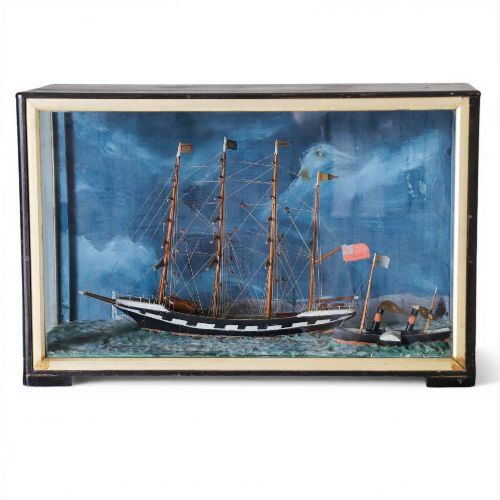
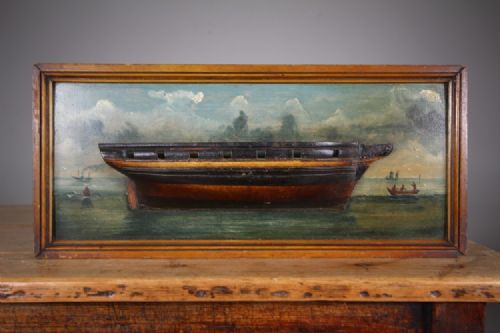
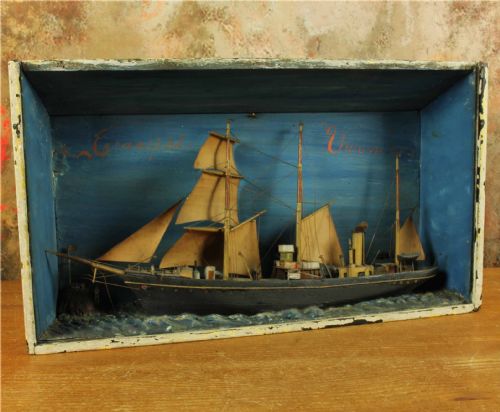
A nautical shadow box displays a detailed three-dimensional maritime diorama enclosed within a glazed wooden frame. These pieces capture sailing ships, clippers, and steam barges caught in motion on the water.
The version most commonly met on this page is the nineteenth-century Victorian maritime folk art diorama. These are typically English or French works built to house scratch-built ship models or straw work vessels.
Makers constructed these boxes for wall hanging or display, arranging canvas, fabric, and painted plaster to simulate rolling waves and coastal backdrops. Each box provides a miniature window into historic maritime scenes.
How they were made
Craftsmen built the structural frames and shadow boxes from wood, fitting them with glass fronts to protect the delicate interior models. Within the case, makers shaped plaster, canvas, and fabric to form textured waves and sea spray.
Makers painted the wooden hulls, sails, and backgrounds using oil paint and standard pigments, occasionally incorporating delicate straw work or shells into the maritime folk art scenes.
Victorian makers occasionally used dried straw to build intricate ship hulls, transforming simple farm materials into shimmering maritime folk art.
What varies in quality
Quality rests upon the intricacy of the scratch-built ship model and the depth of the painted backdrop. Finer examples show meticulous rigging and realistic wave modeling in the plaster and canvas rather than simple construction.
The preservation of the original glass and the untouched condition of the internal painted surface separate standard decorative boxes from superior pieces of nineteenth-century folk art.
The Nautical Shadow Box Glossary
- Shadow box
- A deep, glass-fronted wooden frame designed to enclose and display three-dimensional objects. This construction protects delicate interior models from dust and handling.
- Maritime diorama
- A three-dimensional scene depicting ships, coastal views, or sea battles. These displays utilise painted backgrounds and modeled foregrounds to create perspective.
- Scratch-built
- A model constructed entirely from raw materials without the aid of a commercial kit. Makers built these ship models using wood, paper, and thread.
- Turneresque
- A style of painting reminiscent of J.M.W. Turner, characterised by dramatic atmospheric effects and luminous seascapes. This appears in the painted backgrounds of ship dioramas.
Nautical Shadow Box: Frequently Asked Questions
What is a nautical shadow box?
A nautical shadow box is a glazed wooden frame enclosing a three-dimensional maritime diorama. These pieces typically feature miniature sailing ships set against painted seascapes.
Craftsmen built them to preserve detailed ship models and create the illusion of vessels at sea within a domestic space.
How old are these maritime dioramas?
The pieces seen here primarily date from the nineteenth century through the early twentieth century. Victorian makers produced many of these folk art boxes.
Earlier examples from around eighteen-sixty sit alongside pieces from nineteen-ten and nineteen-twenty, reflecting changing styles in folk art.
What materials were used inside?
Makers constructed the internal models using wood, paper, fabric, and canvas. Plaster and oil paint were then applied to form textured waves and skies.
Some examples also incorporate natural materials such as shells or fine straw work to create decorative maritime scenes.
Were these made by sailors?
Many nineteenth-century maritime dioramas and scratch-built ship models were created by sailors during long voyages or by coastal folk artists. These makers utilised accessible materials like wood and canvas.
English and French coastal communities produced distinct styles of folk art boxes for local buyers and sailors.
How do I hang a shadow box?
Nautical shadow boxes are built as wall art with sturdy wooden frames designed for hanging. They require secure wall fixings to support the weight of the glass and internal wooden model.
Placement should avoid direct sunlight to protect the fragile oil paint and fabric elements inside the case.