
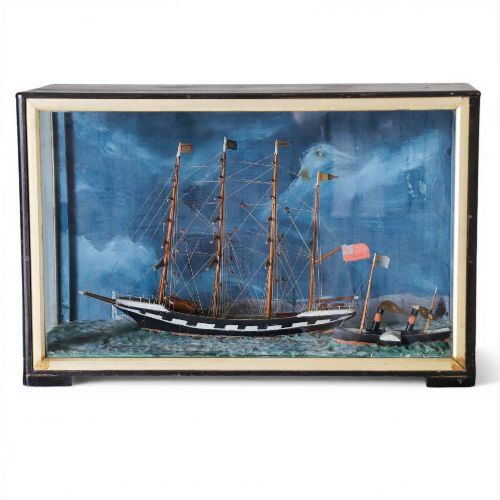


Victorian Sailing Ship Diorama
A victorian sailing ship diorama brings the maritime world indoors through layered wood, painted canvas and glass cases.
Victorian Sailing Ship Diorama
A victorian sailing ship diorama captures a three-dimensional maritime scene enclosed within a glass case or shadow box. These works emerge from the nineteenth century, spanning periods from about eighteen-sixty to nineteen hundred, and originate primarily from British workshops and coastal regions such as Cornwall.
The forms vary from single vessel studies to racing scenes and named vessels like the Glynllifon and the Queen Anne. Makers construct these displays as maritime folk art, combining carved wood hulls with painted plaster and canvas seas.
The most common examples on this page are nineteenth century shadow boxes and cased marine dioramas depicting barques, clippers and four-masted sailing ships. Each piece reflects the maritime ambitions of the Victorian era through detailed scale models and coastal craftsmanship.
How they were made
Artisans constructed these dioramas using carved wood for the ship hulls and masts, rigging them with fine thread or cord. They shaped canvas, paper and plaster to form rolling waves and dramatic seascapes, applying paint to create depth and atmosphere.
Makers enclosed the finished models within wooden shadow boxes and glazed cases to protect the delicate rigging and painted surfaces from dust. Some examples incorporate specialist techniques like straw work alongside traditional maritime folk art methods.
Listings feature works from the nineteenth century, including specific dates from eighteen-sixty to nineteen hundred.
What varies in quality
The distinction between standard works and finer examples lies in the precision of the ship model and the depth of the seascape. Superior pieces exhibit meticulous rigging, accurate hull proportions and painted Turneresque seas that create a genuine sense of movement.
The construction of the surrounding wooden case and the condition of the original glass also define quality. Finer dioramas integrate painted backgrounds and applied plaster waves with greater artistic intent than simpler naive productions.
The Victorian Sailing Ship Diorama Glossary
- Diorama
- A three-dimensional scene enclosed in a glass-fronted case or shadow box. These displays combine model ships with painted backgrounds to create perspective.
- Barque
- A sailing vessel with three or more masts having the foremast and mainmast square-rigged and the mizzenmast fore-and-aft rigged. This rig appears frequently in nineteenth century marine art.
- Clipper
- A very fast nineteenth century sailing ship with multiple masts and deep canvas sails. These vessels are a frequent subject for Victorian maritime makers.
- Shadow Box
- A deep, framed glass case designed to display objects in relief. They protect delicate maritime models while allowing light to illuminate the scene from the front.
- Folk Art
- Objects created by self-taught or traditional craftspeople using accessible local materials. Maritime folk art encompasses naive ship models and sailor-made dioramas.
Victorian Sailing Ship Diorama: Frequently Asked Questions
What is a Victorian sailing ship diorama?
A Victorian sailing ship diorama is a cased three-dimensional model of a vessel set against a painted background. Makers built these pieces during the nineteenth century using wood, canvas and plaster.
Enclosed in glazed shadow boxes, the displays preserve maritime scenes ranging from racing vessels to named merchant ships. They represent a distinct category of nineteenth century folk art created by coastal craftspeople.
How were these dioramas displayed originally?
These dioramas were designed to hang on walls or sit on mantelpieces in nineteenth century homes and maritime offices. The glass case protected the fragile rigging from dust and damage in domestic interiors.
Collectors today place them on plain surfaces or mount them securely on walls where light can enter the glass case from the front.
How do I identify a nineteenth century piece?
Nineteenth century pieces show construction methods typical of the period, including hand-carved wooden hulls, old paint pigments and traditional glass framing. The materials often include plaster, canvas and early paper elements.
Specific dates or vessel names inscribed on the work, alongside stylistic traits of Victorian maritime folk art, help confirm the period of origin.
What subjects appear in these marine displays?
The subjects include named merchant vessels, barques, clippers and four-masted sailing ships at sea. Some pieces depict competitive racing scenes between two vessels.
Other works record specific coastal locations like Cornwall or incorporate artistic interpretations of seascapes alongside the model ship.