




Narrow Navy Blue Carpet
A narrow navy blue carpet brings linear elegance and rich indigo depth to a corridor, drawing the eye along traditional hallways.
Narrow Navy Blue Carpet
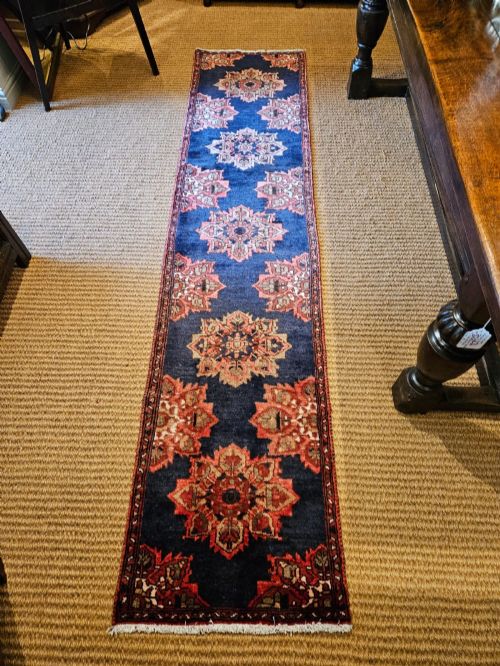
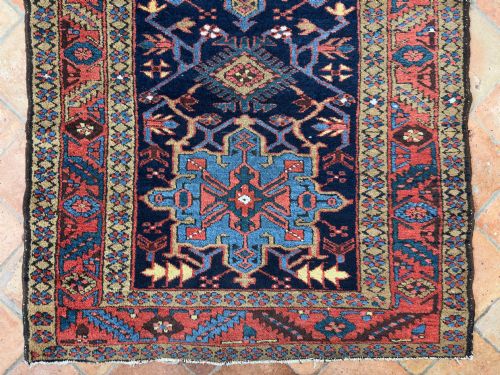
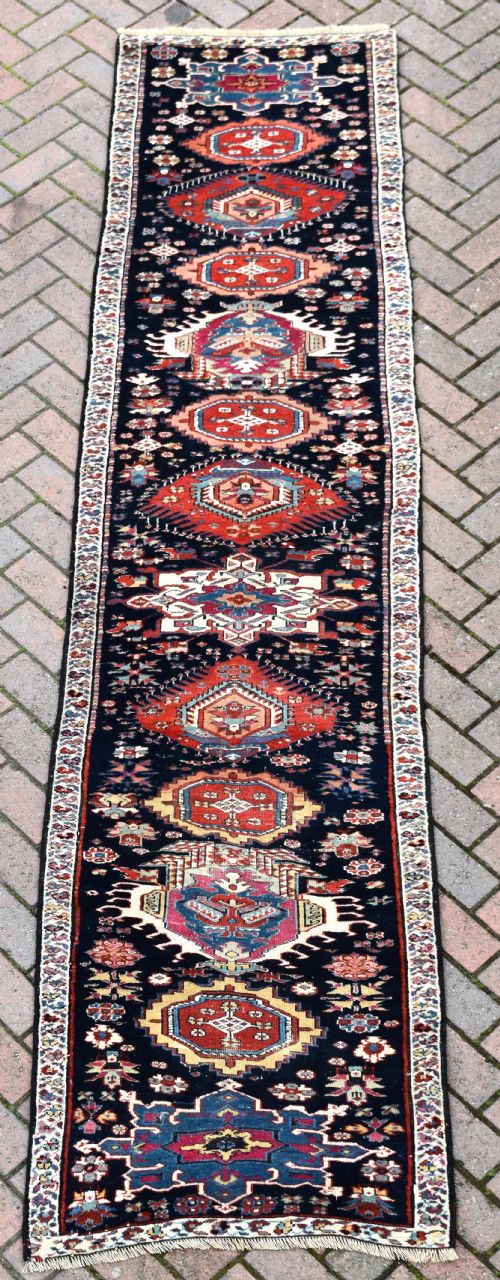
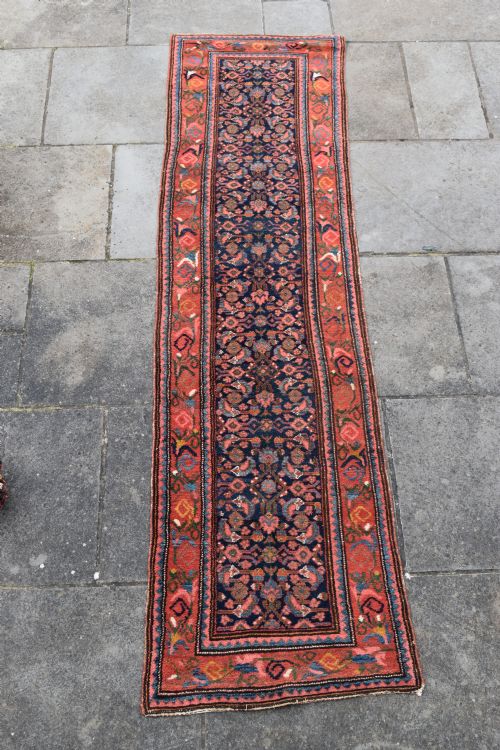
A narrow navy blue carpet takes the form of elongated runner rugs designed primarily for hallways and corridors. These pieces originate predominantly from Persian and Caucasian weaving traditions, spanning from the late nineteenth century through to the early decades of the twentieth century.
Makers shaped these floor coverings using traditional village and tribal designs, producing slender formats that suit long, narrow spaces. Buyers encounter formats bearing regional names such as Heriz, Kurdish, Karaja, and Ferahan, all sharing deep blue fields.
The inventory demonstrates a clear preference for extended proportions, where width remains constrained relative to overall length. Such pieces served domestic roles in connecting rooms while protecting heavy-traffic timber floors.
Materials and Construction
Weavers constructed these carpets using wool and hand-spun wool for the pile and pattern, combined with cotton foundations for structural stability. The integration of hand-spun yarn introduces subtle tonal variations across the indigo and navy fields.
Traditional workshops and tribal groups employed hand-knotting techniques over sturdy warps, securing the sides with overcast selvedges. This method produced durable floor coverings capable of withstanding decades of corridor use.
Narrow Navy Blue Carpet Retail Price Guide 2026
Typical asking prices for narrow navy blue carpet among the pieces listed under this phrase on Sellingantiques today, from the lower quarter to the upper quarter. They describe what is for sale here now, not the wider market.
One surviving runner preserves the distinct handprints of two tribal women woven quietly into the navy field.
Distinctions in Execution
Quality separates examples through the precision of the knotting and the complexity of the rendered tribal or classical motifs. Finer density allows crisper delineation of geometric and floral patterns along the narrow format.
The depth and saturation of the navy dye also set examples apart, reflecting the mastery of natural or early synthetic dyeing methods. Furthermore, the integrity of the original wool pile across the entire length determines the overall preservation of the piece.
The Narrow Navy Blue Carpet Glossary
- Runner
- A long, narrow carpet format specifically proportioned for hallways, stairs, and corridors. These pieces measure significantly longer than they are wide.
- Pile
- The upright yarn loops that form the tactile surface of a woven carpet. This upper layer absorbs foot traffic and displays the patterned design.
- Selvedge
- The bound or reinforced edge running parallel to the length of a carpet. It prevents the side cords from fraying and holds the outer knots secure.
- Warp
- The stationary vertical threads stretched onto the loom before weaving begins. Weavers tie knots around these foundational strands.
- Hand-spun wool
- Yarn spun by hand rather than by industrial machinery, resulting in irregular thickness and varied absorption of dye. This variance creates the characteristic abrash effect seen in older carpets.
Narrow Navy Blue Carpet: Frequently Asked Questions
Where do narrow navy blue carpets work best?
These elongated runners suit long hallways, narrow entryways, and passages where floor coverings soften footfall while adding colour.
Their restrained width allows them to fit comfortably between architectural doorways without obstructing movement.
How do I care for an old wool runner?
Regular gentle vacuuming without a rotating brush roll prevents dust accumulation within the wool pile.
Professional specialist cleaning remains recommended to preserve the natural lanolin and dyed indigo fibres.
What indicates a tribal origin?
Geometric motifs, spontaneous design shifts, and local village nomenclature point toward traditional tribal production.
Such characteristics reflect the weaver's personal interpretation rather than a rigid factory cartoon.
Why do these carpets feature deep blue fields?
Indigo dye provided a durable, rich dark blue base that served as a practical and traditional foundation for oriental weaving.
This sombre tone balanced brighter secondary hues used in geometric medallions and floral borders.