





Moriage Satsuma Pottery
Moriage satsuma pottery brings dimensional earthenware and gilt enamel into a room, offering rich decoration that collectors prize for its detailed raised work.

Moriage Satsuma Pottery
Moriage satsuma pottery centres on earthenware pieces decorated with raised slip patterns, commonly taking the form of vases and figurines. These objects emerge primarily from the nineteenth century, encompassing Victorian and Meiji periods.
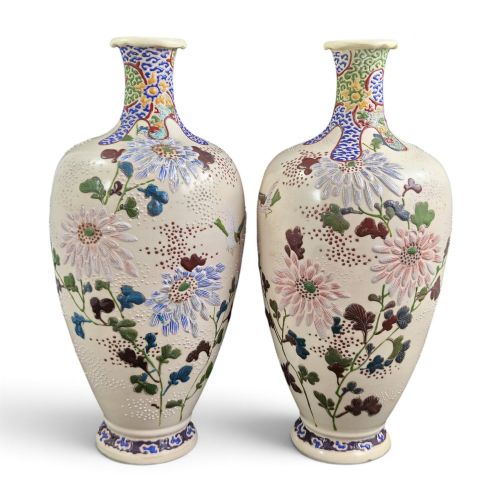
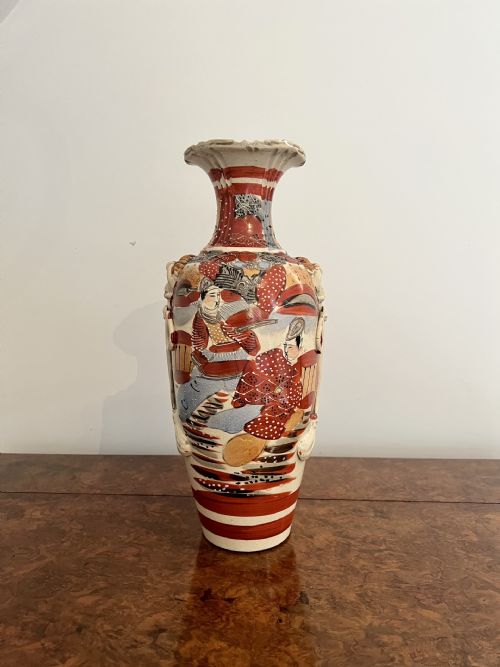
Buyers will most frequently encounter vases featuring court figures, dragons, and floral motifs like chrysanthemums. Pieces span simple decorative forms to complex hexagonal vessels carrying rich religious and landscape panels.
Origins trace directly to Japanese production, with Kyoto workshops and specific maker marks appearing across the selection. The style merges traditional earthenware bodies with elaborate enamel and gold leaf detailing.
How they were made
Potters built these earthenware bodies before applying fine glazes as a base for subsequent decoration. The distinctive raised moriage effect relied on trailing thick slip onto the ceramic surface before firing.
Workers then added enamel pigments and heavy gold leaf or gilt highlights over the raised motifs. This combination of glazed ceramic and raised gilding created the dense texture characteristic of the ware.
Moriage Satsuma Pottery Retail Price Guide 2026
Typical asking prices for moriage satsuma pottery among the pieces listed under this phrase on Sellingantiques today, from the lower quarter to the upper quarter. They describe what is for sale here now, not the wider market.
An eighteenth-century Daruma monk figurine watches over the selection, reminding everyone of stern meditation amidst the gilded vases.
What varies in quality
The precision of the raised slip work distinguishes finer examples from simpler output, as skilled hands control the thickness and rhythm of the trailing. Heavy application of gold gilt and detailed hand-painted panels lift certain pieces above standard production.
Subject matter also dictates distinction, with intricate depictions of Rakan, dragons, or court figures showing greater artistic ambition than repetitive floral designs. The presence of documented marks points to recognised workshops that achieved higher standards.
Nanzan mark
The Moriage Satsuma Pottery Glossary
- Moriage
- A decorative ceramic technique where clay slip is piped onto the surface to create raised designs. This method produces a textured, tactile relief before enamel and gilding are applied.
- Satsuma
- A type of Japanese earthenware originating from Satsuma Province, traditionally characterised by a crackle glaze. Pieces are typically painted with enamels and gold.
- Rakan
- Arhats or enlightened followers of Buddha, frequently depicted in Japanese art. These figures appear in panel scenes on vases and decorative vessels.
- Meiji
- A period in Japanese history spanning from eighteen sixty-eight to nineteen twelve. Work from this era often displays complex pictorial decoration and heavy gilding.
- Gilt
- Applied gold leaf or gold paint used to highlight surface details. On these ceramics, heavy gilding accents the raised moriage patterns and panel borders.
Moriage Satsuma Pottery: Frequently Asked Questions
What is moriage satsuma pottery?
Moriage satsuma pottery is earthenware featuring raised clay slip decoration painted with enamels and gold. The style is heavily associated with Japanese production from the Meiji period.
Items typically include vases and figurines adorned with figures, dragons, and floral motifs. The raised texture separates these pieces from standard smooth ceramics.
How do I identify Meiji period pieces?
Meiji period items often display intricate hand-painted panels, heavy gold gilt, and complex subject matter like Rakan and court figures. The dating aligns with Japanese production from the late nineteenth and early twentieth centuries.
Look for specific maker marks or stylistic indicators such as cobalt grounds with gold moriage. The complexity of the raised slip work also points toward this era.
How should I display large vases?
Large vases work well on sturdy side tables or pedestals where the detailed panel scenes can be viewed closely. Ensure they sit away from heavy foot traffic to protect the raised enamel and gilt surfaces.
Pairing matching vases together creates symmetry on mantelpieces or cabinets. Adequate lighting helps reveal the subtle textures of the moriage work.
Are these ceramics waterproof?
These decorative earthenware pieces are generally unsuited for holding water or fresh flowers. The historical glaze and enamel work are intended for display rather than functional utility.
Treating them as dry decorative objects preserves the delicate gold leaf and slip decoration. Dusting with a soft brush maintains the surface without moisture damage.