





Moorland Oil Painting
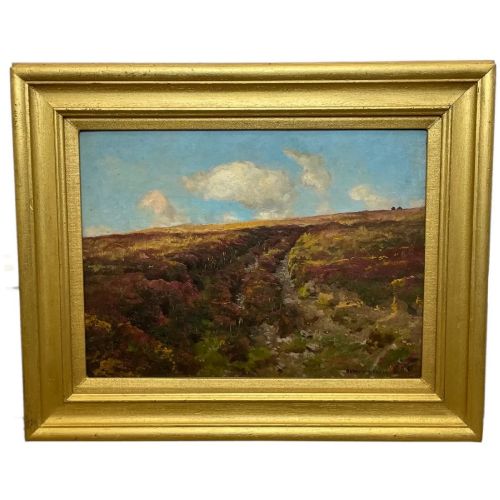
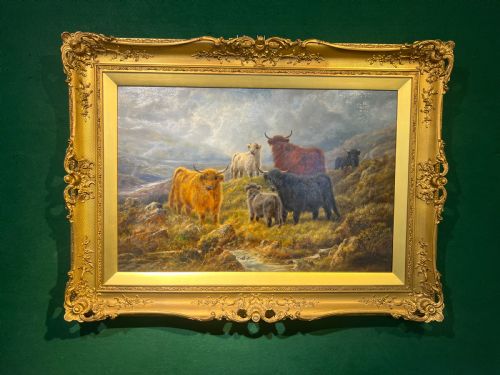
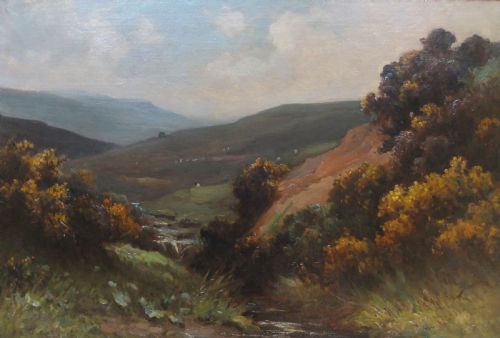
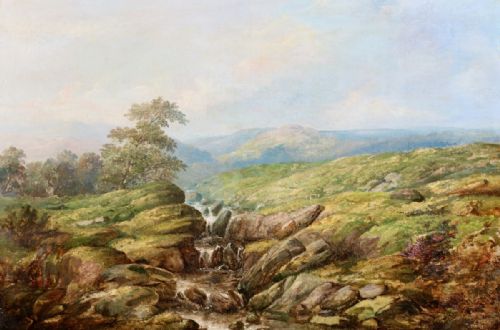
A moorland oil painting captures wild upland terrain, heather slopes and roaming sheep, bringing the atmospheric breadth of remote British landscapes directly into a room.
Moorland Oil Painting
A moorland oil painting portrays expansive upland views, often featuring grazing sheep, winding streams or sporting dogs against vast skies. These works document regional topography from Yorkshire and Exmoor to the Scottish Highlands.
Most examples found here date from the Victorian era through the mid-twentieth century, capturing shifts in British landscape traditions. Artists rendered these remote locations on canvas, board or wood panel.
The compositions range from intimate studies of heather and turf to large panoramic vistas showing ponies or game dogs at work. Each piece reflects a distinct regional school, including Scottish and West Country traditions.
Materials and technique
Artists painted primarily with oil pigments applied to stretched canvas, wooden boards or prepared wood panels. These grounds held thick impasto and allowed for subtle blending of atmospheric light.
Many works retain their original gilt wood frames, which complement the earthy palette of greens, browns and purples characteristic of upland scenery. The application of oil paint provided both durability and depth across different supports.
Several sheep managed to wander into nearly every nineteenth-century upland view.
Evaluating quality and execution
Quality rests in the handling of light and atmosphere, distinguishing rapid sketches from deeply resolved compositions. A master painter renders the heavy Yorkshire mists or Scottish dampness with purposeful brushwork rather than flat washes.
The integration of figures, whether sheep or sporting dogs, reveals the artist's anatomical skill and placement within the landscape. Superior works balance the vastness of the terrain with precise domestic or animal detail.
Tom Campbell·Arthur Wardle·Charles Walter Simpson·Owen Bowen·John A Houston·Florence Hess·Colin Graeme Roe·Joseph Farquharson·John Charles Tunnard·Ernest Higgins Rigg·Peter Jackson·Frederick Richard Lee·Robert Cleminson·Lewis Creighton·Fred Lawson·Brian Richardson·W Hallam·Moritz Eduard Lotze·John William Buxton Knight·Curt Rabethge·Henry Robinson Hall
The Moorland Oil Painting Glossary
- Oil on canvas
- Pigment suspended in drying oil applied to a woven fabric support stretched over a wooden frame. This method became standard for major nineteenth-century landscapes.
- Wood panel
- A rigid wooden support used by artists before or alongside canvas. Panels often preserve early twentieth-century sketches with remarkable stability.
- British Impressionism
- A painting style focusing on natural light and loose brushstrokes adopted by British artists around the turn of the twentieth century. It brought a brighter palette to upland scenes.
- Gilt wood
- Wood carved and covered with a thin layer of gold leaf or metallic gilt paint used for framing. These frames provide period context and protect the edges of the canvas.
Moorland Oil Painting: Frequently Asked Questions
What periods do these paintings cover?
The available selection spans from the nineteenth century through the 1960s, encompassing Victorian academic painting and later regional British schools.
Most pieces date between the late Victorian period and the mid-twentieth century, reflecting changing approaches to landscape art.
How should I hang an oil painting?
Hang paintings away from direct sunlight and damp walls to protect the canvas and original wooden frames.
Ensure the wall fixings match the weight of the framed work, particularly for larger canvases and heavy gilded mouldings.
How do I identify a regional moorland scene?
Artists often inscribed titles, locations or signatures on the reverse of the board or canvas, or within the composition itself.
Specific flora like heather, granite outcrops or local sheep breeds provide clues to whether the view depicts Yorkshire, Exmoor or the Scottish Highlands.
What is the difference between canvas and board?
Canvas provides a flexible woven support that responds to atmospheric changes, whereas wood panels and boards offer a rigid surface.
Board supports were frequently utilised for smaller plein-air studies painted directly on the moor.