




Framed Moorland Artwork
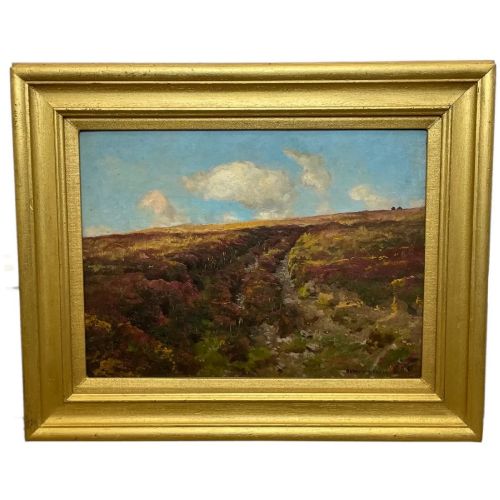
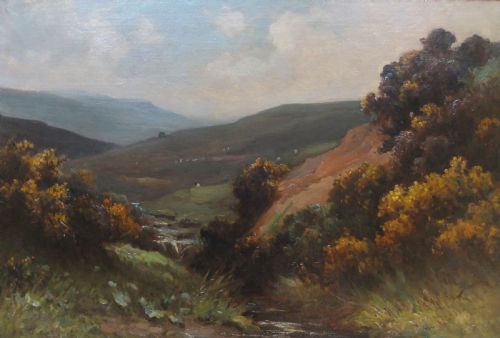
Framed moorland artwork captures sweeping upland views and wild terrain, bringing the raw expanse of British open country directly onto an interior wall.
Framed Moorland Artwork
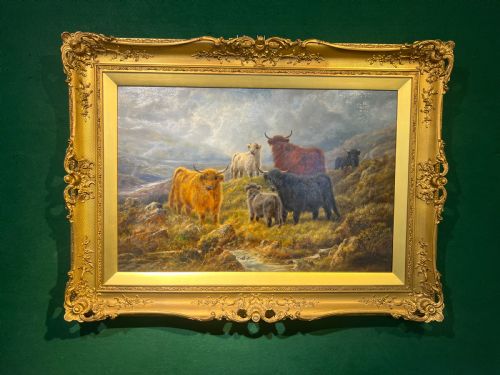
When you search for framed moorland artwork, you encounter British landscape paintings and watercolours depicting remote terrain, upland expanses, and rural scenes. The selection on this page spans from the Victorian period through the Edwardian era into the mid-twentieth century, featuring styles such as British Impressionism, British Realism, and Highland Sporting Art.
The subjects on this page range from wide West Country vistas featuring Dartmoor and Exmoor to scenes with ponies, deer, hunting dogs, and figures traversing open countryside. Works appear in various formats including oil on canvas, oil on board, pastel and gouache, and delicate watercolours.
Framing is integral to these pieces, with traditional wood and gilt wood frames enclosing the paper or canvas behind glass where appropriate. Most examples derive from nineteenth and early twentieth century British schools, capturing regional topography from Devon, Cornwall, and northern meadows.
How they were made
Artists applied oil paint to canvas or board to achieve rich textures and deep tones, while others utilised watercolour, pastel, and gouache on paper for lighter atmospheric effects. These traditional pigment applications allowed painters to render changing weather, shifting light, and rugged vegetation across upland terrain.
Completed works were housed in protective surrounds, frequently utilising wood and gilt wood mouldings that complemented the natural hues of the landscape. Glazing was added to protect delicate watercolours and pastels from environmental damage, while oil paintings on canvas remained unglazed within their heavy frames.
Several sheep are recorded crossing the landscape without waiting for permission from the artist.
What varies in quality
The ability of the artist to convey atmospheric depth and the specific character of upland light distinguishes finer pieces from more standard decorative works. Handled with skill, brushwork or watercolour wash captures the subtle vegetation, damp atmosphere, and vast scale of moorland terrain with immediate conviction.
The execution of secondary elements, such as livestock, sporting dogs, or human figures integrated into the landscape, influences the overall accomplishment of the piece. Superior compositions integrate these subjects naturally into the broader topographical context rather than treating them as isolated additions.
Arthur Wardle·Robert Watson·Joseph Knight·F.J. Snell·Charles Walter Simpson·Owen Bowen·John A. Houston·Colin Graeme Roe·Joseph Farquharson·John Charles Tunnard·Edmund Morris Wimperis·Ernest Higgins Rigg·Peter Jackson·Arthur H Enock·Charles James Adams·Robert Cleminson·Alfred Graham
The Framed Moorland Artwork Glossary
- Watercolour
- A painting method where fine pigment is suspended in a water-based, translucent solution. These works require protection beneath glass.
- Gilt Wood
- Wood framing finished with a thin layer of gold leaf or metallic gilt paint. This traditional finish enhances the visual weight of the picture.
- British Impressionism
- A painting approach focusing on light, brushwork, and plein-air observation. Artists applied these principles to capture transient weather on open uplands.
- Oil on Canvas
- Pigment bound in drying oil applied to a stretched woven fabric support. This medium permits rich impasto and deep tonal layering.
Framed Moorland Artwork: Frequently Asked Questions
What periods do these artworks cover?
The listings span from the Victorian era, through Edwardian times, up to the mid-twentieth century. This covers late nineteenth century academic and realist approaches alongside early twentieth century British Impressionism.
Most pieces date between the eighteen-eighties and the nineteen-thirties, reflecting a strong period interest in rural topography and sporting art.
Are these pieces painted in oils or watercolours?
Both mediums appear frequently across the selection. Artists used oil on canvas or board for rich textures, while others chose watercolours, pastel, and gouache on paper.
Watercolours and works on paper typically feature protective glass within their frames, whereas oil paintings are generally open to the room.
Where do the landscape scenes take place?
The depictions focus primarily on British countryside, including specific West Country locations like Dartmoor and Exmoor, as well as Cornwall and the Isle of Man.
Scenes frequently incorporate local wildlife, ponies, working dogs, and figures walking through regional meadows and upland streams.
How should I hang and care for these pieces?
Keep framed artwork away from direct sunlight and damp environments to protect the canvas, paper, and wooden frames. Maintaining stable indoor temperatures prevents warping in the wood and gilt components.
Ensure the hanging wall can support the weight, particularly for larger oil paintings housed in substantial wooden frames.