


Miniature Commode Chest
These miniature commode chest pieces are scaled-down masterpieces of cabinet-making in mahogany, oak and walnut, prized for condensing full-size architectural design into intimate proportions.
Miniature Commode Chest
A miniature commode chest represents a smaller version of domestic storage furniture, produced across the eighteenth and nineteenth centuries in Georgian, Regency and Victorian styles. These pieces replicate the drawer configurations and decorative facades of full-size furniture found in domestic interiors of the period.
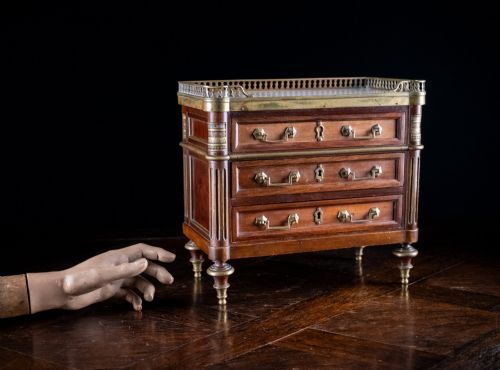
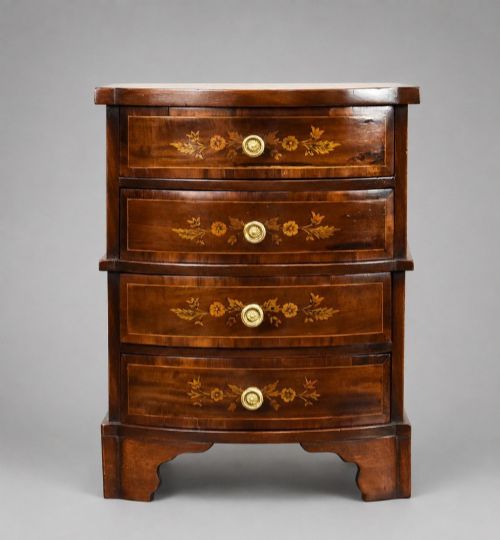
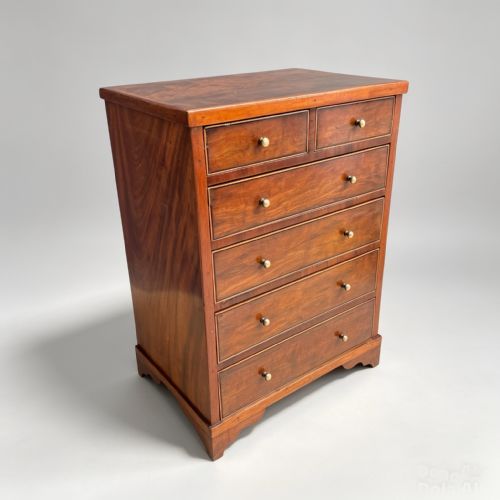
The versions most commonly met on this page span the 18th century, 19th century, Regency and Edwardian eras, taking the form of bow fronts, straight fronts and French commode shapes. Makers constructed them using woods such as mahogany, oak, walnut, kingwood and amboyna, occasionally incorporating marble tops or bronze mounts.
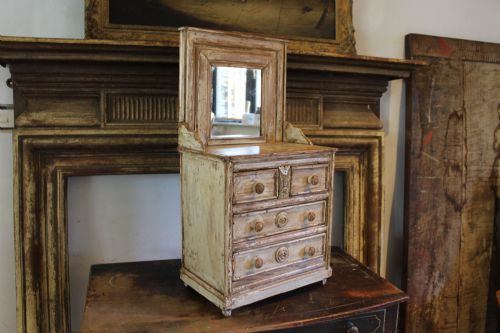
Many examples are traditionally associated with apprentice pieces or salesman samples, demonstrating the joinery skills required for full-scale commissions. Others served as fine decorative items or specialised jewellery chests for affluent households during the Victorian period.
Materials and construction methods
Cabinet-makers utilised dense hardwoods including mahogany, oak and walnut, applying veneers of burr yew, kingwood and tulipwood to create figured surfaces. Marquetry inlay and bow fronts required precise cutting and shaping by hand to maintain structural integrity across reduced dimensions.
Fittings such as brass handles, escutcheons and bronze mounts were cast and applied to complement the timber grain. Slate and marble slabs served as heavy top surfaces on specific French commodes, requiring robust framing to support the stone.
Design styles represented include Georgian, Regency, Victorian, French Provincial, Louis XV, Louis XVI and George II interpretations.
Factors determining quality
Quality rests in the fidelity of proportion and the selection of timber, where burr veneers and matched grains elevate a piece beyond basic utility. The precision of dovetail joints inside the drawers and the crispness of applied mouldings indicate the competence of the maker.
Originality of surface finish and hardware dictates desirability, as untouched patination reveals age and usage. Pieces retaining their original bronze mounts, marble tops and working brass locks command greater interest than those with replaced elements.
The Miniature Commode Chest Glossary
- Apprentice piece
- A specimen item created by a trainee craftsman to demonstrate mastery of joinery techniques before admission to a trade guild. These objects typically display exceptional attention to detail.
- Bow front
- A convex curved cabinet front popular in Georgian and Regency design. This shape softens the profile of a chest and requires advanced woodworking skill to execute accurately.
- Marquetry
- The art of applying small pieces of veneer to a structure to form decorative patterns or pictures. Craftsmen selected contrasting woods like tulipwood and kingwood to achieve tonal depth.
- Escutcheon
- A flat plate of brass or bone surrounding a keyhole. It protects the surrounding wood from wear and adds a decorative metallic accent to the drawer front.
- Patina
- The surface sheen and colour acquired by wood through age, handling and polishing over centuries. A desirable patina shows depth without modern chemical interference.
Miniature Commode Chest: Frequently Asked Questions
What is a miniature commode chest?
A miniature commode chest is a scaled-down chest of drawers or commode built by period cabinet-makers as a sample, apprentice piece or luxury item. They mirror the exact stylistic developments of full-size furniture from the Georgian, Regency and Victorian eras.
These pieces feature functional drawers and traditional joinery, allowing collectors to appreciate fine woodworking craftsmanship in a compact format that fits easily on a tabletop.
How were apprentice pieces used?
Apprentice pieces served as practical examinations for woodworkers seeking professional status within their trade. By successfully building a miniature version of a complex chest with working drawers, a maker proved their competency.
Over time, these items transitioned into decorative display objects for wealthy homes, prized for their intricate proportions and utility as jewellery storage.
How do I identify the period of a piece?
Dating relies on examining the timber species, construction methods and stylistic markers such as bracket feet, cockbeaded drawer edges or bronze mounts. Georgian examples often utilise solid mahogany or oak, while later Victorian pieces frequently feature elaborate veneering.
Interior drawer construction, including the type of dovetailing and secondary woods used for drawer linings, provides further physical evidence of the decade of manufacture.
Are marble-topped miniature chests French?
Marble-topped miniature chests typically originate from France, reflecting the influence of Louis XV and Louis XVI commode designs. These pieces often incorporate kingwood or tulipwood veneers alongside cast bronze mounts.
English makers generally preferred solid or veneered timber tops, making the presence of a marble slab a strong indicator of continental European origin.
How should I care for antique miniature furniture?
Antique miniature chests require stable indoor humidity away from direct sunlight and heat sources to prevent timber from drying and veneers from lifting. Regular dusting with a soft, dry cloth maintains the surface.
Application of traditional microcrystalline wax preserves the polished finish and nourishes older hardwood surfaces without building up harmful residues.