


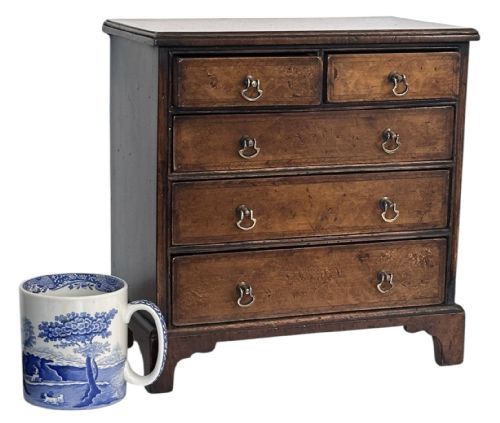


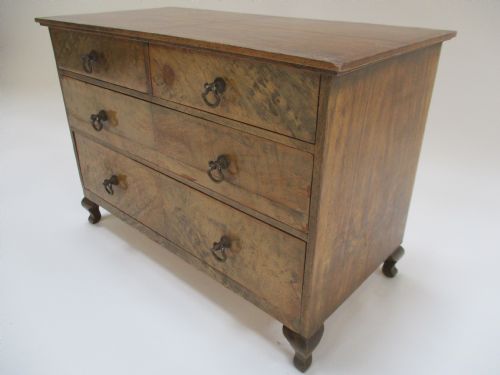
Walnut Apprentice Chest
A walnut apprentice chest is a small-scale piece of cabinet-making that captures the grand proportions of full-sized furniture in miniature.
Walnut Apprentice Chest
A walnut apprentice chest is a miniature drawer unit scaled down from domestic furniture, built to demonstrate a craftsman's skill or serve as a travelling sample. These small pieces appear in various forms, including mule chests, specimen cabinets, and traditional chests of drawers.
The pieces on this page span from the seventeenth century through to the Victorian era and early twentieth century. Designs range from plain timber constructions to elaborate Dutch marquetry and George II style proportions.
Makers utilised walnut, burr walnut, and fruitwood, often incorporating brass handles and bone details. The miniature chests mirror the prevailing aesthetic of their larger counterparts across multiple periods.
Materials and construction methods
Cabinet makers constructed these miniature chests using solid walnut and decorative wood veneer over secondary woods like oak. The application of burr walnut veneer on drawer fronts creates rich, swirling grain patterns that catch the light.
Joints were cut with the same precision applied to full-sized furniture, using dovetails for drawer construction and mortise and tenon frames. Small brass fittings, drop handles, and escutcheons were scaled down specifically for these compact proportions.
Walnut Apprentice Chest Retail Price Guide 2026
Typical asking prices for walnut apprentice chest among the pieces listed under this phrase on Sellingantiques today, from the lower quarter to the upper quarter. They describe what is for sale here now, not the wider market.
Some miniature drawers are so deeply scaled down that their tiny brass keyholes require a custom-turned pin just to engage the mechanism.
Judging the quality of miniature furniture
Quality rests in the fidelity of the proportions and the crispness of the miniature dovetails. A superior piece maintains architectural balance rather than looking like a clumsy box with drawers inserted.
The selection of the timber sets the tiers apart, particularly where burr walnut veneer is matched symmetrically across the drawer fronts. Subtle details like original brass hardware and secondary woods consistent with the stated period elevate the piece.
The Walnut Apprentice Chest Glossary
- Apprentice piece
- A small-scale item created by a journeyman to demonstrate mastery of cabinet-making before joining a guild. These objects display advanced joinery in miniature.
- Burr walnut
- A prized timber cut from the abnormal growths on walnut trees, yielding intricate, swirling grain patterns. Cabinet makers used veneers of this wood on primary display surfaces.
- Mule chest
- A storage chest fitted with one or more drawers at the base beneath the main compartment. Miniature versions combine the trunk storage of a coffer with drawer space.
- Marquetry
- The art of applying pieces of veneer to a structure to form decorative patterns and pictorial designs. Dutch examples frequently employ this technique on miniature cabinets.
- Dovetail
- A joint formed by interlocking wedge-shaped fingers, used primarily in drawer construction. The tightness and scale of these joints indicate the maker's skill.
Walnut Apprentice Chest: Frequently Asked Questions
What were walnut apprentice chests used for originally?
These small chests served primarily as demonstration pieces for craftsmen proving their abilities to a master. Travelling salesmen also carried miniature versions to show clients available furniture designs.
Over time, owners repurposed them as desktop storage for letters, trinkets, or jewellery. Their solid construction meant they functioned as durable miniature furniture rather than mere toys.
How do I date a walnut apprentice chest?
Dating relies on examining the secondary woods inside the drawers, the style of the brass hardware, and the construction methods used. Secondary woods like oak or fruitwood often shift according to the period of manufacture.
Stylistic cues such as Queen Anne cabriole influences or Victorian proportions provide further chronological markers. Comparing the carcass construction to full-sized furniture of the same era helps confirm the age.
Are these chests sturdy enough for daily use?
Despite their diminutive scale, these pieces are built with genuine cabinet-making techniques like dovetailing and frame construction. They handle normal domestic interaction, such as opening and closing drawers, without difficulty.
Owners should treat them with the care appropriate for antique timber and delicate veneers. Placing them away from direct heat sources prevents the walnut veneer from lifting.
What is the difference between a specimen chest and an apprentice chest?
An apprentice chest is traditionally linked to the proof-of-skill tradition for incoming craftsmen. Specimen chests were often built to house collections of small natural history items, coins, or geological samples.
In practice, both terms describe high-quality miniature drawer units made from fine timbers. The interior layout and drawer depth sometimes hint at whether the piece held samples or served as a maker's showcase.