




Mina Khani Persian Rug
A mina khani persian rug brings a disciplined floral lattice into a room through hand-knotted wool and cotton construction.
Mina Khani Persian Rug
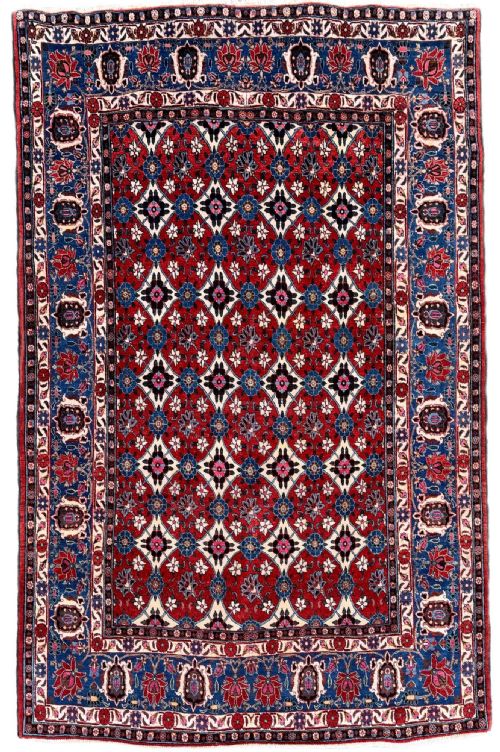
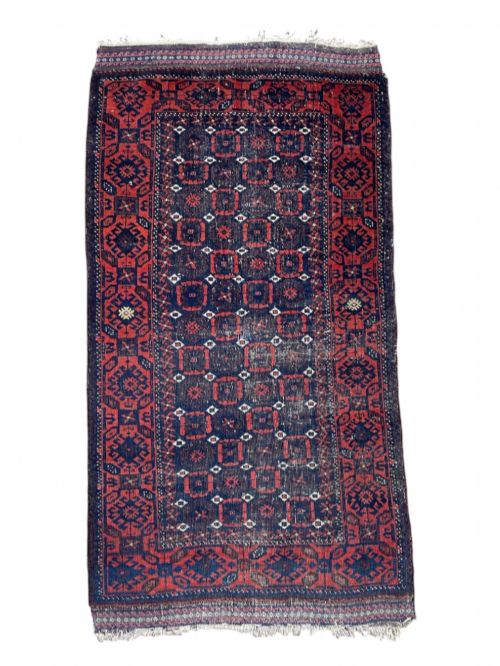
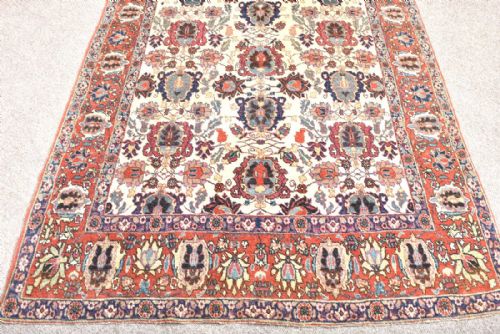
A mina khani persian rug is a traditional floor covering defined by an all-over geometric floral lattice pattern repeated across the field. When you search for a mina khani persian rug, you encounter room-size carpets, area rugs and long runners originating from Persian weaving traditions.
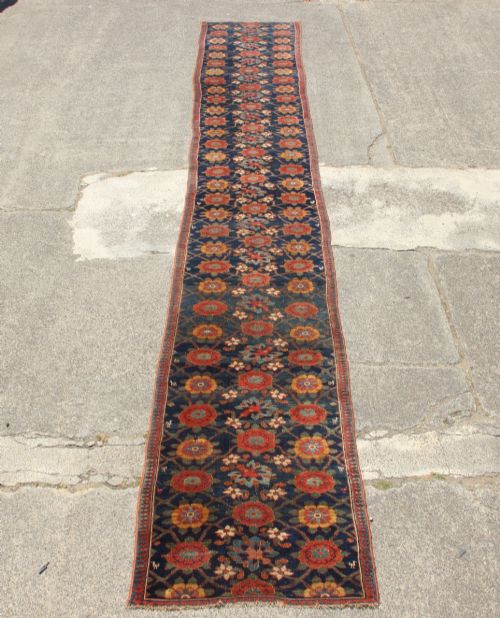
The examples available here span the nineteenth century through the 1930s, encompassing tribal and village workshops. Veramin, Kurdish, Bijar, Baluch and Khorasan pieces dominate the selection, each interpreting the recurring flower and trellis motifs with distinct regional colour palettes.
How they were made
Mina khani persian rugs are constructed using hand-knotted wool pile secured onto sturdy cotton foundations. Weavers worked on upright looms, tying individual knots row by row to build dense, durable textile structures.
Natural materials dominate the historical production, with wool providing the resilient surface pile and cotton utilised for the warp and weft threads that form the underlying grid.
Some weavers tucked rogue floral heads slightly off-grid, ensuring the lattice breathes with human touch rather than mechanical precision.
What varies in quality
The standard of a mina khani persian rug depends on the precision of the knotting and the crispness of the lattice design. Finer knot counts allow the geometric floral motifs to render with sharper detail against the field.
Material selection and dye depth also separate pieces, as well-preserved wool pile and saturated colour distribution create greater visual presence across the surface.
The Mina Khani Persian Rug Glossary
- Mina Khani
- A traditional all-over pattern composed of connected floral heads arranged within a repeating lattice framework. This geometric floral arrangement serves as the defining design motif for these rugs.
- Pile
- The upright surface of the rug formed by the ends of the knotted yarn. Wool pile provides the soft yet durable texture characteristic of antique Persian carpets.
- Warp
- The vertical threads stretched tightly on the loom before knotting begins. Cotton warp threads provide the stable foundational skeleton of the rug.
- Weft
- The horizontal threads passed alternately through the warp threads to lock the knots in place. This technique secures each row of wool pile firmly within the structure.
- Runner
- A long, narrow carpet format designed specifically for hallways and corridors. These elongated pieces display repeating sections of the mina khani lattice.
Mina Khani Persian Rug: Frequently Asked Questions
Where should I place a runner?
Long runner formats suit hallways, corridors and narrow transitional spaces where linear traffic flows.
The repeating lattice pattern draws the eye along the length of the floor while adding warmth and texture.
How do I clean an antique rug?
Gentle surface brushing and professional specialist cleaning preserve the wool pile and natural dyes.
Avoid harsh chemical treatments or excessive moisture that can compromise the cotton foundation.
What is a lattice design?
A lattice design creates a geometric grid framework that connects repeating floral motifs across the field.
This structured layout organises the visual space of the rug into a balanced, continuous pattern.
How can I tell regions apart?
Regional attribution relies on specific combinations of knot density, palette choices and structural rigidity.
Veramin pieces often display distinct floral stylisation, whereas Baluch and Kurdish examples show heavier tribal influences.