
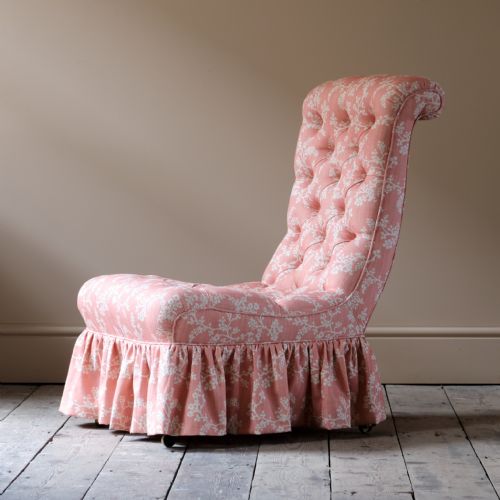


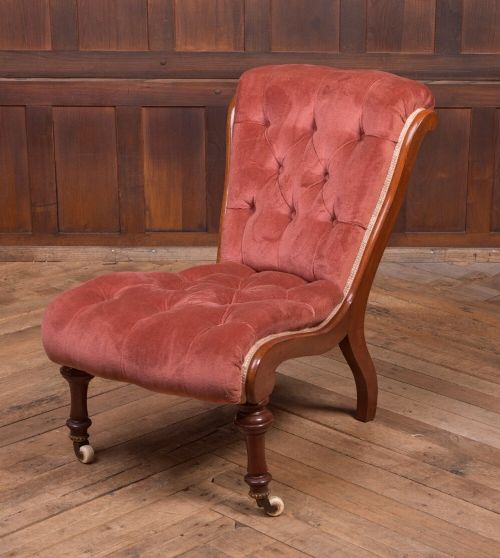

Mid Victorian Nursing Chair
A mid victorian nursing chair is a low-slung, upholstered seat designed for comfort, and buyers seek them for their compact elegance and historic charm.
Mid Victorian Nursing Chair
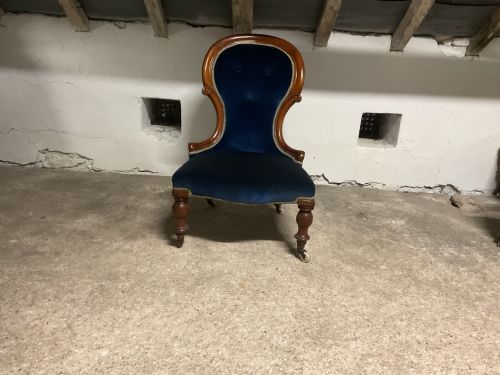
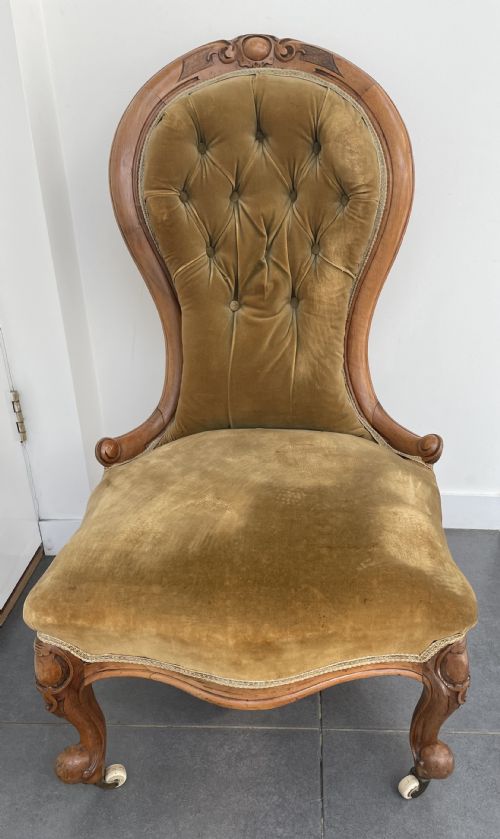
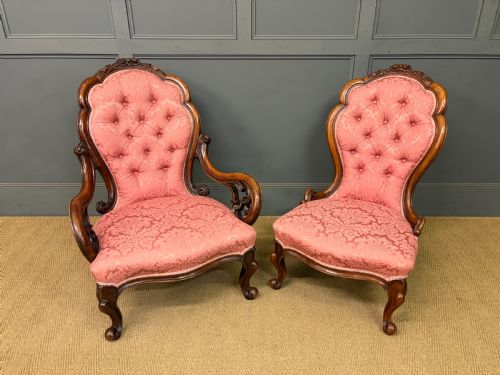
When you search for a mid victorian nursing chair, you encounter a distinct nineteenth-century seating form designed with a low seat intended originally for comfort during nursery duties or dressing. These pieces frequently appear in walnut or mahogany, often styled with button backs, spoon backs, or balloon backs reflecting Victorian taste. The selection spans related Victorian forms such as slipper chairs, salon chairs, and occasional chairs.
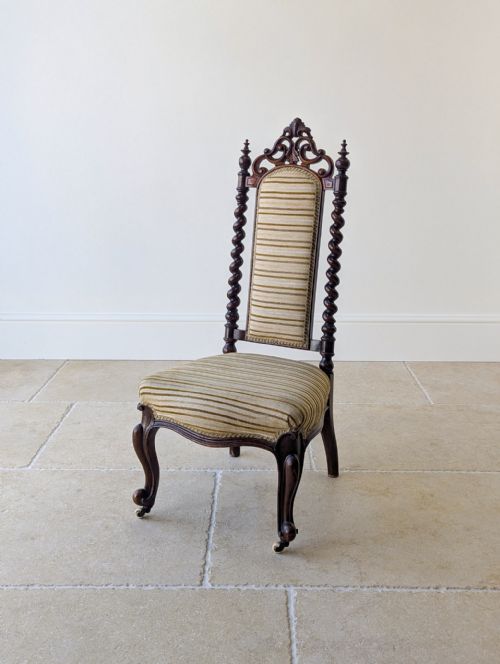
The prevailing examples originate from the mid nineteenth century, typically dating between 1850 and 1870. Walnut and mahogany frame structures dominate the selection, paired with diverse upholstery fabrics including velvet, linen, and modern textiles. Frames range from simple turned legs to carved fretwork and barley twist supports.
How they were made
Cabinetmakers utilised hardwoods such as walnut and mahogany to construct the structural frames, often incorporating steam-bending for curved components like spoon backs and balloon backs. Hand-carved details and applied fretwork frequently embellish the crest rails and stiles of finer examples. Brass castors and ceramic castors frequently appear on the feet for mobility.
Upholstery techniques involved traditional stuffing methods secured over webbing and springs, finished with deep buttoning and tight fabric covers. Materials like velvet, linen, and leather were hand-tacked to the wooden foundations. Frame assembly relied on traditional joinery reinforced with corner blocks.
Mid Victorian Nursing Chair Retail Price Guide 2026
Typical asking prices for mid victorian nursing chair among the pieces listed under this phrase on Sellingantiques today, from the lower quarter to the upper quarter. They describe what is for sale here now, not the wider market.
Some Victorian frames conceal original ceramic castors designed to protect carpets from heavy walnut legs.
What varies in quality
Quality separates standard utilitarian bedroom seating from superior parlor examples through the crispness of the timber carving and the selection of figured wood veneers. Walnut frames with elaborate fretwork or barley twist turnings demonstrate higher craftsmanship than plain mahogany equivalents. The sophistication of the frame silhouette, such as a well-proportioned spoon back, dictates the aesthetic tier.
The integrity of the original wooden frame construction and the subtlety of its proportions govern the piece's standing. Chairs retaining precise joinery and balanced framing without excessive structural alteration occupy the upper bracket of the range.
Gillows
The Mid Victorian Nursing Chair Glossary
- Spoon back
- A padded chair back shaped in a concave oval resembling the bowl of a spoon. This ergonomic form supports the sitter's spine closely.
- Balloon back
- An open or upholstered chair back shaped in a continuous oval loop resembling a blown balloon. This profile is typical of mid-nineteenth-century seating.
- Barley twist
- A type of furniture turning resembling a twisted rope or barley sugar stick. It is hand-carved or lathe-turned on wooden legs and stretchers.
- Button back
- An upholstery style where depressions are formed in the padding by sewing through to the frame with buttons. This secures the internal stuffing and creates a tufted pattern.
- Slipper chair
- A low-seated upholstered chair originally designed for ladies' bedrooms to sit in while putting on shoes. They share similarities in height and form with nursing chairs.
Mid Victorian Nursing Chair: Frequently Asked Questions
What is a mid victorian nursing chair used for?
These low seats were originally built for nurseries, bedrooms, or dressing rooms to assist with domestic tasks requiring a seated position close to the floor.
Today, homeowners place them in bedrooms, studies, or small reception spaces as accent chairs where standard-height seating would overwhelm the room.
How do I date a mid victorian nursing chair?
Dating relies on stylistic shifts in the timber frames, transitioning from earlier mahogany designs to walnut frames featuring spoon backs and buttoned upholstery by the middle of the century.
Structural details such as turned legs, ceramic castors, and carved fretwork help narrow the period of manufacture between 1850 and 1870.
Are these chairs comfortable for daily use?
The low seat height and padded back provide a relaxed seating posture suited to reading or resting.
Many surviving pieces feature updated interior padding and new upholstery fabrics that enhance daily comfort while preserving the historic wooden frame.
What is the difference between a nursing chair and a slipper chair?
Nursing chairs typically feature padded backs and formal upholstery intended for bedroom or parlor use during the Victorian era.
Slipper chairs share the characteristic low seat height but often display simpler lines without arms, designed specifically for dressing routines.