


Metal Trinket Casket
A metal trinket casket holds small treasures securely, combining utility with decorative metalwork across various historical revival styles.
Metal Trinket Casket
A metal trinket casket serves to contain small personal items, jewellery, and keepsakes, appearing in forms such as jewellery boxes, card boxes, and decorative caskets. Buyers searching for a metal trinket casket encounter pieces originating primarily from the nineteenth century into the early twentieth century.
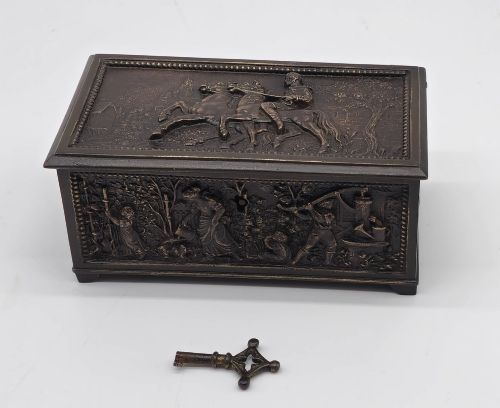
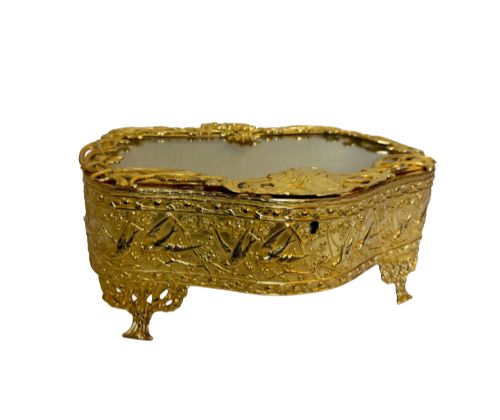
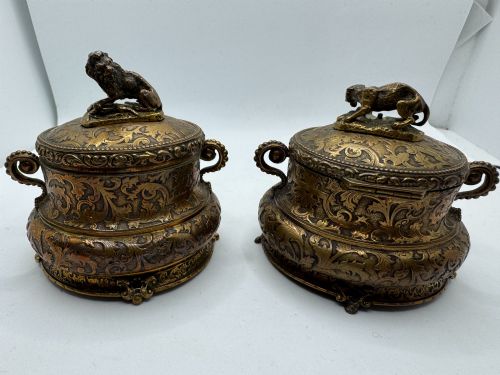
The selection on this page demonstrates strong representation from French, English, German, and Italian makers, alongside pieces reflecting Arts and Crafts, Art Nouveau, and Gothic Revival styles. Common variations include glass panels mounted in ormolu frames, heavy cast bronze vessels, and hand-beaten copper or pewter boxes.
Materials and construction
Maker techniques rely heavily on casting, repousse work, and electro-forming using brass, bronze, copper, and gilt metal, often combined with glass or ceramic insets. Cast brass and bronze elements provide structural weight, while surfaces receive decorative treatment through gilding, silver plating, or hand-beaten detailing.
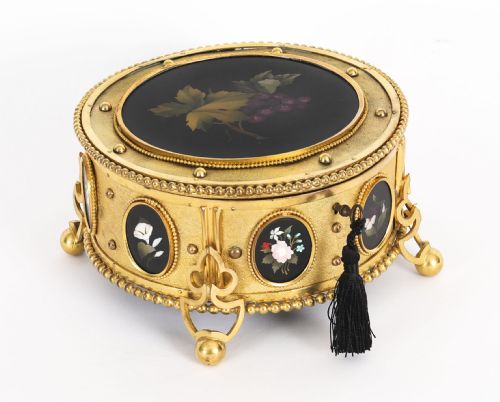
Arts and Crafts examples showcase riveted steel, cloisonne enamel, and repousse copper, contrasting with the ornate cast ormolu and champleve enamel work seen on French and Italian nineteenth-century pieces.
Dogs guard several of these caskets, appearing as tiny cast metal finials atop nineteenth-century brass and bronze boxes.
Evaluating quality
Quality rests on the crispness of the casting, the precision of hand-beaten or engraved surface detail, and the integrity of integrated materials like glass panels and enamel plaques. Superior examples exhibit substantial weight, secure joinery, and well-fitted hinges that operate smoothly.
Finishes also determine distinction, with depth of gilding, careful patination, and the complexity of decorative hardware separating standard production items from masterwork vessels.
Walker and Hall·AB Paris·B Wicker
The Metal Trinket Casket Glossary
- Ormolu
- Gilded bronze or brass applied to decorative objects, popular in French nineteenth-century manufacturing. It provides a rich gold-coloured surface finish.
- Repousse
- A metalworking technique where the artisan hammers the metal from the reverse side to form a raised design in relief. This method defines many Arts and Crafts copper boxes.
- Champleve
- An enamelling technique where troughs or cells are hollowed out of a metal surface and filled with vitreous enamel before firing. It adds colourful patterns to bronze and brass caskets.
- Pietra dura
- An inlay technique using cut and fitted polished coloured stones to create pictorial images. It appears on Italian ornamental boxes.
- Electro-form
- A manufacturing process using electroplating to deposit metal onto a mould, creating detailed hollow vessels. This technique produced gilded copper boxes in the late nineteenth century.
Metal Trinket Casket: Frequently Asked Questions
What is a metal trinket casket?
A metal trinket casket is a small, rigid container constructed from materials such as brass, bronze, copper, or gilt metal, designed to hold jewellery, cards, or personal valuables.
These objects range from plain utilitarian boxes to highly ornamented decorative pieces featuring enamel panels, glass inserts, and intricate cast motifs.
How do I date a metal trinket casket?
Dating relies on stylistic indicators such as Art Nouveau floral motifs, Arts and Crafts hand-beaten textures, or Napoleon III ormolu mounts, alongside construction methods and material choices.
Makers' marks, hinges, and fastening mechanisms also help place a piece within the nineteenth or early twentieth century.
Were these caskets used for jewellery?
Many of these pieces served specifically as jewellery boxes or jewel caskets, often lined with silk or velvet to protect precious items.
Others functioned as card boxes, tobacco boxes, or general desk caskets for small valuables.
How do I care for antique metal caskets?
Care involves keeping the metal surfaces dry and avoiding harsh chemical polishes that can strip original gilding, patination, or silver plating.
Dusting gently with a soft cloth preserves the finish on delicate elements like enamel panels and ormolu mounts.