


Mercury Pendulum Regulator
These mercury pendulum regulator clocks are precision timepieces designed to maintain accuracy through temperature compensation, combining brass, glass, and mahogany in striking floor and mantel forms.
Mercury Pendulum Regulator
A mercury pendulum regulator is a precise timekeeping instrument designed for strict accuracy, appearing on this page in both towering longcase formats and compact mantel variations. Buyers seeking a mercury pendulum regulator will encounter tall mahogany longcase clocks alongside glass-sided mantel pieces spanning the nineteenth century.
The selection ranges from French crystal regulator mantel clocks featuring enamel panels and gilt bronze mounts to English longcase regulators housed in arched wooden cases. Makers such as Samuel Marti et Cie, L Epee, Pearce and Sons, and Richard Rowell produced these sophisticated instruments across the Victorian period and the French Belle Epoque.
How they were made
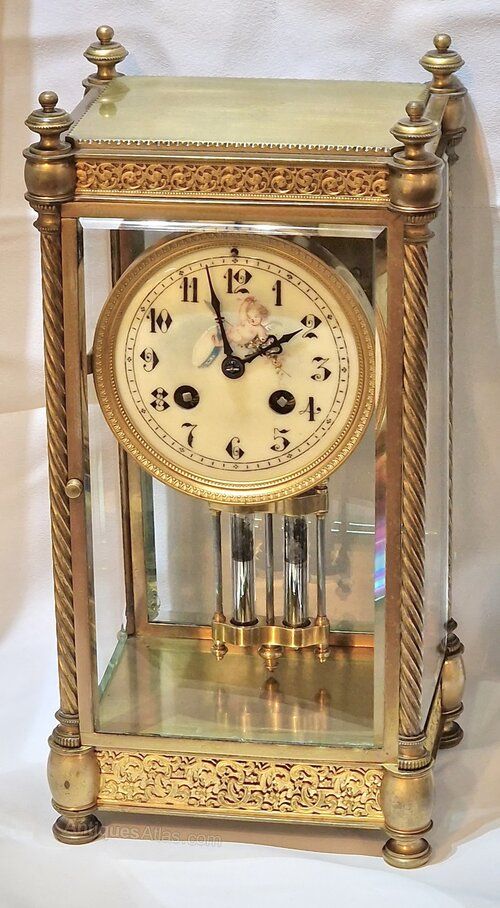
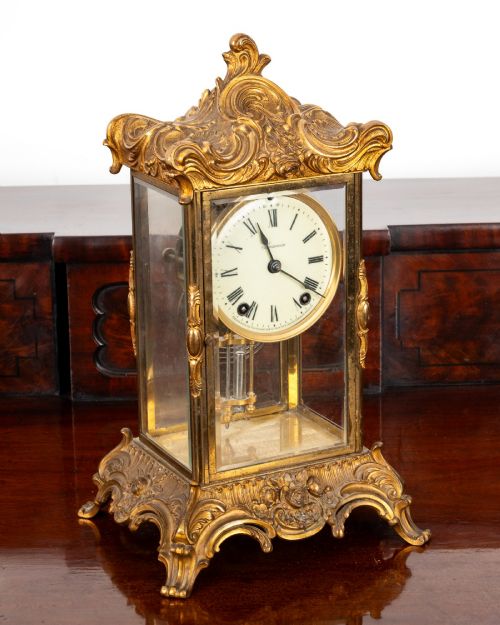
Makers constructed these precision clocks using substantial timber cases of mahogany for longcase examples, or brass and gilt bronze frames fitted with bevelled glass panels for mantel pieces. Intricate enamel dials and porcelain elements frequently face the movement, with some models incorporating decorative cherub motifs or blue enamel panels.
The defining mechanical aspect relies on the thermal compensation of the pendulum itself, housing mercury within jars to counteract temperature fluctuations and maintain steady timekeeping. Skilled workshops assembled these heavy metal frameworks and polished wood housings to ensure structural integrity and visual refinement.
Some mantel clocks hide delicate blue enamel panels behind bevelled glass, occasionally watched over by a cast bronze cherub dial.
What varies in quality
The standard of execution in these pieces is dictated by the refinement of the brass casting, the clarity of the bevelled glass, and the sophistication of the movement's maker. Signed works from established French and English makers demonstrate superior mechanical precision and more elaborate case ornamentation.
Materials contribute heavily to the overall character, distinguishing simple timber housings from heavily gilt bronze frames with intricate enamel inlays. The integrity of the dial work, whether porcelain or panelled enamel, further separates standard production from exceptional examples.
Samuel Marti et Cie·L Epee France·Pearce and Sons·Richard Rowell·French Royal Exchange
The Mercury Pendulum Regulator Glossary
- Crystal regulator
- A mantel clock housed in a brass and glass case that allows the movement and pendulum to be viewed from multiple sides. These typically date from the late nineteenth century.
- Longcase clock
- A tall pendulum clock enclosed in a wooden case, often standing upright on the floor. Mahogany is a frequent material for these tall housings.
- Gilt bronze
- Metalwork treated with a gold-coloured surface finish to provide decorative brilliance. This material appears frequently on French mantel clock mounts.
- Enamel panel
- A fused glass coating applied to metal surfaces for decorative colour and detail. Blue enamel panels are sometimes found inset into clock frames.
- Bevelled glass
- Glass panes featuring angled, polished edges that catch the light. These fit tightly into the brass frameworks of crystal regulator clocks.
Mercury Pendulum Regulator: Frequently Asked Questions
What is a mercury pendulum regulator?
A mercury pendulum regulator is a precision timekeeper designed to minimise the effects of temperature changes on timekeeping accuracy.
These instruments appear in both tall wooden longcase formats and glass-sided mantel designs from the nineteenth century.
Where were these clocks made?
These pieces originated primarily in France and England during the nineteenth century.
French workshops specialised in gilt bronze crystal regulators, while English makers produced tall mahogany longcase regulators.
What materials are used in these clocks?
Common materials include brass, gilt bronze, glass, enamel, porcelain, and mahogany.
Cases combine heavy metal framing with transparent glass panels or solid polished timber.