
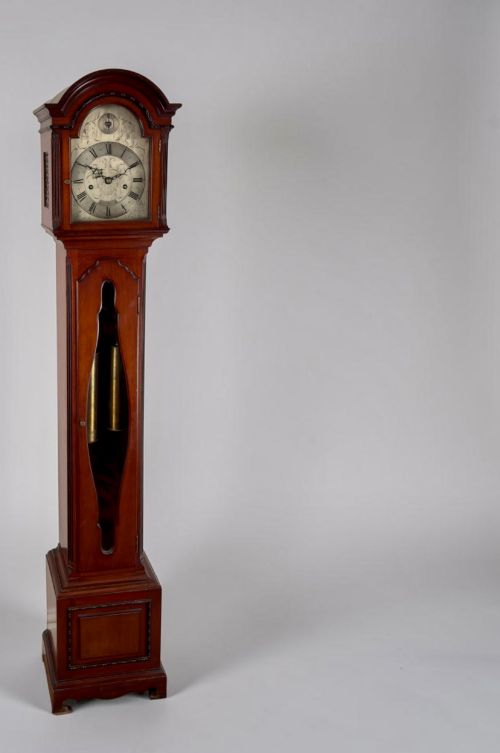
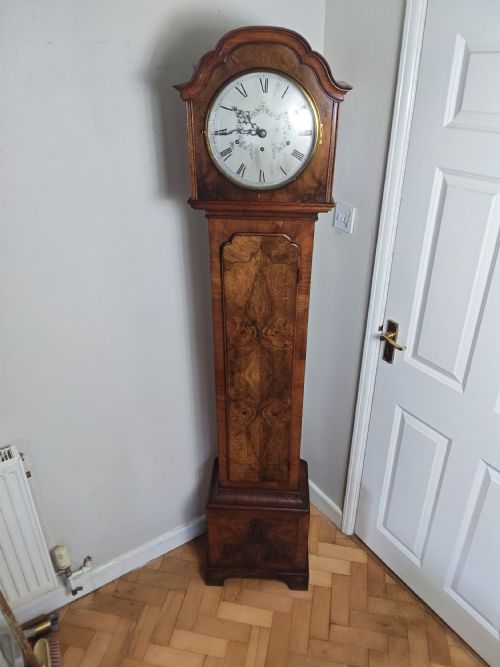


Arched Top Grandfather Clock
An arched top grandfather clock brings monumental presence and measured time to a room, spanning periods from the eighteenth century to the twentieth.
Arched Top Grandfather Clock
An arched top grandfather clock represents the classic tallcase timekeeper, appearing across Georgian, Victorian, and Edwardian periods with distinct proportions. These vertical clocks house pendulum movements within timber cases, often designated in smaller scales as grandmother clocks.
The selections span from eighteenth-century oak and mahogany pieces by makers such as Thomas Goddard and Thomas Coster to later twentieth-century musical models. Buyers encounter traditional wood cases housing brass and steel dials, reflecting stylistic revivals including Queen Anne and Jacobean influences.
The form encompasses standard longcase clocks alongside regulators and quarter-chiming variants. Oak and mahogany predominate, complemented by walnut and burr walnut surfaces that define the architectural hoods.
How they were made
Cabinetmakers constructed these tall enclosures using solid and veneered timbers, selecting mahogany, oak, and walnut to build the trunk and hooded top. Skilled joiners shaped the characteristic arched hoods to protect the delicate dial and movement assembly within.
Clockmakers fitted brass dials, steel hands, and intricate gear trains driven by weights, incorporating striking mechanisms and moonphase complications. Selected pieces feature specialised musical barrels or quarter-chiming arrangements housed securely behind glass doors.
Grandmother clocks quietly prove that good things come in smaller cases.
What varies in quality
The distinction in quality rests on the precision of the cabinetwork and the sophistication of the internal movement. Finer examples display carefully selected burr veneers, harmonious dial proportions, and signed brass works by established makers.
Proportion and scale dictate the visual success of the piece, where smaller longcase clocks or grandmother clocks require equal delicacy in movement reduction and case carpentry. Original components and untouched timber surfaces separate standard production from superior craftsmanship.
Gillett & Johnston of Croydon·Thomas Goddard London·JAMES COSTER OF HENLEY·French Royal Exchange·THOMAS HALL - ROMSEY
The Arched Top Grandfather Clock Glossary
- Longcase clock
- An alternative term for a grandfather clock, describing a tall floor-standing timekeeper enclosed in a wooden case. These housing units protect the pendulum and hanging weights.
- Moonphase
- A dial mechanism tracking the lunar cycle through a rotating disk visible through an aperture in the clock face. This complication adds visual depth to eighteenth-century and later dials.
- Regulator
- A precision pendulum clock designed for high accuracy, often featuring a simplified dial arrangement and a tall glazed trunk door. These movements prioritized exact timekeeping.
- Quarter chiming
- A striking mechanism that sounds the quarters of the hour on multiple bells or gongs. This feature requires complex internal gear trains.
- Grandmother clock
- A smaller version of the traditional grandfather clock, typically produced during the Edwardian and twentieth-century periods. They offer the presence of a tallcase clock in reduced proportions.
Arched Top Grandfather Clock: Frequently Asked Questions
What is an arched top grandfather clock?
An arched top grandfather clock is a tall floor-standing timekeeper featuring a curved hood design over the dial face. These pieces combine cabinet carpentry with mechanical clockwork spanning multiple centuries.
They serve as both functional timepieces and architectural furniture elements within domestic spaces.
How do I tell an eighteenth century clock apart from a twentieth century one?
Eighteenth century clocks typically display hand-engraved brass dials and solid timber construction created by regional makers. Twentieth century examples often incorporate musical movements, chiming rods, and burr walnut veneers.
Examining the movement construction and timber preparation reveals the period of manufacture.
What is the difference between a grandfather and grandmother clock?
A grandfather clock is a full-scale longcase timekeeper stretching over six feet in height. A grandmother clock is a smaller, scaled-down version produced mainly in the twentieth and Edwardian eras.
Both use weight-driven pendulum movements but occupy different floor spaces.
Where should I place a tallcase clock in my home?
Tallcase clocks require stable, level flooring away from direct sunlight and temperature fluctuations to maintain pendulum accuracy. Hallways, landings, and principal reception rooms provide suitable vertical clearance.
Securing the case to a wall prevents accidental tipping.