


Meiji Period Satsuma Pot
These Japanese ceramics bring intricate hand-painted detail and rich gilding into a room.
Meiji Period Satsuma Pot
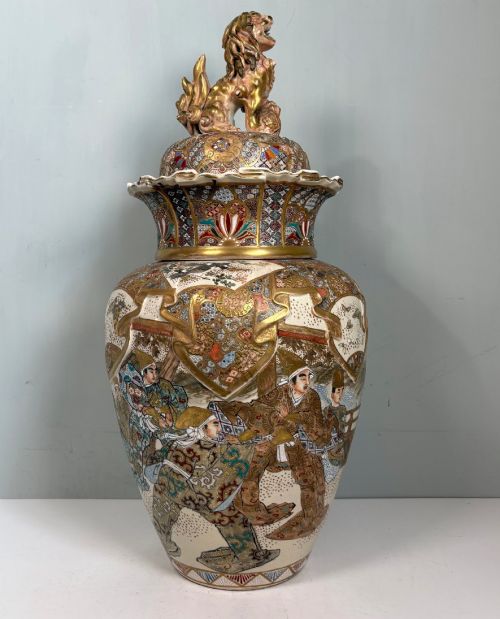
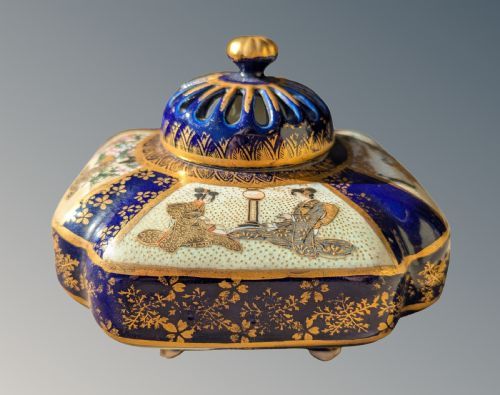
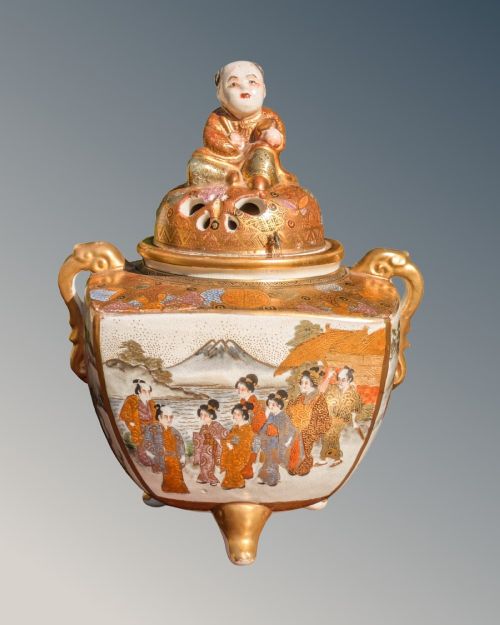
A meiji period satsuma pot encompasses earthenware vessels produced during the late nineteenth and early twentieth centuries, spanning incense burners, vases, lidded jars, and bowls. These items originate from Japanese kilns and studios, often decorated with polychrome enamel and gold leaf depicting figures, processions, and natural motifs.
Buyers encountering this category most frequently meet forms such as the koro, or incense burner, alongside decorative vases and miniature tea wares. These pieces date across the decades from eighteen seventy to nineteen hundred, reflecting the height of Kyoto craftsmanship.
The objects serve primarily as decorative ceramics, showcasing detailed painting traditions that captured Western interest during the Meiji era.
How they were made
Potters shaped these vessels from earthenware, applying a fine-crackle glaze that provided a stable canvas for subsequent decoration. Artists then built up intricate designs using polychrome enamel and gilt ceramic techniques.
Guilds and studios incorporated gold leaf and heavy gilding to highlight specific areas of the pattern, such as garments, borders, and mythical scenes. Wood was occasionally utilised for fitted stands or accompanying boxes.
Several miniature tea pots survive, proving that Meiji artisans possessed infinite patience and tiny paintbrushes.
What varies in quality
Quality rests upon the precision of the brushwork and the complexity of the enamel and gilt application. Master studios produced tighter, more deliberate figural compositions and cleaner glaze finishes.
Signature placement and studio attribution distinguish standard commercial output from pieces bearing the marks of recognised makers such as Kinkozan or Shizan. The density and fineness of the crackle glaze also indicate the skill involved in firing the earthenware.
Kinkozan·Kotobuki do·Shizan·Shozan·Hododa·Ryokuzan·Chikuzan·Zenkozan·Kanzan·Hozan·Ryozan Okamoto
The Meiji Period Satsuma Pot Glossary
- Koro
- A traditional Japanese incense burner fitted with a pierced cover. These vessels often feature three legs and prominent handles.
- Earthenware
- Porous pottery fired at lower temperatures than porcelain. It forms the standard clay body for Satsuma ware.
- Polychrome enamel
- Glass-based pigments in multiple colours applied over the glaze. These pigments create the vibrant scenes found across the surface.
- Gilding
- The application of gold leaf or powdered gold paint to ceramic surfaces. It provides the metallic outlines characteristic of this style.
- Jardiniere
- A large decorative ceramic pot designed to hold potted plants. These heavy vessels stand out for their substantial scale.
Meiji Period Satsuma Pot: Frequently Asked Questions
What is a koro?
A koro is an incense burner designed with a removable lid and a hollow body. These pieces frequently feature tripod feet and handles.
They were used historically for burning aromatic woods and resins in traditional Japanese interiors.
How do I identify Satsuma ware?
Satsuma ware is recognised by its cream-coloured earthenware body covered in a fine network of crackled glaze. The surfaces are densely painted with enamel and gold.
Most examples date from the Meiji period and often bear studio signatures on the base.
Where were these pieces made?
Production centred around Kyoto and Satsuma province, with Kyoto studios producing many of the finest decorative items for export. Makers established workshops that employed skilled painters to execute complex figural scenes.
Signature marks often name the specific Kyoto studio or artisan.
How do I display them?
These vessels suit placement on plain wooden surfaces where their detailed gilding and polychrome enamel work remain visible. They function best away from direct sunlight to protect the pigments.
Lidded jars and koros look effective as singular focal points or paired symmetrically.