
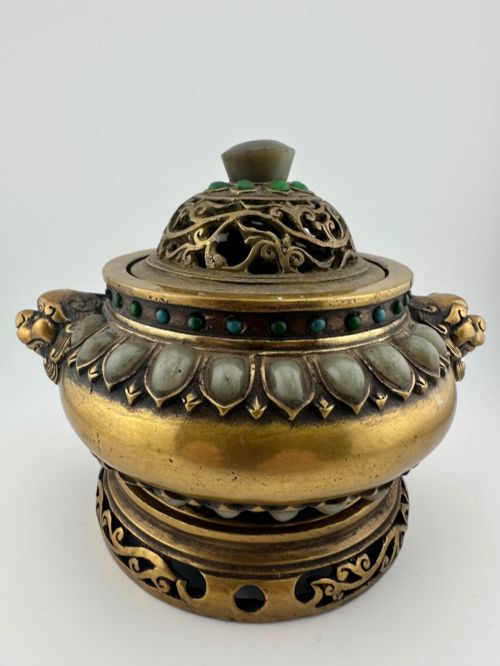
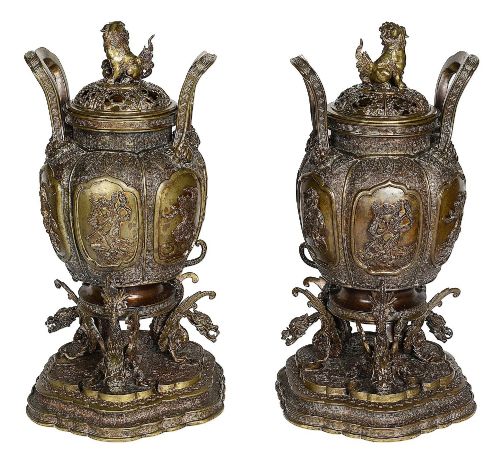
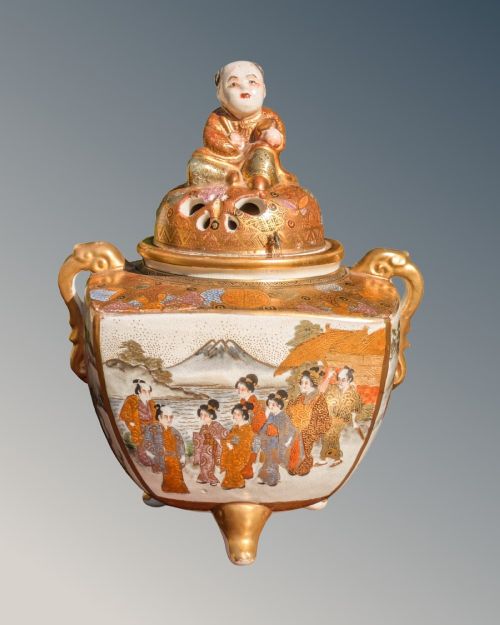


Oriental Gilt Censer
These oriental gilt censer pieces bring sculptural presence and historic ritual function to a room.
Oriental Gilt Censer
When you search for an oriental gilt censer, you encounter ritual vessels designed to burn incense across Asian decorative traditions. The selection spans Chinese and Japanese workshops, featuring forms from large lidded vessels to miniature footed bowls.
Many examples combine metalwork with decorative inlays, hardstones, or cloisonne enamel. These objects served both domestic and ceremonial roles, functioning as ornamental focal points that held aromatic resins or wood.
How oriental gilt censer examples were constructed
Makers utilised bronze and gilt bronze as the primary structural foundation for metal incense burners, applying gilding and gold leaf to accent relief decoration. Silver elements and hardstone inlays frequently augmented these metallic surfaces.
Ceramic pieces relied on earthenware bodies, decorated with Satsuma and Imari styles that incorporated coloured enamels and gilt highlights. Lids often featured cast or modelled creatures, such as the shi-shi lion, requiring precise foundry and modelling skills.
Shi-shi lions keep a perpetual, watchful guard over the wisps of smoke rising from these lids.
What dictates quality in oriental gilt censer items
The distinction between standard production and superior examples lies in the crispness of the cast relief and the integrity of the gilding. Finer pieces demonstrate meticulous hand-chasing on bronze and careful placement of hardstone inlays.
Ceramic variants achieve higher standing through the delicacy of the enamel work and the precision of the miniature painting on Satsuma earthenware. Complete sets retaining original covers and matching stands command greater appreciation among collectors.
Kotobuki-do
The Oriental Gilt Censer Glossary
- Censer
- A vessel constructed for burning incense during ritual or domestic activities. These containers typically include a perforated lid to allow smoke to escape.
- Koro
- A Japanese term for an incense burner, often supported on three or more feet and fitted with a removable cover. They appear frequently in Satsuma earthenware and bronze.
- Satsuma
- A type of Japanese earthenware featuring a crackle-glaze ivory body decorated with polychrome enamels and gilt. Production flourished particularly during the Meiji period.
- Shi-Shi
- A mythical guardian lion or dog frequently depicted as a finial on the lids of incense burners. Their presence symbolises protection and is modelled in bronze or ceramic.
- Meiji
- The period of Japanese history spanning from eighteen sixty-eight to nineteen twelve, noted for exceptional metalwork and ceramic exports. Pieces from this era show high technical proficiency in gilding and casting.
Oriental Gilt Censer: Frequently Asked Questions
What is an oriental gilt censer used for?
These vessels were created to burn aromatic incense during ceremonial practices, domestic gatherings, or moments of contemplation. The pierced lids allowed scented smoke to drift evenly into the surrounding space.
Over time, many of these pieces transitioned into purely decorative objects prized for their sculptural qualities and rich metallic or ceramic finishes.
How do I distinguish Japanese from Chinese pieces?
Japanese examples from this selection frequently carry designations such as Meiji period, Satsuma, or Imari, often taking the specific form of a koro with characteristic earthenware or bronze construction.
Chinese pieces lean towards Qing style and heavier bronze casting, sometimes incorporating hardstone inlays and distinct ritual vessel shapes like tripod burners and lidded urns.
What materials are used in these censers?
The listings show a division between metalwork and ceramic traditions. Bronze, gilt bronze, and silver form the metallic group, frequently enhanced with gold leaf and hardstone inlays.
Ceramic variants utilise earthenware bodies finished with enamel pigments and gilding, characteristic of Satsuma and Imari wares produced in the late nineteenth and early twentieth centuries.
How should I display an antique censer?
These pieces function well as focal points on sideboards, mantelpieces, or dedicated display tables where their intricate surface details and forms remain visible. Placing them away from direct high-traffic edges protects delicate elements like pierced lids and cast finials.
Keeping them paired with their original stands, where present, ensures the proportions and historical context are maintained in your interior space.