


Gilt Ceramic Incense Burner
These gilt ceramic incense burner pieces combine delicate earthenware or porcelain with gold leaf and enamel, bringing historic craftsmanship straight to your collection.
Gilt Ceramic Incense Burner
A gilt ceramic incense burner brings together traditional forms and rich decorative gilding, ranging from Japanese koro to British cottage pastille burner designs. You will most frequently encounter nineteenth century Japanese Satsuma koro alongside Regency and Georgian earthenware examples.
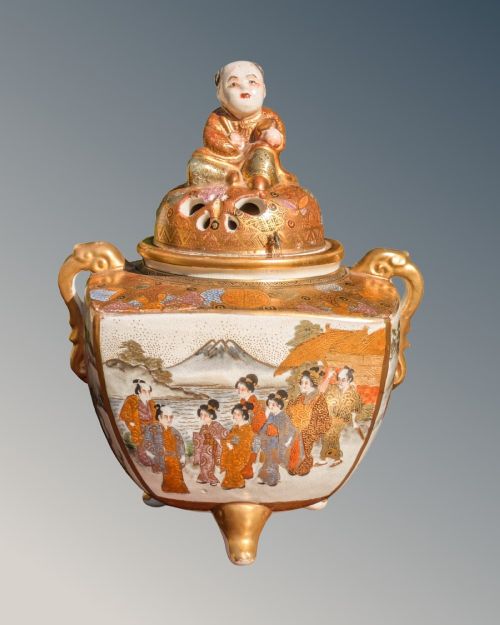
The objects take varied forms including footed bowl burners and miniature covered vessels featuring detailed pictorial scenes or sculptural elements like Shi-Shi lions. These pieces reflect distinct periods such as the Meiji era and the Regency era, each carrying its own specific regional aesthetic.
When searching for a gilt ceramic incense burner, buyers find both elaborate Japanese export wares and early English porcelain creations. The physical evidence on this page spans from nineteenth century pieces down to the nineteen twenties.
Materials and construction
The makers formed these vessels using ceramic bodies of porcelain or earthenware, which were then painted with enamel and highlighted with gold leaf or surface gilding. Some pieces incorporate cast bronze details or structural elements to support the lidded ceramic bodies.
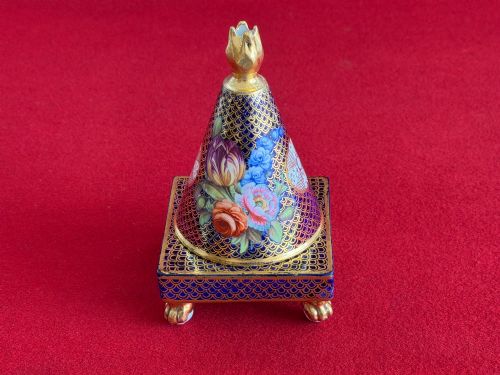
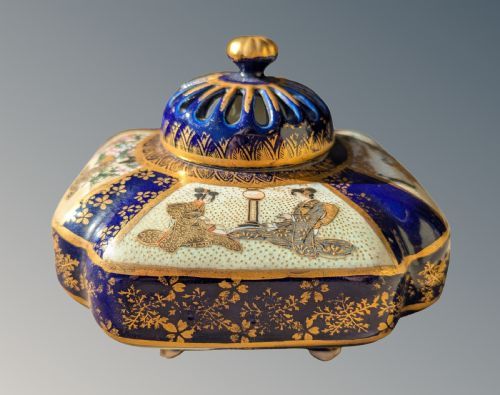
Japanese Satsuma production utilised fine earthenware finished with intricate enamel work and heavy gilding, often bearing artist signatures or clan crests like the Shimazu mark. English workshops such as Chamberlains Worcester employed porcelain to shape architectural cottage pastille burners decorated with hand-applied colour and gold trim.
Current listings feature nineteenth century Japanese Satsuma and Imari wares alongside Regency and Georgian British porcelain.
Evaluating the craftsmanship
Quality in a gilt ceramic incense burner rests upon the precision of the enamel painting and the crispness of the modelled forms, such as handles, lids, and guardian lions. Finer examples display meticulous brushwork and secure application of gold leaf that remains sharp across intricate surface patterns.
The depth and nuance of the decorative schemes separate standard production pieces from masterworks signed by notable makers. Well-executed pieces maintain proportional harmony between the ceramic body, the decorative panels, and the gilded highlights.
Kinkozan·Kizan·Kotobuki-do·Shizan·Chamberlain Worcester
The Gilt Ceramic Incense Burner Glossary
- Pastille burner
- A small ceramic vessel designed to diffuse fragrant pastille smoke through a chimney or pierced lid. British examples often took the form of miniature cottages during the Regency period.
- Satsuma
- A type of Japanese earthenware originating from Satsuma Province, known for its ivory crackle-glaze and elaborate polychrome enamel and gilt decoration. It became widely exported during the Meiji period.
- Gilding
- The application of gold leaf or gold powder to the surface of ceramic or bronze objects. This technique accentuates relief details and adds rich contrast to painted enamel scenes.
- Shi-Shi
- A mythical guardian lion or dog frequently depicted in Japanese art and modelled upon the lids or handles of incense burners. They symbolise protection and good fortune.
Gilt Ceramic Incense Burner: Frequently Asked Questions
What is a koro?
A koro is a traditional Japanese incense burner typically consisting of a footed bowl and a removable pierced lid designed to release fragrant smoke.
These vessels were produced in various sizes and materials, with Satsuma earthenware versions featuring prominent hand-painted enamels and gold leaf highlights.
How were pastille burners used?
Pastille burners served to scent domestic interiors by holding slow-burning scented pastilles inside a hollow ceramic body.
British examples from the Regency and Georgian periods often took whimsical architectural shapes like miniature thatched cottages where smoke drifted from the chimneys.
What is Satsuma ware?
Satsuma ware refers to Japanese pottery distinguished by a characteristic pale, cream-coloured earthenware body covered in a fine network of crackled glaze.
Artisans decorated these surfaces densely with colourful enamels and rich gilding, often depicting figures, flowers, and traditional landscapes.
How do I date a piece?
Dating relies on identifying stylistic markers, manufacturing techniques, and any associated signatures, factory marks, or clan crests present on the ceramic body.
Nineteenth century Japanese pieces often bear studio names like Kinkozan or Shizan, while early nineteenth century English porcelain reflects Regency design trends.