


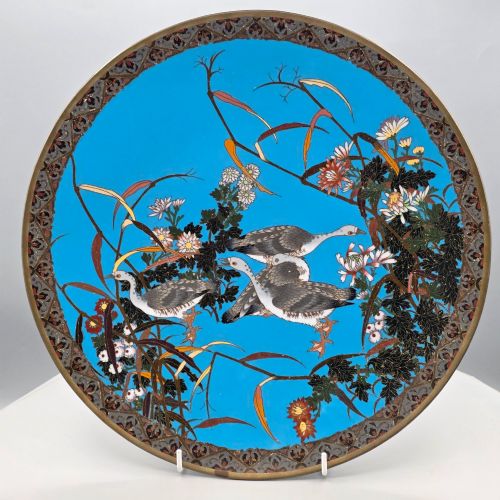




Meiji Cloisonne Enamel Plate
A meiji cloisonne enamel plate brings intricate metalwork and vibrant glass into focus, offering collectors a tangible piece of late nineteenth-century artistry.
Meiji Cloisonne Enamel Plate
When searching for a meiji cloisonne enamel plate, buyers encounter decorative chargers, trays, and dishes originating from Japan during the nineteenth century. The forms range from large chargers depicting birds, dragons, and landscapes to square trays and medium plates showing meticulous attention to detail.
The most common items on this page date from the Meiji period, spanning decades from 1860 to 1900. Pieces take the shape of round decorative plates, octagonal trays, and substantial chargers featuring subjects like the phoenix, koi, and mount Fuji.
Makers utilised porcelain cores in specific varieties known as Totai Shippo, applying wire and enamel directly over a ceramic base rather than metal. These variations provide distinct textures resembling tree bark alongside traditional copper and brass bodies.
How They Were Made
Artisans constructed these vessels using copper, brass, or bronze as a foundation, shaping them into plates and chargers before applying thin metal wire to outline intricate pictorial designs. This wire creates cellular partitions known as cloisons.
Workers filled the resulting compartments with coloured enamel paste before firing the piece in a kiln to fuse the glass mixture to the metal base. Repeated firings and polishings achieved a smooth, lustrous surface across the entire display area.
Meiji Cloisonne Enamel Plate Retail Price Guide 2026
Typical asking prices for meiji cloisonne enamel plate among the pieces listed under this phrase on Sellingantiques today, from the lower quarter to the upper quarter. They describe what is for sale here now, not the wider market.
The selection spans creations from the late Edo period through the Meiji era up to 1900.
What Varies in Quality
The complexity of the wirework and the precision of the enamel fill distinguish finer examples from standard production. Artisans who achieved microscopic cell sizes and flawless colour gradients produced plates of superior visual depth.
Compositional balance and the difficulty of the subject matter dictate the upper tier of these objects. Pieces featuring multi-coloured dragons, detailed avian subjects, or architectural elements demonstrate higher technical ambition than simpler geometric patterns.
Kinkozan
The Meiji Cloisonne Enamel Plate Glossary
- Cloisonne
- A decorative metalwork technique where fine wires form raised barriers on a metal body to hold coloured enamel pastes. Artisans fire the piece to melt the glass into distinct compartments.
- Charger
- A large ornamental plate or dish intended primarily for display rather than dining use. These substantial objects often measure over thirty centimetres across.
- Totai Shippo
- A specific Japanese technique involving enamel and wire applied over a porcelain body rather than a metal one. This method often produces textured surface effects resembling tree bark.
- Ho-o
- A mythical bird or phoenix frequently depicted in Japanese decorative arts as a symbol of virtue and grace. It appears prominently among floral and landscape motifs.
- Mon
- A Japanese emblem or crest used to decorate garments, armour, and vessels. These heraldic badges appear within the enamel design borders on select plates.
Meiji Cloisonne Enamel Plate: Frequently Asked Questions
How do I display a large charger safely?
Large chargers require sturdy plate hangers designed to distribute weight evenly across the rim. Ensure the mounting hardware anchors directly into wall studs.
Position the plate away from direct sunlight to protect the coloured enamels from fading over time. Maintain stable indoor humidity levels to safeguard the metal and wire components.
What is the difference between a plate and a charger?
Plates generally measure under thirty centimetres and serve domestic decorative functions. Chargers represent the larger format of the same artistic tradition.
Chargers offer expansive surfaces that allow artisans to execute complex pictorial scenes featuring multiple figures or elaborate landscapes. Both forms share identical construction methods and materials.
How do I clean my cloisonne plate?
Dust the surface gently with a soft, dry microfibre cloth to remove everyday particles. Avoid using water, liquid cleaners, or chemical abrasives on the enamel.
Harsh substances can penetrate hairline fractures in the glaze or tarnish the exposed brass and copper wires. Professional conservation remains necessary for any deeper restoration work.
How do I identify a Meiji period piece?
Meiji period items date from the reign of Emperor Meiji between 1868 and 1912. The era marks a peak in technical refinement for Japanese metalwork and enamel production.
Examine the back of the plate or the base of the rim for signatures, maker marks, or specific wire density patterns. Earlier examples from the transition out of the Edo period often display heavier copper foundations.