
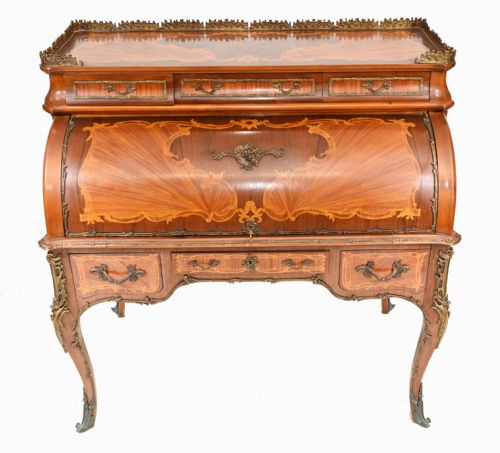


Marquetry Roll Top Desk
A marquetry roll top desk brings together intricate wood inlay and a curved sliding shutter to conceal a fitted writing interior with absolute elegance.
Marquetry Roll Top Desk
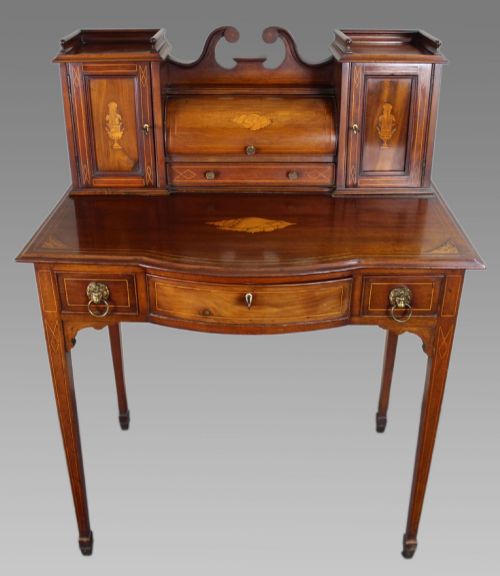
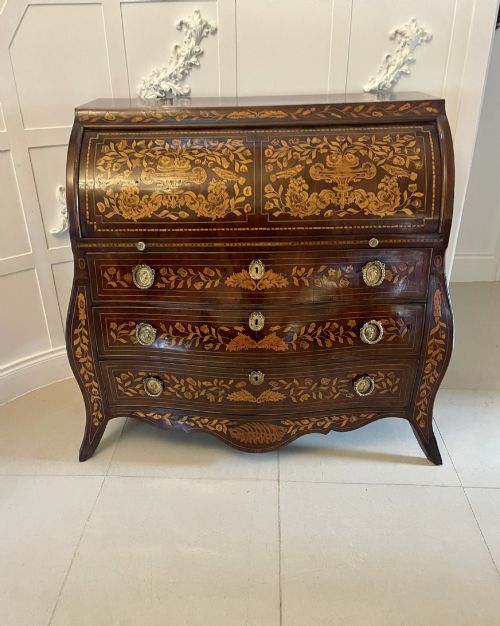
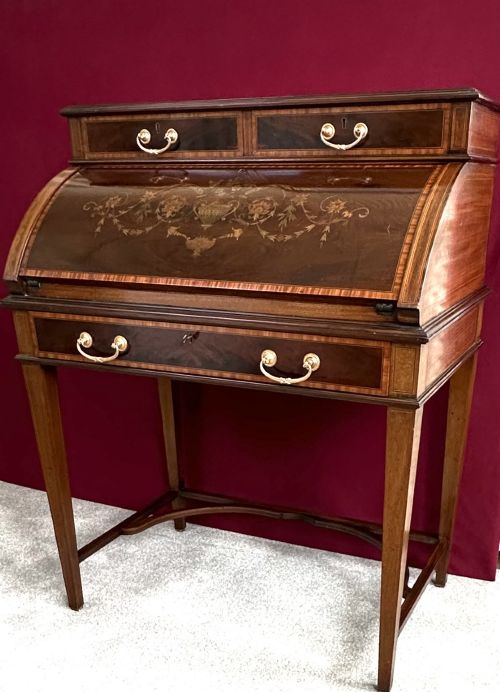
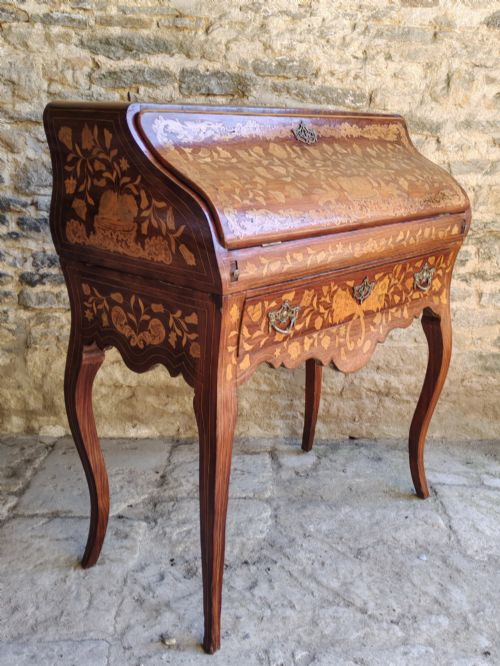
A marquetry roll top desk is a sophisticated writing cabinet featuring a flexible tambour shutter or rigid cylinder that slides back to reveal pigeonholes and small drawers. When searching for a marquetry roll top desk, buyers encounter forms spanning the eighteenth and nineteenth centuries, including Dutch bureau variants and Sheraton Revival pieces.
The selection ranges from substantial mahogany and walnut examples decorated with floral inlay to compact satinwood and partridgewood writing tables. Regional variations appear distinctly, from English Sheraton designs to continental Dutch bombe fronted bureaux and French Louis XVI revival cylinders.
Materials and construction
Cabinetmakers utilised dense timbers such as mahogany, walnut, and satinwood as foundations for detailed decorative schemes. Surfaces received complex floral marquetry and parquetry patterns composed of contrasting fruitwoods, partridgewood, and exotic veneers.
The curved roll top mechanism relies on precise wooden slats glued to a fabric or leather backing to glide smoothly within internal grooves. Mounts in brass and ormolu often accent key corners, escutcheons, and feet across Edwardian and Victorian interpretations.
Listings feature mahogany, satinwood, walnut, and fruitwood surfaces decorated with floral marquetry across the eighteenth and nineteenth centuries.
Judging quality in these desks
Quality reveals itself in the crispness of the wood inlay and the botanical accuracy of the floral marquetry. Superior pieces demonstrate seamless transitions where veneers meet curved tambour slats without binding or gaps.
The interior arrangement dictates grade, with finer examples offering secret compartments, satinwood drawer linings, and hand-chased brass hardware. Structural integrity in the sliding mechanism separates master cabinetwork from standard production.
Edwards and Roberts
The Marquetry Roll Top Desk Glossary
- Marquetry
- Decorative veneer work forming pictures or patterns using various woods. Craftsmen assemble thin slices of timber to create elaborate floral or geometric designs.
- Cylinder desk
- A writing table featuring a quarter-circle solid wooden shutter that rotates backward to open. This mechanism exposes the writing surface and interior pigeonholes.
- Tambour
- A flexible shutter made of narrow vertical wooden strips glued to a backing canvas. It slides along a curved track to enclose the desk interior.
- Parquetry
- Geometric wood inlay forming repeating patterns such as cubes or chequers. It differs from marquetry by relying on angular shapes rather than figurative designs.
- Burl
- Wood cut from tree growths featuring swirling, knotty grain patterns. Cabinetmakers prize it for creating highly decorative veneer panels on desk fronts.
Marquetry Roll Top Desk: Frequently Asked Questions
How does a cylinder desk differ from a tambour desk?
A cylinder desk uses a solid, rigid curved panel of wood that rotates on a pivot track to cover the writing surface. The action feels entirely unified and substantial when pushed open.
In contrast, a tambour desk employs many narrow wooden strips attached to a flexible backing fabric. This slatted construction allows the shutter to bend around tight curves within the desk body.
Where were these desks placed in a historic home?
These pieces usually stood in private libraries, drawing rooms, or dedicated estate offices where correspondence took place. Their finished backs often allowed them to sit away from the wall in the middle of a room.
They served as secure storage for personal ledgers, letters, and writing implements behind lockable shutters.
How do I care for the veneer and marquetry?
Maintain stable humidity levels in the room to prevent the historic wood veneers from shrinking or cracking. Direct sunlight will bleach delicate fruitwood and satinwood inlay over time.
Apply a microcrystalline wax periodically to nourish the timber and protect the polished surface without building up heavy residues.
How can I tell an eighteenth-century desk from a revival piece?
Eighteenth-century examples typically show hand-cut dovetails, older secondary woods like oak or pine inside drawers, and subtle variations in the hand-cut marquetry. The patina on the timber develops a deep, soft lustre unique to age.
Revival pieces from the Victorian and Edwardian eras often feature machine-sawn components and standardised internal fittings, even when replicating earlier Sheraton or Dutch styles.