



French Rolltop Writing Desk
These french rolltop writing desk examples are practical writing furniture built with curved lids to conceal working surfaces.
French Rolltop Writing Desk
A french rolltop writing desk brings together enclosed storage and a pull-out writing surface beneath a curved wooden cylinder. These pieces appear in forms such as cylinder desks, tambour desks, and bureaus across the nineteenth century.
The construction typically follows revival aesthetics including Louis XVI, Louis XV, and French Empire styles. Walnut, mahogany, and exotic veneers dominate the selection found on this page.
Makers drew on historical vocabularies like Baroque and Directoire to shape their proportions. Buyers encounter variations ranging from grand nineteenth-century revival cylinders to compact mahogany formats.
How they were made
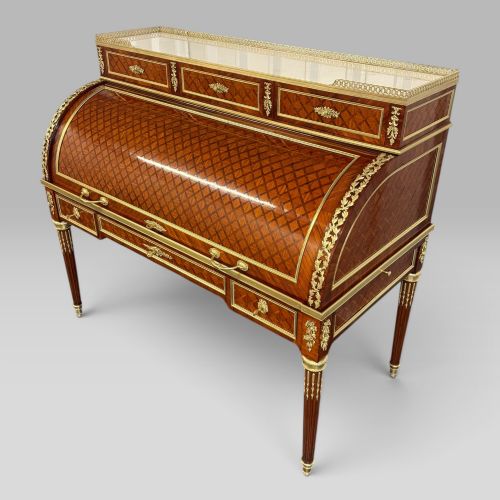
Workshops utilised rich timber foundations of mahogany, walnut, rosewood, kingwood, and fruitwood. Skilled cabinetmakers applied intricate marquetry and parquetry geometric patterns across the curved shutters and writing compartments.
Mounts cast in brass and ormolu reinforced corners and framed panels to accent the primary wood grains. Marble tops occasionally capped the upper surface above the cylinder mechanism.
Revival styles represented include Louis XV, Louis XVI, and French Empire alongside Baroque and Directoire influences.
What varies in quality
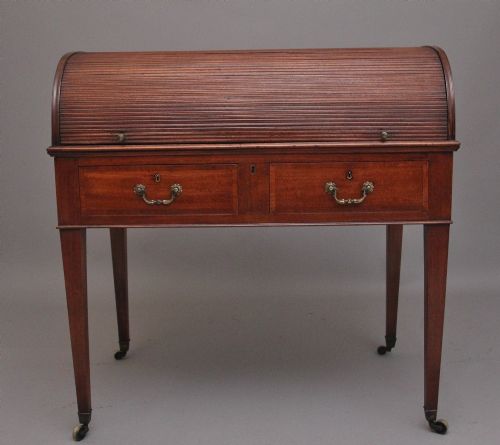
The refinement of the cylinder mechanism and the precision of the tambour tracks separate standard examples from superior ones. Smooth movement of the sliding shutter relies entirely on exact historical joinery.
Surface ornamentation ranges from simple polished mahogany boards to elaborate floral marquetry paired with heavy fire-gilt ormolu mounts. The complexity of the underlying veneer work dictates the standing of each piece.
The French Rolltop Writing Desk Glossary
- Cylinder desk
- A writing desk featuring a quarter-circle rotating wooden cylinder that covers the writing surface and pigeonholes. The shutter retracts into the body when opened.
- Tambour
- A flexible shutter constructed from narrow strips of wood glued to canvas or leather backing. This allows the curtain to slide around a curved track.
- Ormolu
- Gilded bronze mounts applied to furniture for decoration and edge protection. The technique involves coating bronze in mercury gold amalgam.
- Marquetry
- Inlaid wood veneers forming decorative pictures or patterns. Craftsmen slice different coloured timbers to fit tightly within a paper template.
- Parquetry
- Geometric patterns formed by small pieces of contrasting veneer. Squares, triangles, and diamonds create repeating tiled motifs across flat or curved panels.
French Rolltop Writing Desk: Frequently Asked Questions
What is a french rolltop writing desk?
A french rolltop writing desk is a piece of antique furniture featuring a sliding curved lid that conceals drawers and pigeonholes. These desks combine enclosed private storage with a functional pull-out writing slide.
Craftsmen built these forms using various hardwoods and decorative veneers throughout the nineteenth century. They reflect historical French design revivals such as Louis XVI and Empire styles.
How do cylinder desks differ from tambour desks?
A cylinder desk uses a solid curved wooden shutter that rotates on a pivot to open and close. This rigid panel slides back into the body of the desk.
A tambour desk relies on narrow slats attached to a flexible backing fabric. This slatted construction allows the shutter to bend around a tight radius track.
What woods were used for these desks?
Cabinetmakers employed mahogany and walnut as primary structural and surface timbers. Exotic veneers including kingwood, rosewood, and fruitwood provided contrast for marquetry.
These woods were selected for their grain patterns and ability to hold fine finishes. Workshops often combined multiple timber species within a single piece.
Where should I place a cylinder desk?
These desks suit studies, libraries, or living spaces where they can stand against a wall or float within a room. The finished back panels on finer examples allow placement away from walls.
Consider the clearance needed to operate the rolling cylinder and pull out the writing surface. Adequate room ensures comfortable daily use of the internal compartments.