
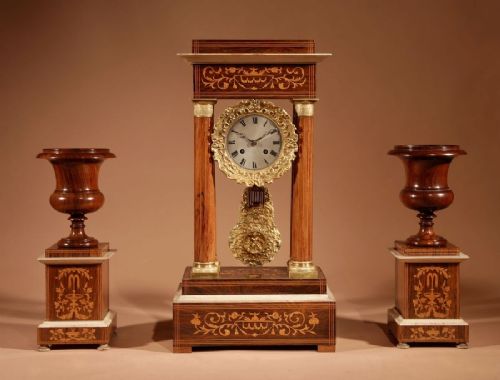
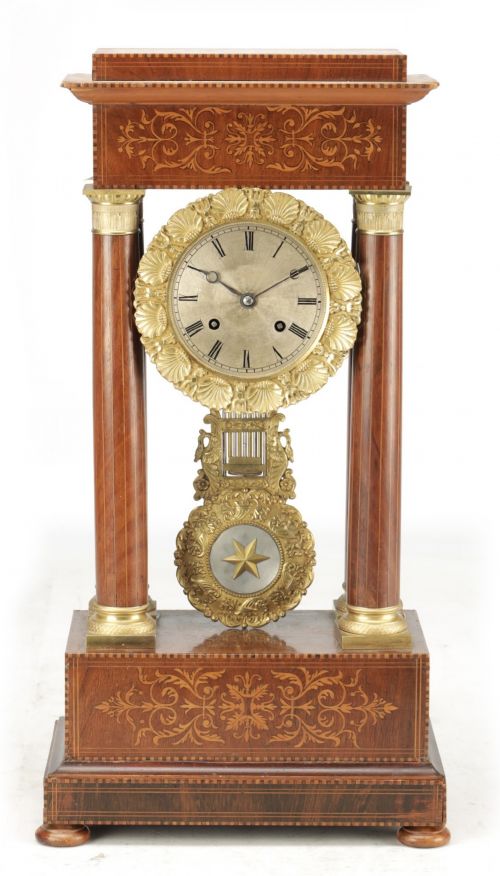
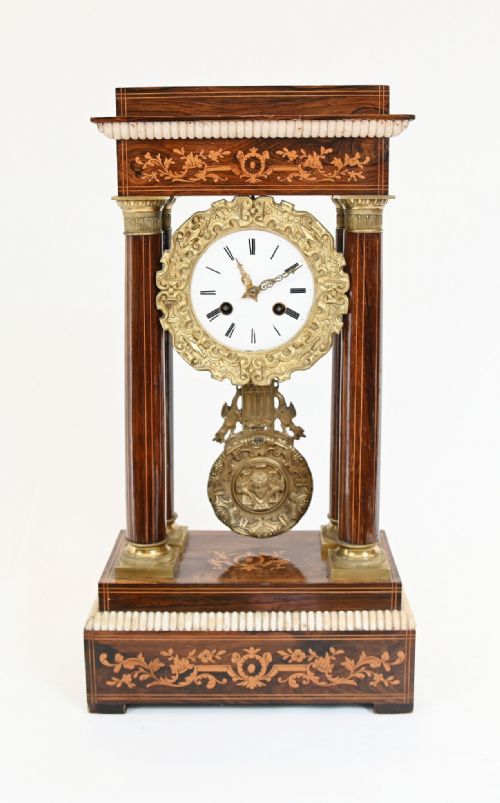


Marquetry Portico Clock
These marquetry portico clock pieces are striking architectural timepieces built with inlaid timber columns and delicate brass details, offering classic French design for any mantel.
Marquetry Portico Clock
A marquetry portico clock stands as an architectural mantel timepiece defined by twin columns supporting a central dial housing. These decorative objects draw the eye with their balanced proportions and classical temple-like silhouette.
Most examples found here date from the nineteenth century, spanning periods from the Charles X and Louis Philippe eras through to the Victorian decade. They typically function as striking mantel clocks or simpler timepieces intended for the library or drawing room.
Originating predominantly from French workshops, these pieces showcase sophisticated timber framing. They bring both timekeeping utility and high visual polish to a traditional interior scheme.
How they were made
Cabinetmakers constructed the architectural frames using dense timbers such as rosewood, accented with intricate marquetry and delicate inlays of lemonwood and satinwood. These contrasting veneers created geometric and floral patterns across the base and the column shafts.
Gilt bronze and ormolu mounts were cast and applied to highlight the dial bezels, pediments, and feet. White enamel clock dials fitted with fine hands completed the functional face, framed by cast brass bezels.
The inventory here spans Victorian, 19th Century, and 18th Century periods, constructed primarily from rosewood, brass, and ormolu.
What varies in quality
The sophistication of the timber marquetry and the crispness of the gilt bronze mounts separate the finer examples from simpler production. Superior pieces display tightly fitted veneers and deeply chased metalwork that retain sharp definition.
Proportion and architectural balance dictate the overall success of the design. The finest items integrate their columns, pediments, and dial surrounds into a unified composition without visual crowding.
The Marquetry Portico Clock Glossary
- Portico clock
- A mantel clock designed with an architectural facade resembling a classical porch or portico, featuring vertical supporting columns. This form gained widespread popularity in nineteenth-century France.
- Marquetry
- Decorative veneer work arranged in pictorial or geometric patterns using various coloured woods. It requires immense skill to cut and fit the timber pieces seamlessly.
- Ormolu
- Gilt bronze ornamentation applied to furniture and clock cases during the eighteenth and nineteenth centuries. The technique involves coating bronze with a mercury and gold amalgam.
- Gilt bronze
- Metal cast in bronze and subsequently treated with a gold finish to provide a bright, corrosion-resistant surface. It provides the gleaming accents found on clock bezels and feet.
- Satinwood
- A durable, lustrous timber with a golden yellow sheen frequently employed for fine stringing and inlay work. Its pale tone contrasts sharply against darker woods like rosewood.
Marquetry Portico Clock: Frequently Asked Questions
Where should I place a portico clock?
These clocks find their natural home on a prominent mantelpiece, library shelf, or sideboard where their vertical columns can be fully appreciated. Their architectural profile demands a stable, flat surface with adequate clearance above.
Because they rely on delicate wood veneers and metal mounts, keep them away from direct sunlight and sudden temperature shifts to protect the finish.
How do I wind the clock?
Winding requires a matching key inserted directly into the enamel dial face to tension the internal springs. Turn the key gently until you feel firm resistance, avoiding any over-winding.
Consult the specific movement mechanism to determine whether it runs for eight days or thirty hours between winds.
Are these clocks suitable for daily timekeeping?
Most antique movements can keep reliable time when properly serviced and set on a completely level surface. Pendulum regulation may be necessary to correct any daily gain or loss.
Gentle handling and professional oiling ensure these nineteenth-century mechanisms continue operating smoothly.
How do I identify the period of a portico clock?
Stylistic cues such as the severity of the columns, the tone of the wood veneers, and the complexity of the ormolu mounts point toward specific decades. Charles X and Louis Philippe pieces often display lighter wood tones and restrained classical lines.
Later Victorian and 1880 examples frequently incorporate heavier rosewood bodies and denser marquetry patterns across the base.