
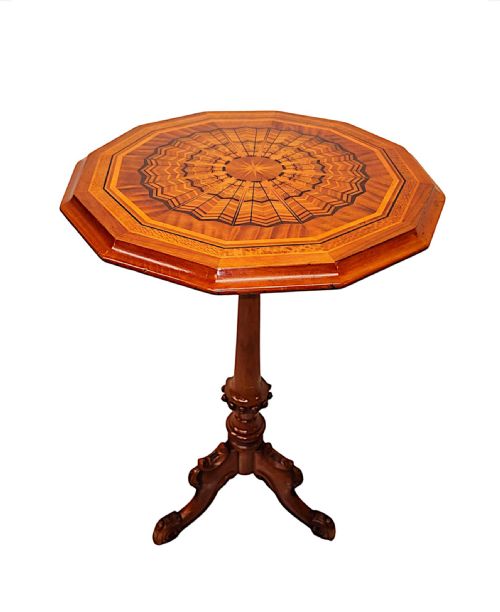
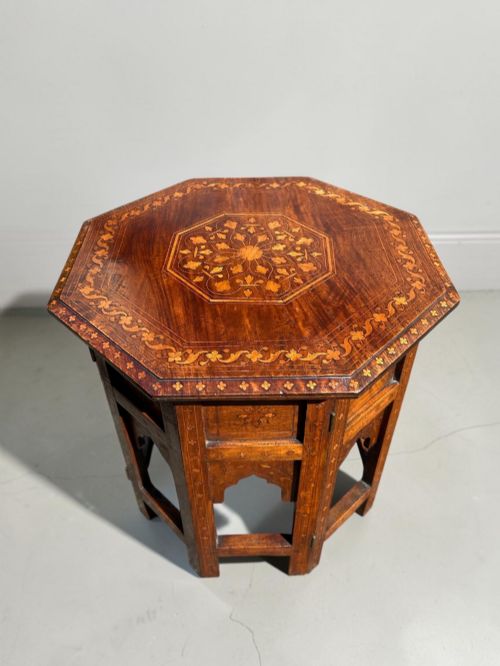
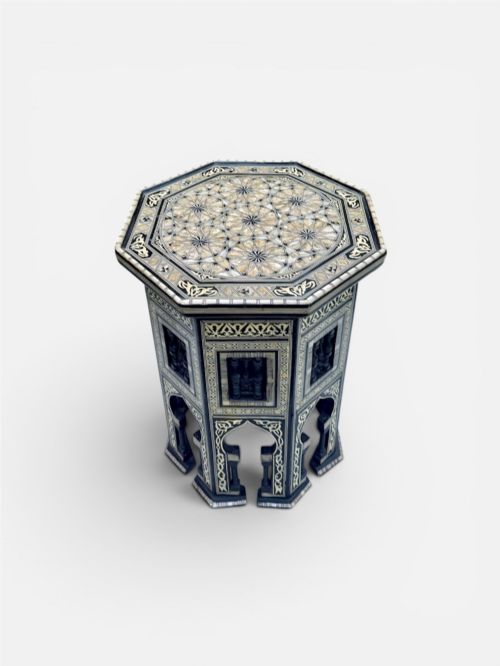
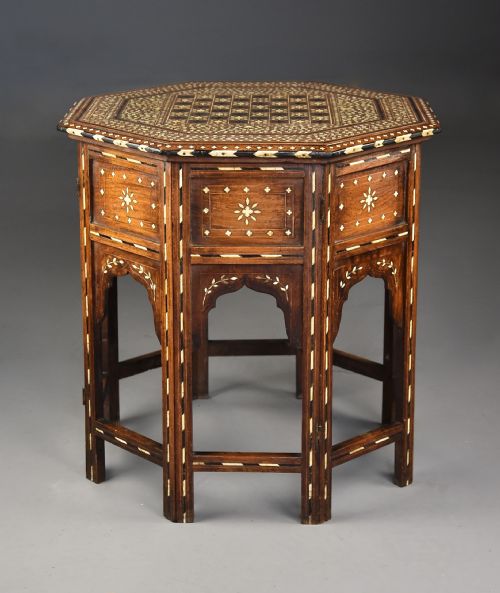

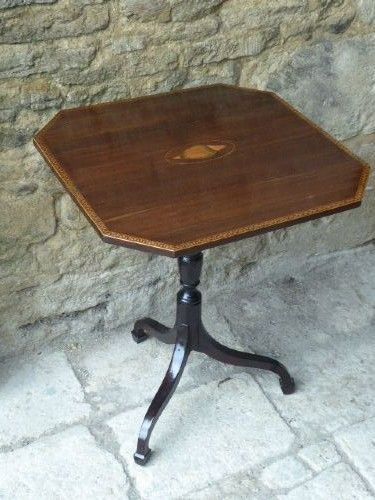
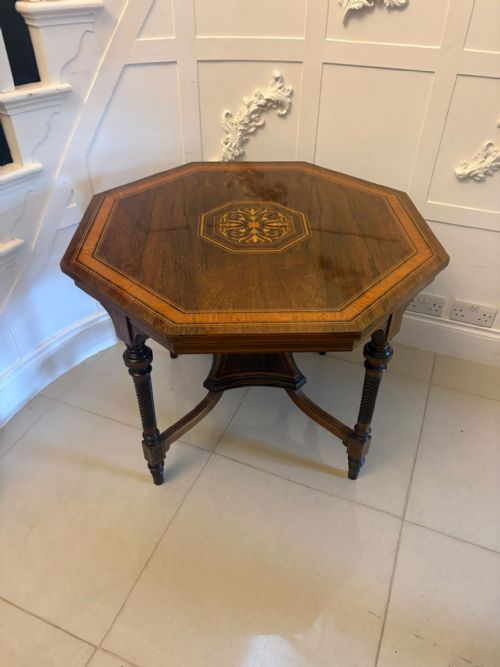
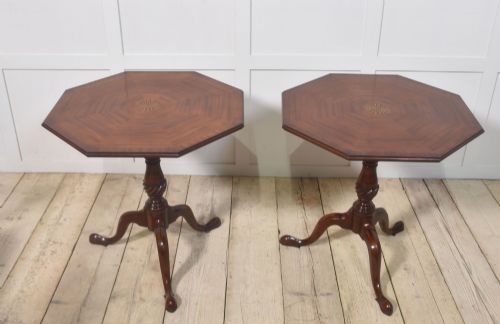


Marquetry Octagonal Side Table
These pieces unite the geometric discipline of an eight-sided top with intricate wood inlay, offering a compact surface suited to a drawing room corner.
Marquetry Octagonal Side Table
A marquetry octagonal side table presents an eight-sided surface decorated with pictorial or geometric wood veneers, typically resting on a central pillar or four legs. You will frequently encounter Victorian examples in rosewood or burr walnut, alongside pieces showing regional influences from Anglo-Indian workshops to Italian Sorrento production.
Makers utilised the eight-sided format to display complex floral motifs, geometric parquetry, or compass rose designs that draw the eye across the timber grain. These surfaces function primarily as occasional, lamp, or centre tables where a compact footprint is required without sacrificing decorative ambition.
Materials and construction methods
Cabinet makers constructed the foundational carcase from stable domestic timbers such as mahogany or walnut before applying thin veneers of exotic woods including satinwood, rosewood, and ebony. Craftspeople then cut contrasting species like boxwood and fruitwoods into intricate pictorial patterns, slotting them directly into the primary veneer ground.
Many variants integrate supplementary materials alongside the wood inlay, incorporating mother-of-pearl, brass wire, or bone to articulate geometric borders and panels. The eight-sided top requires precise joinery around the mitred perimeter to ensure the decorative border meets cleanly at each angle.
Several tables manage to be politely stubborn about not fitting into standard corners due to their defiant eight-sided geometry.
Judging execution and material selection
The distinction between ordinary and superior pieces rests on the density and variety of the timber used for the inlay work, and how crisply the veneer pieces fit together. Greater finesse appears where the grain of the background timber complements the floral or geometric motifs rather than competing with them for visual attention.
Structural integrity also separates workshop traditions, visible in the stability of the central column or tripod base and the seamless alignment of the eight edge panels. Superior examples maintain flat surfaces without timber shrinkage lifting the delicate inlay above the general plane of the table top.
Gillows·Liberty & Co.·Collinson & Lock·Anton Seuffer
The Marquetry Octagonal Side Table Glossary
- Marquetry
- The art of applying pieces of veneer to a structural structure to form decorative patterns and pictures. It differs from parquetry by employing curved and pictorial designs rather than strict geometric tiling.
- Parquetry
- Geometric mosaic woodwork used for floors and furniture surfaces. It relies on repeating angular shapes like triangles and squares to create rhythmic patterns.
- Specimen wood
- Furniture constructed using a diverse collection of native and exotic timbers selected for their contrasting natural colours and grain patterns. These pieces often celebrate botanical variety.
- Sorrento ware
- Woodwork decorated with micro-mosaic inlay originating from the Italian town of Sorrento. It frequently depicts architectural ruins or local rustic figures.
- Killarney ware
- Irish decorative woodwork typically fashioned from arbutus wood and embellished with marquetry scenes of monastic ruins or local flora. It gained popularity during the nineteenth century.
Marquetry Octagonal Side Table: Frequently Asked Questions
How do I identify Victorian marquetry?
Victorian marquetry typically employs rich dark ground woods like rosewood and walnut, contrasted with lighter boxwood and fruitwood floral inlays.
Examine the precision of the joints and the natural ageing of the varnish to understand the period execution.
Where were Sorrento tables made?
Sorrento tables originated in the coastal Italian town known for specialised wood-carving and micro-mosaic inlay traditions.
Craftsmen there produced distinctive light-toned wooden surfaces often featuring intricate geometric banding or pastoral views.
What is Anglo-Indian inlay?
Anglo-Indian inlay work combines traditional British furniture forms with elaborate geometric brass, bone, or contrasting wood ornamentation executed by Indian artisans.
These items frequently hail from production centres like Hoshiarpur and incorporate dense, all-over surface decoration.
How do I care for inlaid wood?
Protect inlaid wooden surfaces by keeping them away from direct sunlight and maintaining stable room humidity to prevent veneer lifting.
Apply a microcrystalline wax periodically to nourish the timber grain without building up heavy chemical residues.