
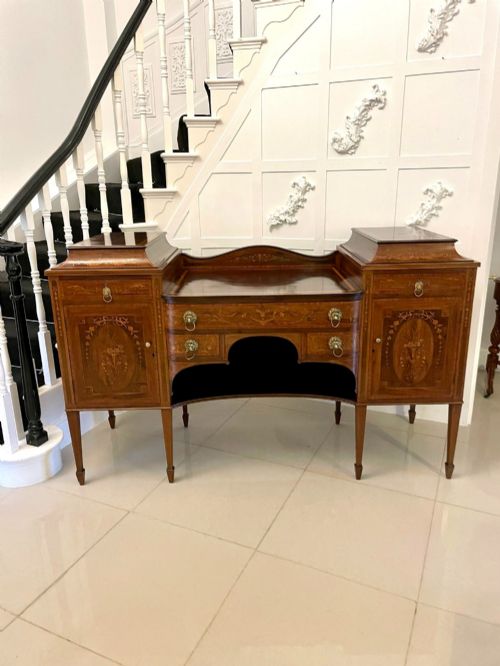
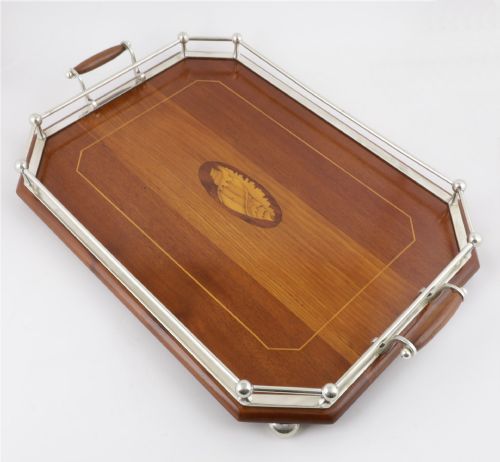
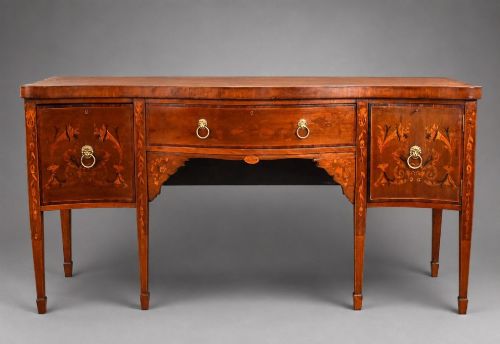
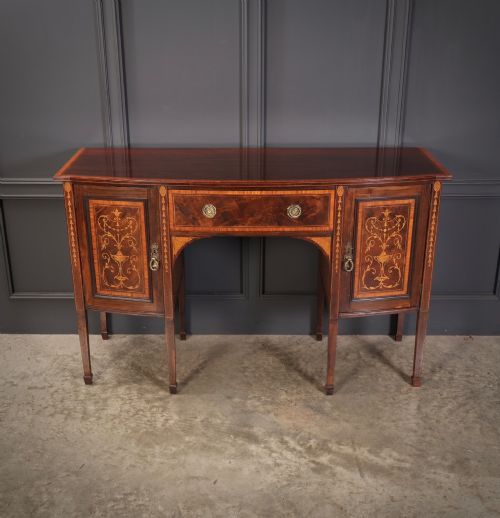
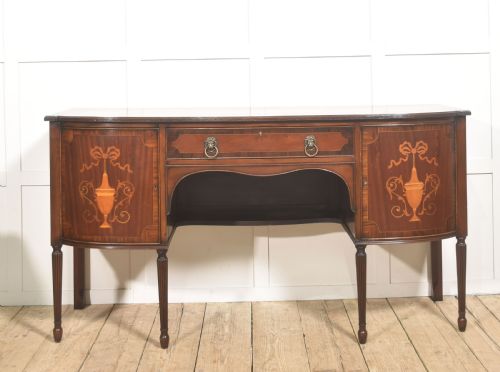

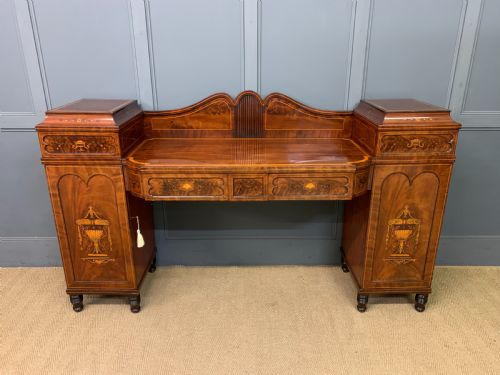


Marquetry Mahogany Server
These marquetry mahogany server options combine rich timber and intricate inlaid detail to anchor a dining room with classical proportion.
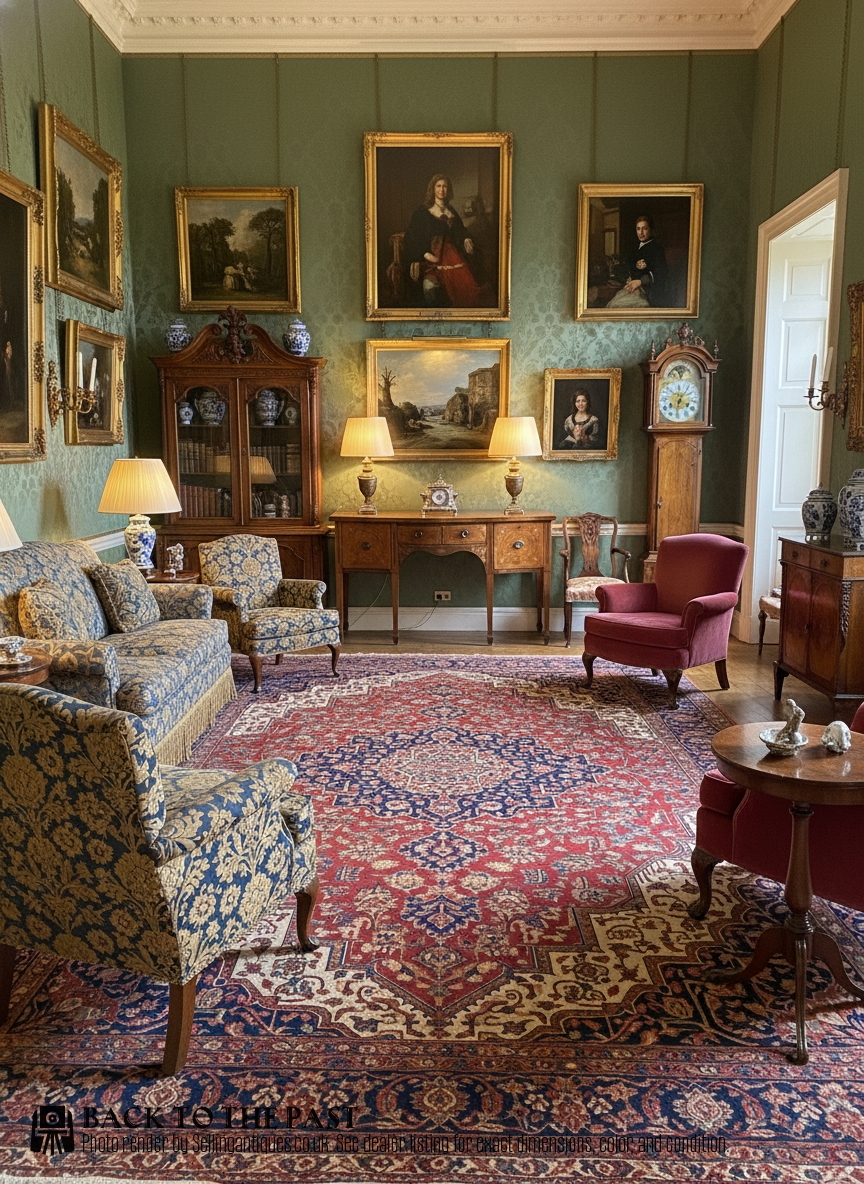
Marquetry Mahogany Server
A marquetry mahogany server brings together deep timber grains and complex inlaid motifs to serve as both a practical dining room focal point and a display surface. The examples gathered here span several key eras, from George III and Georgian origins through Victorian revivals and Edwardian interpretations.
Most pieces you encounter take the form of sideboards and side cabinets, though occasional side tables, washstands, and serving trays appear. These range from serpentine and breakfront outlines to straightforward bow fronts and pedestal configurations.
The aesthetic leans heavily toward revival movements, notably Sheraton Revival and Hepplewhite Revival, alongside distinct Edwardian French and Sheraton expressions. Such pieces rely on proportion and decorative contrast rather than sheer bulk to define their presence.
Materials and construction methods
Makers built these pieces primarily from solid mahogany and mahogany veneers over secondary timbers, providing a dark and stable structural foundation. This dense wood takes a high polish and accepts contrasting inlays without splintering.
Decorative detailing relies on marquetry inlay and satinwood inlay, often accompanied by boxwood stringing to frame panels and drawers. Brass hardware and occasional silver plate fixtures complete the assembly, adding functional contrast to the wooden surfaces.
The listings span George III, Georgian, Victorian, and Edwardian periods, utilising mahogany, satinwood, and brass.
Distinctions in craftsmanship
The skill of the cabinetmaker dictates the crispness of the serpentine or breakfront outline and the tightness of the drawer joints. Superior pieces demonstrate seamless integration between the primary mahogany carcase and the delicate marquetry patterns.
Finer examples employ varied secondary woods and precise satinwood or boxwood contrasts that remain flush with the surrounding surface. The depth of the hand-applied polish and the fidelity of revival styles further separate standard workshop output from exceptional commissions.
Hewetsons London·Howard And Sons
The Marquetry Mahogany Server Glossary
- Marquetry inlay
- The practice of fitting decorative veneers of various timbers into a prepared ground to form pictorial or geometric designs. This technique demands immense precision to ensure the wood pieces lock together without gaps.
- Satinwood
- A pale, lustrous timber native to the tropics, frequently utilised in contrasting stringing and panel inlays. Its bright yellow tone sets off the darker red-brown hues of mahogany.
- Serpentine outline
- A front edge curving inward centrally and outward at the ends in a continuous wave. This undulating form requires advanced woodworking skill to shape accurately.
- Breakfront
- A cabinet facade where the central section projects forward from the flanking wings. It creates architectural depth and breaks up long expanses of timber.
- Sheraton Revival
- A late nineteenth and early twentieth century design movement replicating the lighter, neoclassical forms associated with eighteenth century designer Thomas Sheraton.
Marquetry Mahogany Server: Frequently Asked Questions
How do I date a sideboard?
Examine the timber selection, construction methods, and secondary woods used inside the drawers. Hand-cut dovetails and native secondary woods typically point to earlier periods, while machine-cut elements and revival styles suggest nineteenth or twentieth century production.
Style cues like Sheraton revivalism or Edwardian French influences also help narrow the decade of manufacture. Comparing the hardware fixings and the style of inlay against known historical periods provides further clarity.
Where should I place a server?
These pieces suit dining rooms, grand hallways, or living spaces where surface area and storage are both required. Ensure the room has adequate clearance for doors or drawers to open fully, particularly with serpentine or breakfront shapes.
Keep the timber away from direct heat sources and strong sunlight to protect the polish and prevent the veneers from drying out. Positioning the piece against a solid wall allows its proportions to anchor the surrounding interior.
What is the difference between a sideboard and a server?
A sideboard traditionally incorporates deep storage cupboards and drawer banks designed for holding dining linen, cutlery, and china. Servers often present a slightly lighter stance with open surfaces or simpler underframes suited for presenting food and drink.
In antique terminology, these terms frequently overlap depending on the specific maker and the era of production. Both fulfill the central role of dining room organisation and surface display.
How do I care for marquetry surfaces?
Dust the timber regularly with a soft, dry cloth to prevent grit from scratching the polish or the delicate veneer inlays. Avoid silicone-based polishes and excessive moisture, which can damage old finishes and loosen the glue beneath the marquetry.
Apply a traditional wax polish sparingly when the wood appears dry to nourish the surface and maintain its lustre. Maintaining stable room humidity prevents the timber from expanding and contracting, which protects the inlay work over time.