
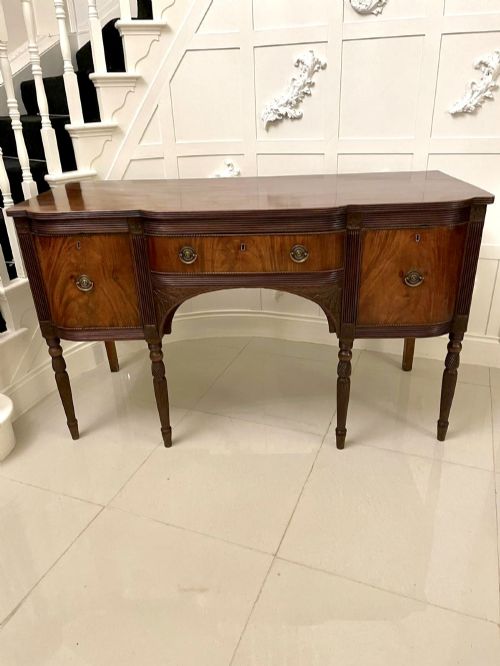
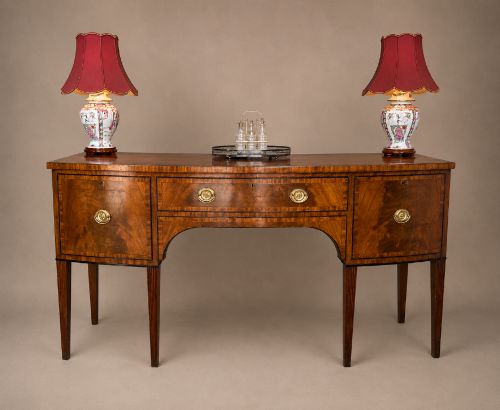
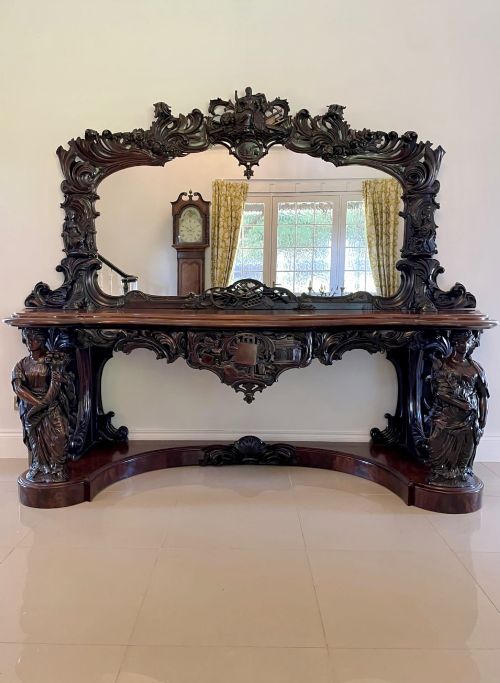
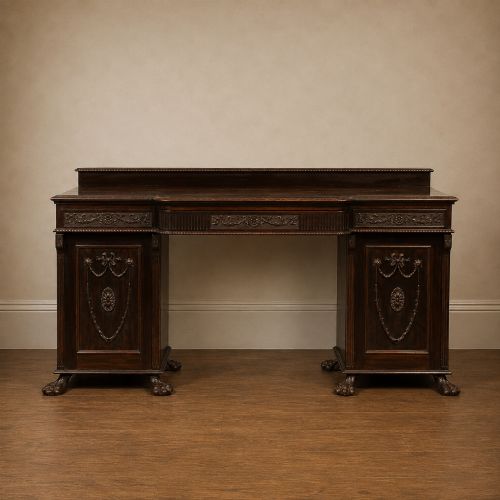
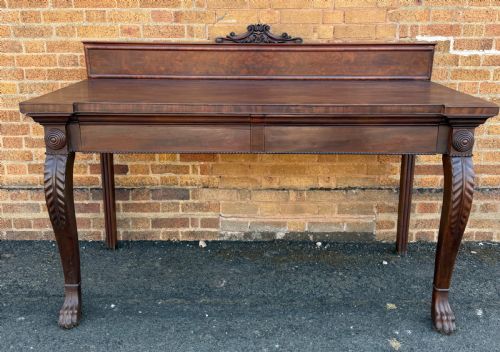
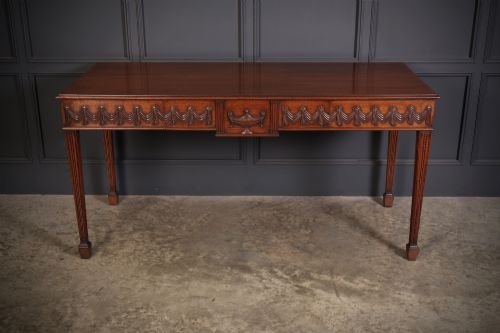
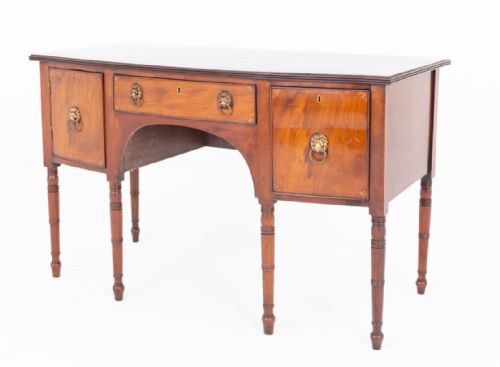
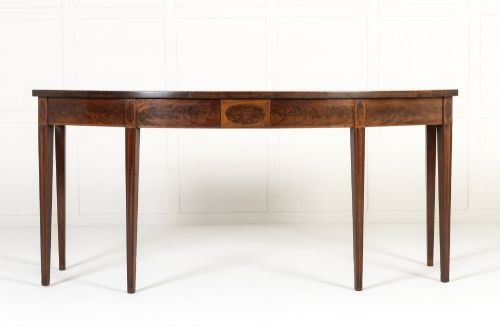
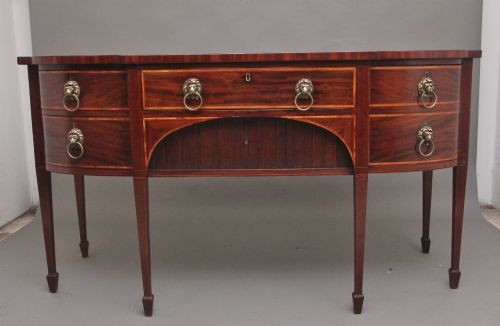
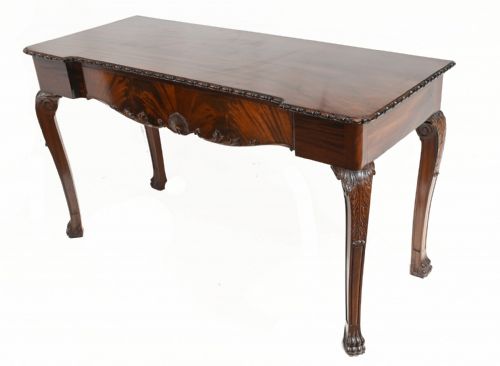


Mahogany Serving Sideboard
When you search for a mahogany serving sideboard, you are looking at substantial dining furniture designed to hold silver, linen and dishes.
Mahogany Serving Sideboard
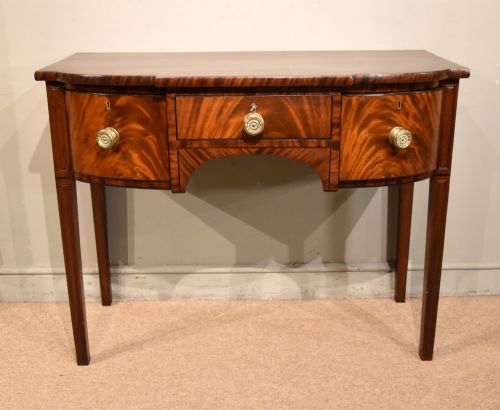
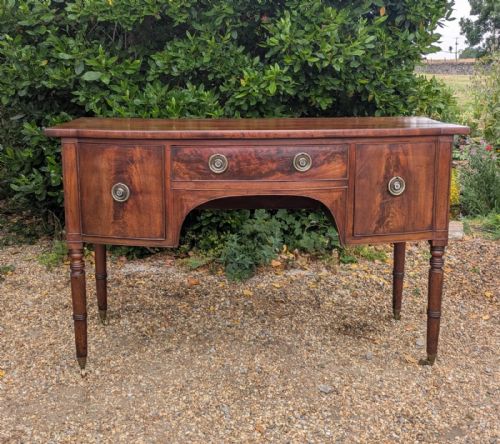
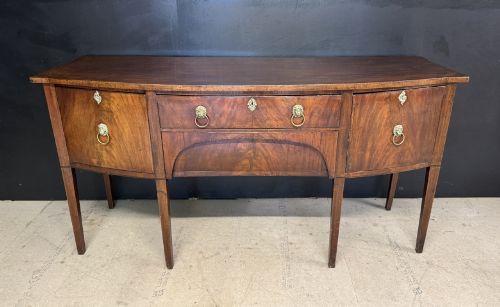
A mahogany serving sideboard represents a major category of dining room furniture spanning the Georgian, Regency and Victorian periods, along with later Edwardian revivals. The forms range from strict bow-front and breakfront sideboards to serving tables, console tables, low dressers, three-tier buffets and servers.
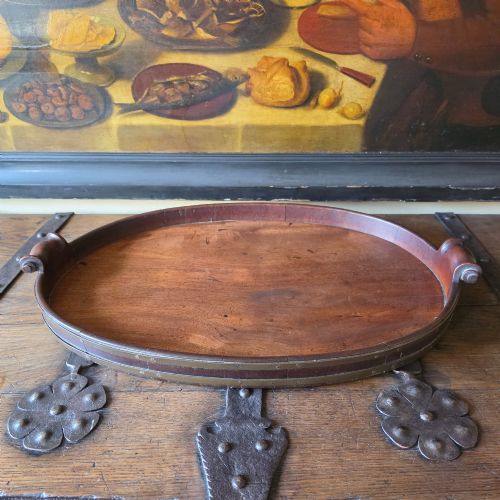
The pieces appearing on this page originate primarily from English and Irish workshops of the eighteenth and nineteenth centuries. You will encounter both flat-front and serpentine designs, alongside metamorphic pieces and specialised serving trays.
These items were built to serve a practical function in grand dining rooms, acting as staging surfaces for meals and storage for dining accessories. Their survival in varied regional styles reflects the shifting tastes of cabinetmakers from the age of George III through to the end of the nineteenth century.
How they were made
Makers utilised solid mahogany and flame mahogany veneers applied to secondary woods, bringing out deep natural grain patterns across large surfaces. Construction relied on traditional joinery techniques suited to heavy dining furniture, executed by hand in regional and metropolitan workshops.
Carved elements appear on specific styles, ranging from the paw feet of Edwardian pieces to the bolder neoclassical carving seen on Irish and Regency items. Glass surfaces and castors also appear on specific buffet and serving table variants.
Some Victorian dining pieces arrived with metamorphic mechanics, letting servants transform a quiet sideboard into a towering multi-tiered buffet.
What varies in quality
The grade of mahogany timber and the selection of flame veneer set the visual hierarchy of these pieces. Higher quality examples display carefully matched grain patterns across drawer fronts and top boards, whereas simpler items rely on plain timber.
The crispness of inlay work and the execution of carved details distinguish workshop output. Precision in brass fittings, original castors and structural integrity reflect the skill of the original cabinetmaker.
Scale and proportion govern the desirability of each form, with imposing breakfront designs and smaller bow-front proportions commanding different architectural presence in a room.
Gillows·Robert Strahan & Co·Wilkinson London·George Smith·George Oakley
The Mahogany Serving Sideboard Glossary
- Breakfront
- A cabinet or sideboard whose central section projects forward from the flanking sections. This architectural form creates depth and shadow across the front elevation of large serving furniture.
- Bow front
- A convex curved front contour typical of late eighteenth and nineteenth-century case furniture. It softens the linear profile of a dining room sideboard.
- Serpentine
- A front contour characterised by a convex central section flanked by concave curves, or vice versa. This undulating line requires advanced woodworking skill to execute properly in solid mahogany.
- Inlay
- The technique of inserting pieces of contrasting wood, such as satinwood or boxwood, into depressions in the mahogany surface to form decorative patterns. It defines the surface ornament of Sheraton and neoclassical styles.
- Metamorphic
- Furniture designed to transform into another object, such as a buffet changing its configuration. These clever mechanical pieces offer dual utility in the dining room.
- Buffet
- A tiered serving piece or sideboard used for displaying and serving food during large meals. They often feature multiple shelves or compartments for dining silver.
Mahogany Serving Sideboard: Frequently Asked Questions
What is a mahogany serving sideboard?
A mahogany serving sideboard is a heavy dining room piece designed for food preparation, serving and storage. These items include sideboards, serving tables, buffets and servers dating from the Georgian period onward.
Cabinetmakers built them using solid mahogany and veneers, incorporating drawers and cupboards for dining accessories. They served a central role in formal domestic dining across Britain and Ireland.
How do I date a mahogany sideboard?
Dating relies on stylistic markers such as leg shapes, handles, inlay types and overall proportions. Georgian pieces often display straight tapered legs or delicate satinwood stringing, while Regency examples lean toward bolder brass inlay and architectural forms.
Victorian and Edwardian items frequently show heavier carving or revival characteristics. Comparing the secondary woods and construction methods inside drawers provides further clues to the period of manufacture.
Where were these sideboards made?
The majority of these pieces originate from English and Irish cabinetmaking workshops. London firms produced high-style metropolitan furniture, while regional English makers and Dublin workshops like Robert Strahan & Co developed distinct local interpretations.
Irish pieces often feature bolder carving and heavier scale compared to their English counterparts. Provincial workshops also produced simpler regional variants of the standard London designs.
How do I care for antique mahogany?
Antique mahogany requires stable indoor humidity levels away from direct heat sources and sunlight, which can fade the timber and dry out veneers. Gentle dusting with a soft dry cloth maintains the surface.
Occasional application of appropriate traditional wax preserves the finish and nourishes the wood. Avoid modern liquid polishes that contain silicone or harsh chemicals.
What is the difference between a sideboard and a serving table?
A sideboard typically incorporates enclosed storage such as drawers and cupboards beneath the main surface. It functions as a complete storage and serving station for the dining room.
A serving table is generally an open-framed table without built-in cupboards, designed strictly for holding dishes and serving food during meals. Some serving tables include lower shelves or tiers.