

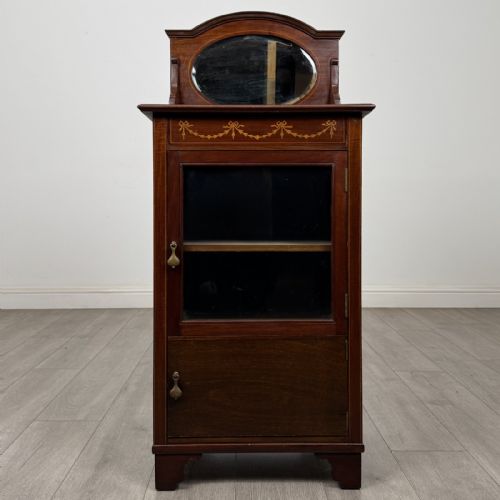
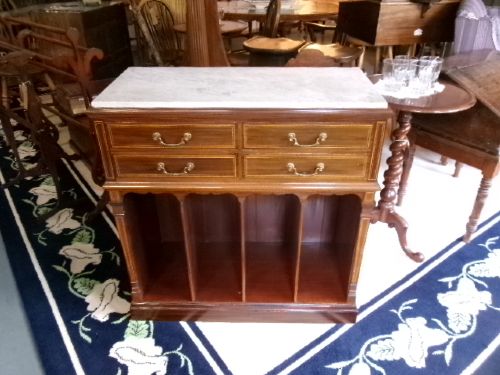
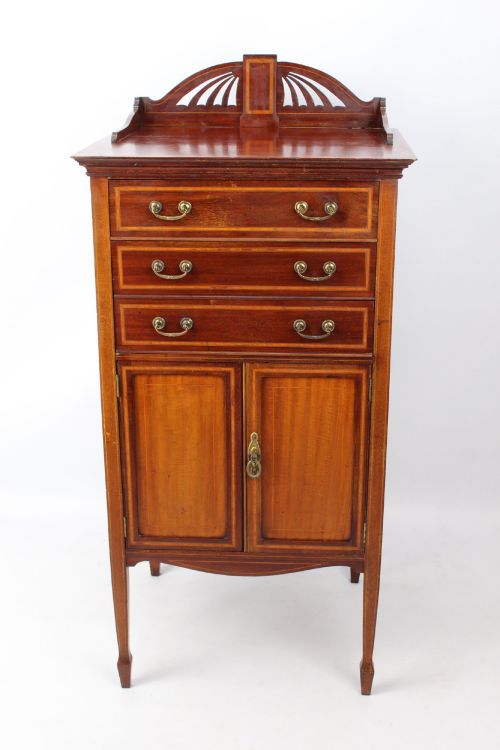


Mahogany Record Cabinet
A mahogany record cabinet organises your collection in timber, spanning Edwardian elegance through to Art Deco utility.
Mahogany Record Cabinet
When you search for a mahogany record cabinet, you are looking at practical storage for musical collections housed in classic timber. These pieces bridge the Victorian era and the twentieth century, evolving from partitioned sheet music holders into dedicated spaces for discs.
The versions you are most likely to meet on this page hail from the Edwardian period and the early decades of the twentieth century. They combine solid mahogany structures with functional drawer or shelf arrangements designed for domestic use.
Many examples on show reflect Sheraton Revival taste or Edwardian styling, often enriched with boxwood inlay and satinwood banding. Alongside dedicated record cabinets, you will find music cabinets and barographs sharing the same polished aesthetic.
How they were made
Cabinet makers relied primarily on mahogany, sometimes selecting solid timber or applying fine veneers over stable secondary woods. Satinwood and boxwood inlay provided contrasting stringing and decorative motifs along door panels and drawer fronts.
Functional metalware such as brass handles and hinges secured doors and dropped fronts, while occasional glass panels displayed contents. Interior divisions used timber slats and partitions tailored to keep upright media orderly.
Mahogany Record Cabinet Retail Price Guide 2026
Typical asking prices for mahogany record cabinet among the pieces listed under this phrase on Sellingantiques today, from the lower quarter to the upper quarter. They describe what is for sale here now, not the wider market.
Some Edwardian music cabinets hide drop-front compartments originally meant for sheet music, now perfectly sized for modern day odds and ends.
What varies in quality
The standard of a mahogany record cabinet rests upon the crispness of its boxwood inlay and the selection of timber figures. Superior examples display thoughtful grain matching across doors and drawer fronts rather than plain, unvaried surfaces.
Hardware choice and interior joinery separate utilitarian items from finer pieces. Original brass fittings and well-fitted internal divisions indicate careful workshop production during the Edwardian and Art Deco periods.
The Mahogany Record Cabinet Glossary
- Mahogany
- A durable reddish-brown tropical hardwood prized for its stability and rich grain. It serves as the primary structural and visual material across these cabinets.
- Edwardian
- A stylistic period spanning the reign of King Edward VII from 1901 to 1910. Pieces from this era often feature lighter proportions and refined classical inlays.
- Sheraton Revival
- A late nineteenth and early twentieth century design movement inspired by the furniture of George Sheraton. It favours symmetrical forms, satinwood banding, and delicate stringing.
- Boxwood Inlay
- Contrasting pale wood inserted into recesses in the mahogany surface to create geometric borders or floral patterns. It highlights the structural lines of the cabinet.
- Barograph
- A meteorological instrument recording barometric pressure over time on a paper chart. Cased in matching mahogany, it occasionally appears alongside musical storage pieces.
Mahogany Record Cabinet: Frequently Asked Questions
What is a mahogany record cabinet used for?
These cabinets serve to store and organise musical media within domestic spaces. Internal shelving and vertical partitions keep discs or sheets upright and accessible.
They function as both practical storage furniture and polished decorative pieces for the home, reflecting the musical tastes of the Edwardian and Art Deco periods.
How do I date an Edwardian music cabinet?
Dating relies on stylistic markers such as Sheraton Revival influences, satinwood banding, and boxwood inlay. Edwardian pieces typically date from around 1900 to 1910.
Construction methods and timber choices also help place the piece within the late nineteenth or early twentieth century timeframe.
Are music cabinets and record cabinets the same?
Music cabinets were originally built to hold loose sheets of paper, featuring shallow drawers or vertical partitions. Record cabinets evolved later to accommodate heavier vinyl discs or early shellac records.
Both forms utilise mahogany construction and share similar exterior dimensions, though interior shelving layouts differ to suit the specific media.
How should I care for a mahogany cabinet?
Keep the timber away from direct sunlight and heat sources to prevent the mahogany and its veneers from drying out. Regular dusting with a soft, dry cloth preserves the polished finish.
Avoid silicone-based polishes and apply traditional beeswax sparingly to maintain the natural lustre of the wood and inlay.