
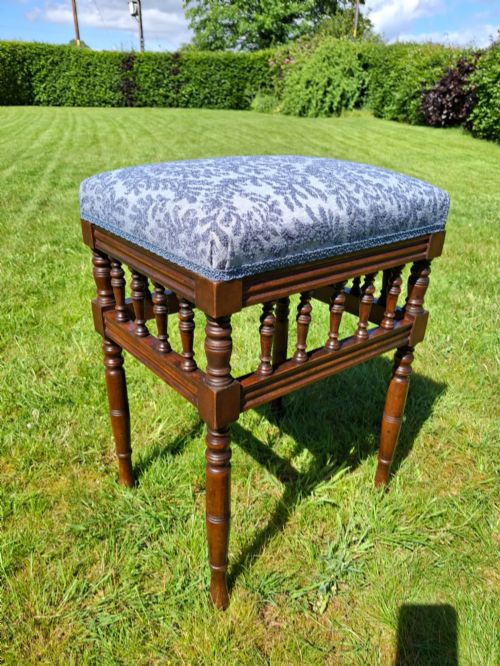


Mahogany Music Bench
A mahogany music bench offers sturdy seating and practical storage near the piano, anchored by the rich grain and warm tones of traditional timber.

Mahogany Music Bench
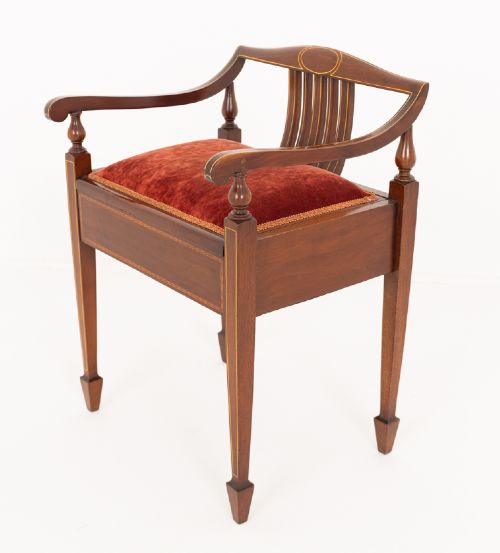
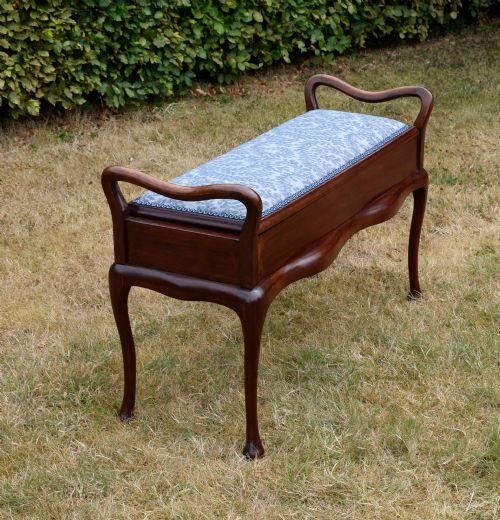
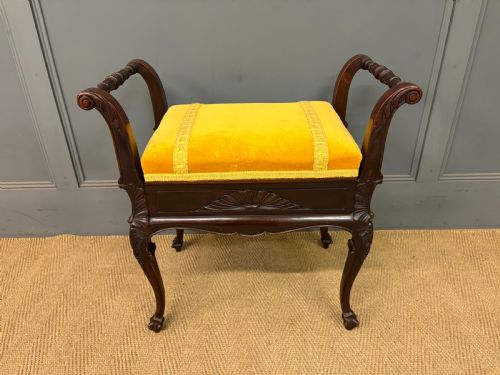
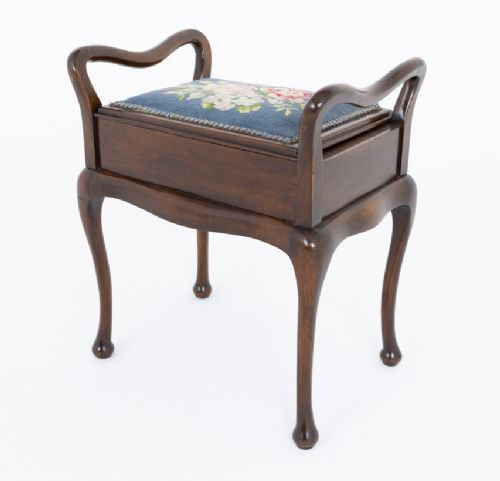
A mahogany music bench is primarily encountered as a piano stool or duet stool originating from the Victorian, Edwardian, and early twentieth-century periods. These seating pieces appear in single and duet formats, designed to accommodate one or two players comfortably at the keyboard.
The selection centres heavily on Edwardian craftsmanship alongside Victorian and 1920s examples, reflecting the domestic musical habits of those eras. Buyers encounter freestanding forms featuring upholstered lift-up seats, revolving tops, or hinged compartments intended for sheet music storage.
Styles range from straightforward Victorian iterations to elaborate Sheraton Revival and Edwardian neoclassical designs, sometimes incorporating X-framed supports. These variations provide functional seating solutions that double as elegant furniture for the sitting room.
Materials and construction
Makers utilised solid mahogany and mahogany veneers as the primary timber framework, often selecting the wood for its durability and deep reddish-brown appearance. Workshops embellished select pieces with delicate satinwood inlay, adding contrasting decorative borders and classical motifs to the woodwork.
Upholstery plays a central role in construction, with seats traditionally covered in fabric, velvet, tapestry, or tan leather. Metal and brass components frequently appear in the mechanical hardware, supporting revolving seats, hinges, and lift-up mechanisms.
Many of these benches survived decades of enthusiastic piano practice while secretly hoarding forgotten classical sheet music beneath their cushions.
Judging quality and craftsmanship
Quality rests heavily on the depth of the timber selection and the precision of the cabinetwork joining the frame. Superior examples demonstrate crisp execution in satinwood inlay and robust mechanical joints for revolving or lifting seats.
The refinement of the decorative style distinguishes finer pieces, particularly where Sheraton Revival or neoclassical influences shape the silhouette. Balance between the solid mahogany structure and the original or sympathetic upholstery completes a well-executed bench.
Jas Shoolbred
The Mahogany Music Bench Glossary
- Duet stool
- A wider seating bench designed to accommodate two pianists side by side at the keyboard. These pieces often feature hinged lift-up seats providing generous internal storage for large portfolios of sheet music.
- Satinwood inlay
- A decorative technique where lighter contrasting wood veneers are inserted into recessed channels in the primary mahogany surface. This creates subtle geometric or floral patterns across the timber.
- Revolving piano stool
- An adjustable seating form featuring a central threaded screw mechanism operated by turning the top. This allows the player to alter their seating height for optimal reach at the keyboard.
- X-framed
- A structural support design where the legs cross in the centre to form an X shape. This configuration provides sturdy load-bearing strength while maintaining an open, architectural profile.
Mahogany Music Bench: Frequently Asked Questions
What is a mahogany music bench?
A mahogany music bench is a specialised piece of wooden seating designed for use at a piano or keyboard, combining a stable wooden frame with an upholstered top.
Most examples include internal storage compartments or adjustable mechanisms for sheet music and player comfort.
How do I use one today?
These benches serve effectively as piano seating, dressing table stools, or compact window seats in modern living spaces.
The hinged or lift-up compartments provide discreet storage for household items while maintaining a tidy appearance.
How do I date a music bench?
Dating relies on observing the prevailing stylistic traits, such as Edwardian neoclassical inlay or Victorian revolving screw mechanisms.
Timber grain characteristics and upholstery methods also offer reliable clues to whether a piece originates from the nineteenth or early twentieth century.
What is the difference between a solo and duet stool?
Solo stools provide compact seating dimensions intended for one person practicing alone at the instrument.
Duet stools offer an extended width to accommodate two players simultaneously, frequently incorporating larger storage boxes beneath the seat.