




Mahogany Mercury Barometer
Mahogany mercury barometers measure atmospheric pressure through the movement of liquid metal enclosed in rich timber cases.
Mahogany Mercury Barometer
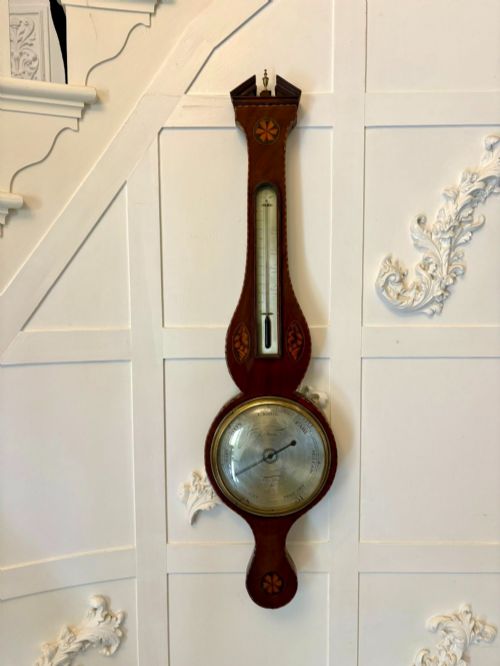
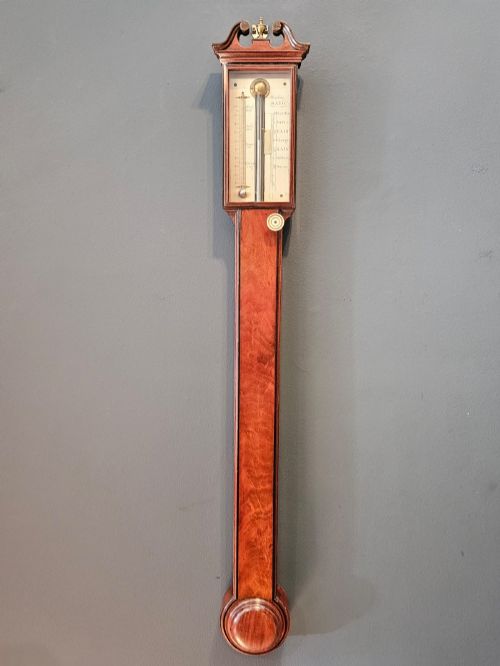
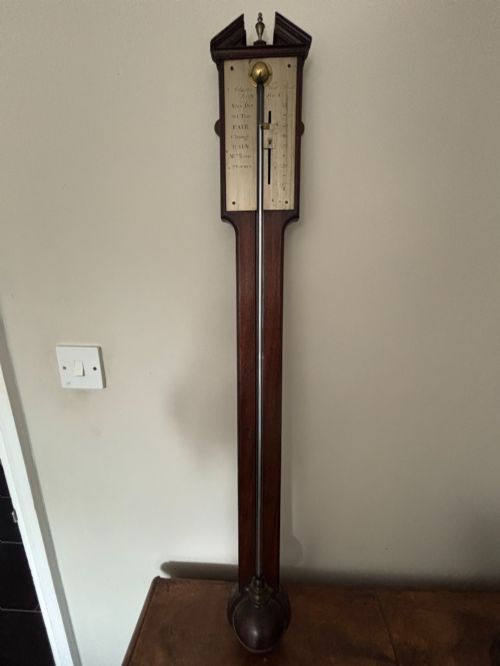
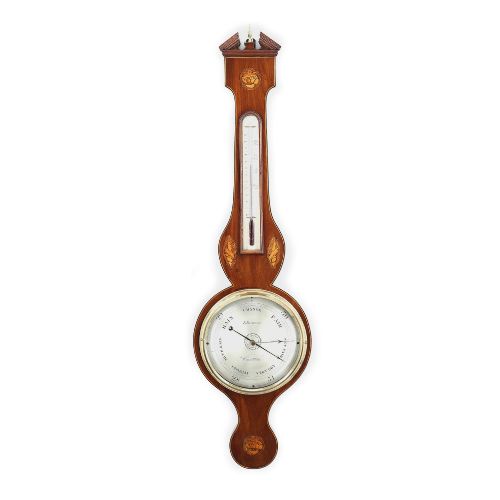
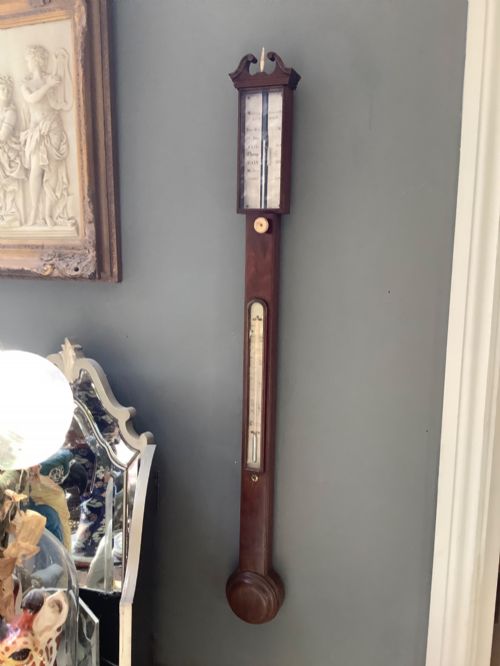
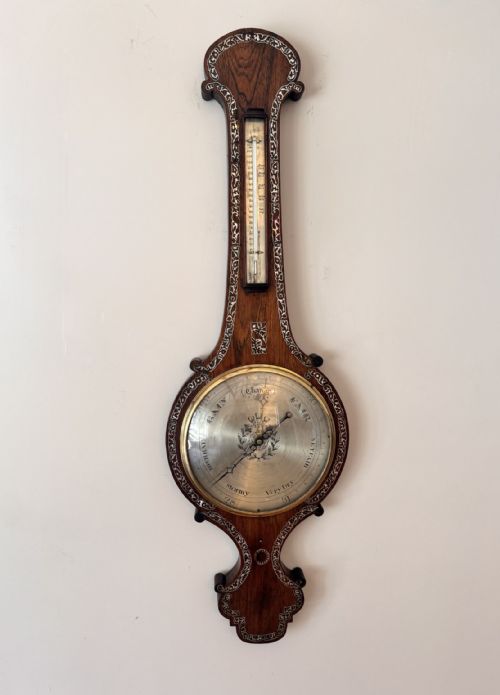
A mahogany mercury barometer is an instrument for measuring atmospheric pressure housed within a timber enclosure, appearing across Georgian, Regency and Victorian periods. The examples found here divide broadly between the upright stick barometer and the larger, curving wheel banjo barometer.
Makers working during the Georgian era favoured slender stick formats with exposed tubes and protective cistern covers. Later nineteenth century pieces frequently adopt the banjo shape, integrating thermometers, hygrometers and circular silvered dials beneath damp-resistant glass faces.
Materials and construction
Cases utilise solid mahogany, occasionally accented with rosewood veneers, boxwood stringing, shell marquetry or mother-of-pearl inlay. Long trunk bodies protect the fragile glass capillary tube while offering a stable vertical plane for mounting.
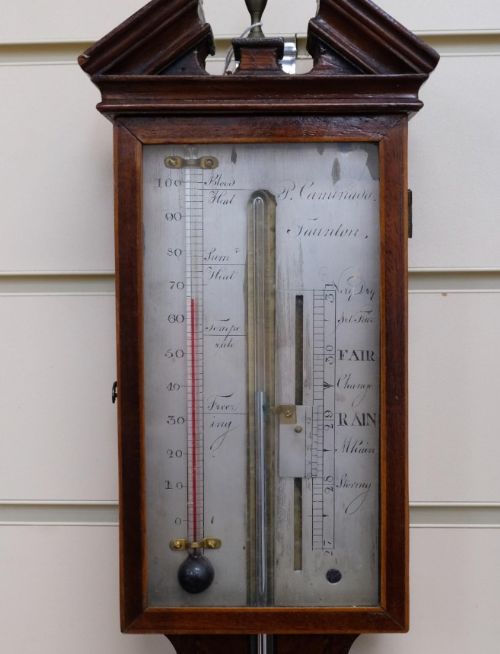
Dials are executed in silvered brass or metal, engraved with weather descriptions and calibrated scales. Brass indicators, bezels and mercury reservoirs complete the internal mechanisms built by opticians and instrument makers.
Makers frequently operated from provincial towns like Wisbech and Melksham, bringing precision instrument design into bustling market high streets.
Assessing execution
Quality rests in the crispness of the case woodwork, the subtlety of any inlay work and the legibility of the engraved silvered metal dial. Finer examples retain their original maker signatures, brass finials and undisturbed mercury columns.
The hand of the maker dictates the distinction between standard provincial pieces and urban workshop productions. Integrated secondary instruments, such as hygrometers or alcohol thermometers, elevate the sophistication of the piece.
P. Caminada·George Adams·B. Besozzi·Dollond·Ganthony·JB Bergna·Prada·Alexander Wright·Molton·Luisetti·Giana·Bate·Jenkins·Ronchetti·L Casatelli·James H Kelly·Watkins·Roncoroni·W.E. Pain·H Marks·Sandrino·Hayward·Faglio·Pini·Bullock
The Mahogany Mercury Barometer Glossary
- Stick barometer
- A vertical instrument where the height of the mercury column is read directly against a graduated scale. This form represents the most direct method for observing barometric pressure changes.
- Wheel barometer
- A banjo-shaped instrument that uses a concealed float and pulley system to translate mercury movement into the rotation of a pointer around a dial. These often incorporate subsidiary hygrometers or spirit thermometers.
- Silvered metal
- A brass or metallic plate treated with a silver solution to create a reflective, engraved surface for readings. This material provides high contrast for legible graduations.
- Cistern
- The reservoir at the base of the instrument containing the pool of mercury exposed to atmospheric pressure. Enclosed wooden or brass covers protect this vulnerable component.
- Boxwood inlay
- Contrasting pale wood sections inserted into the mahogany case surface to create geometric borders or decorative shell motifs. Such detail indicates careful cabinetmaking.
Mahogany Mercury Barometer: Frequently Asked Questions
How do I read a mercury barometer?
Read the position of the main pointer against the engraved scale, noting whether the pressure is rising or falling towards specific weather terms.
Many banjo models feature a secondary hand set by hand to track movement relative to the current column position.
Are these instruments safe to transport?
Transporting requires tilting the instrument slowly to force the mercury up the tube into the bag cistern, preventing air from entering the vacuum.
Specialist handling is advised for long journeys to ensure the delicate glass components remain intact and supported.
How do I date a mahogany barometer?
Dating relies on stylistic clues in the mahogany case, such as architectural pediments, stringing details, and the shape of the dial surround.
Signatures engraved on the metal dial plates often connect the piece to documented regional makers and active workshop periods.
Where should I hang a wall barometer?
Mount the instrument on an interior wall away from direct sunlight, central heating radiators, and damp exterior stone surfaces.
Stable ambient temperatures prevent excessive wood movement in the mahogany case and ensure accurate pressure response.