
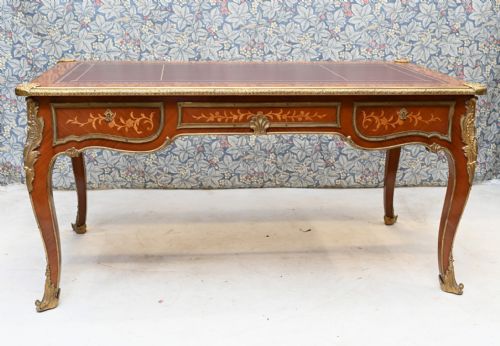


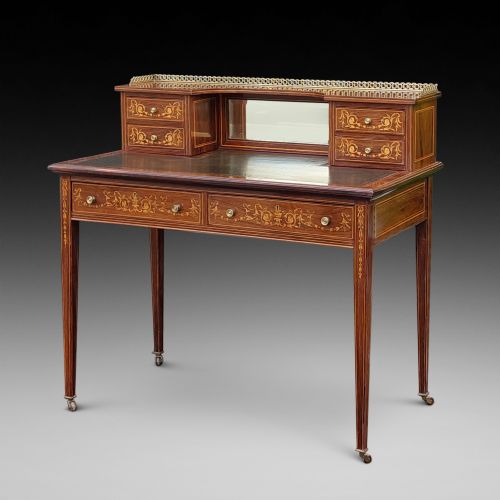


Mahogany Marquetry Bureau
A mahogany marquetry bureau offers a sloping fall front concealing fitted interior pigeonholes above drawers, united by intricate inlaid woodwork.
Mahogany Marquetry Bureau
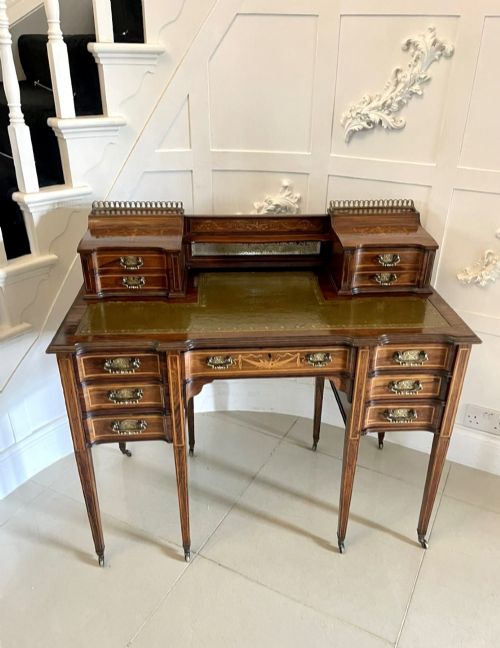
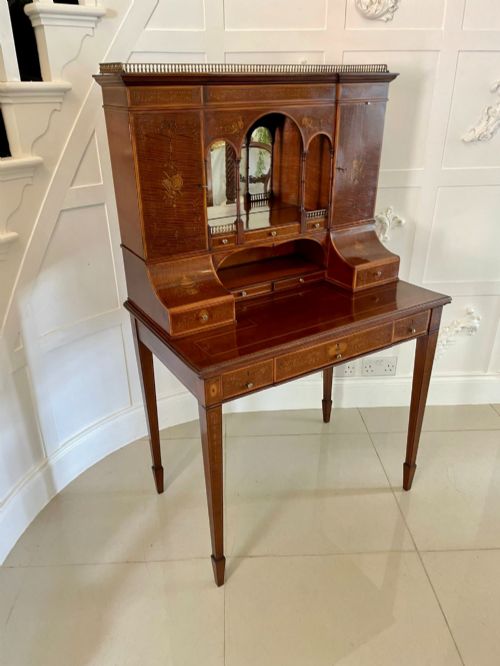
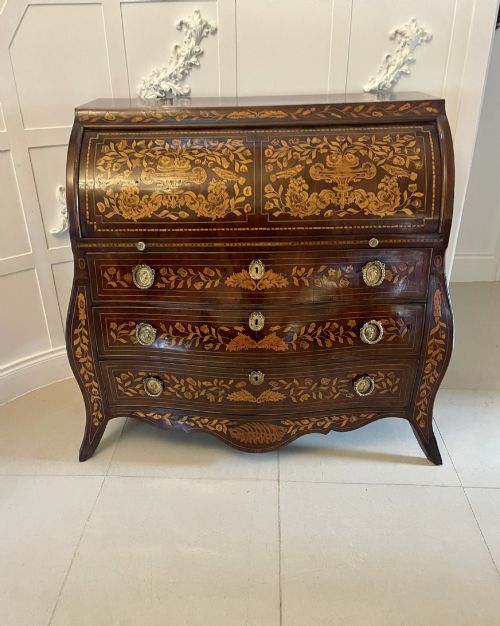
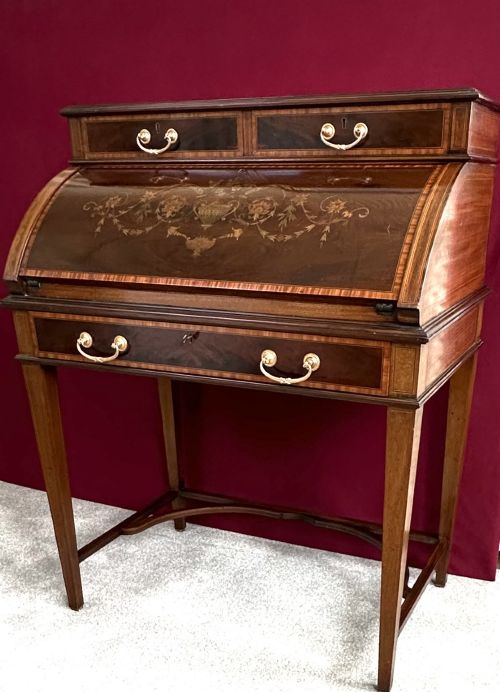
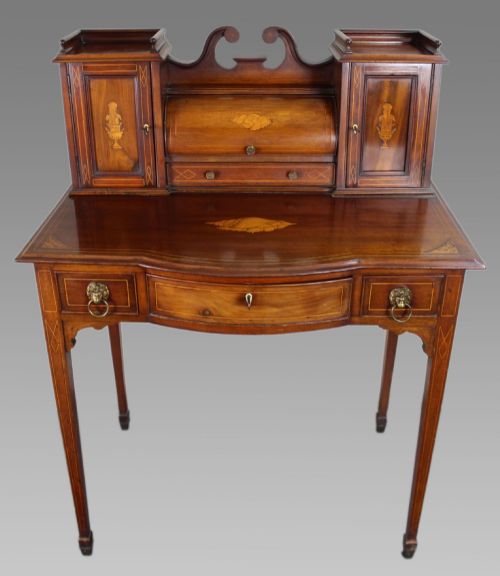
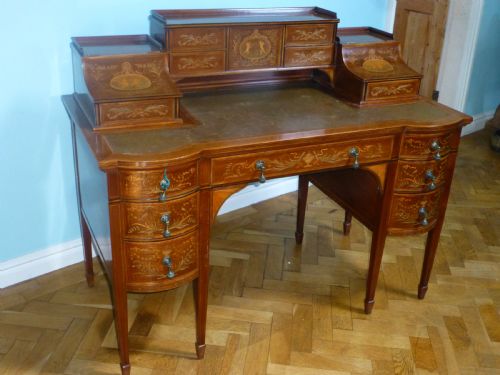
A mahogany marquetry bureau combines a practical writing surface with compartmentalised storage, appearing in forms ranging from compact Edwardian fall-front examples to substantial eighteenth-century bombé shapes. The selection spans distinct eras including Victorian Sheraton Revival interpretations, Georgian origins, and robust Dutch floral marquetry pieces.
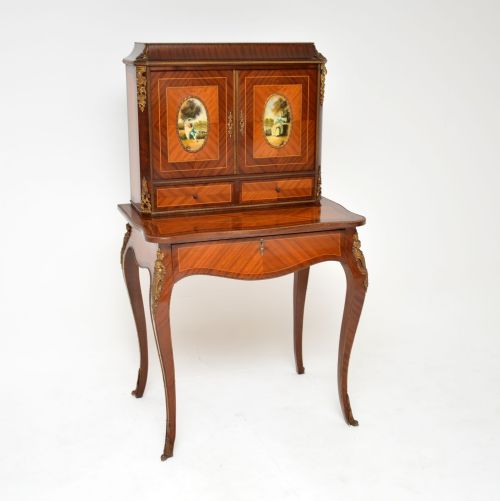
Buyers encounter cylinder desks, bureau bookcases with upper shelving, and delicate ladies writing tables alongside traditional fall-front write-desks. These items serve as working furniture that simultaneously functions as decorative cabinetwork within reception spaces or studies.
How they were made
Cabinetmakers constructed these pieces using solid mahogany frameworks, frequently applying contrasting veneers of satinwood, rosewood, and kingwood to create pictorial marquetry panels. Floral and geometric designs relied on precision cutting of thin wood veneers set flush into the primary surface.
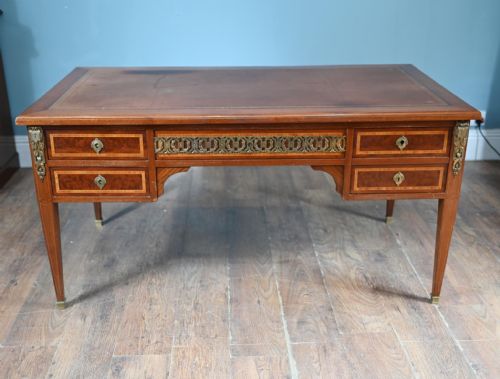
Many examples incorporate cast brass handles, escutcheons, and occasionally gilt ormolu mounts to accent drawer fronts and corners. Leather writing inserts frequently line the fall-front desks or pull-out writing surfaces, edged with gold tooling.
Child-sized bureaus exist for tiny Victorians to practice their handwriting.
What varies in quality
The sophistication of the marquetry design and the fidelity of its botanical or architectural motifs separate standard production from exceptional examples. Dense, finely shaded wood inlays demand high skill, whereas simpler compositions use fewer contrasting timbers.
Structural integrity of the fall-front hinges, the smoothness of interior pigeonhole mechanics, and the preservation of original secondary woods indicate superior workshop standards. Finer pieces demonstrate seamless veneer matching across curved surfaces and drawer divisions.
Maple and Co·Edwards and Roberts·James Shoolbred of London·Linke
The Mahogany Marquetry Bureau Glossary
- Marquetry
- Decorative veneer work forming pictorial patterns using various coloured woods. It differs from inlay by assembling the design on a backing sheet before applying it to the carcase.
- Fall front
- A hinged writing flap that drops forward to provide a horizontal desk surface. It conceals internal drawers and pigeonholes when closed.
- Bombé
- A swelling, outward-curved profile found on the front and sides of case furniture. This curvilinear form requires advanced cabinetmaking techniques.
- Cylinder desk
- A writing desk featuring a quarter-circle rolling wooden shutter that conceals the writing surface and interior compartments. When rolled back, it retracts into the body of the desk.
- Bureau bookcase
- A two-part piece of furniture combining a lower sloping desk base with an upper glazed or panelled bookcase section. It provides both workspace and storage.
Mahogany Marquetry Bureau: Frequently Asked Questions
What is a mahogany marquetry bureau?
A mahogany marquetry bureau is a writing desk featuring a sloping fall-front lid and decorative wood-inlaid floral or pictorial veneers.
These pieces provide a concealed writing surface and internal compartment storage while acting as decorative furniture.
How do I use a bureau daily?
The hinged fall-front drops down to create a writing ledge, allowing you to compose letters or place a laptop on the leather insert.
Internal pigeonholes and small drawers keep stationery and documents organised when the lid is closed.
How do I tell Edwardian from Victorian pieces?
Edwardian examples often display lighter satinwood contrasts and simpler Sheraton Revival lines, dating around nineteen hundred.
Victorian pieces tend to use heavier mahogany timbers and denser marquetry, reflecting earlier nineteenth-century revival tastes.
Where should I place a bureau?
Freestanding models with finished backs can sit centrally in a study or drawing room to display their marquetry from all angles.
Against a wall, a fall-front bureau occupies minimal floor space while offering substantial vertical storage.