
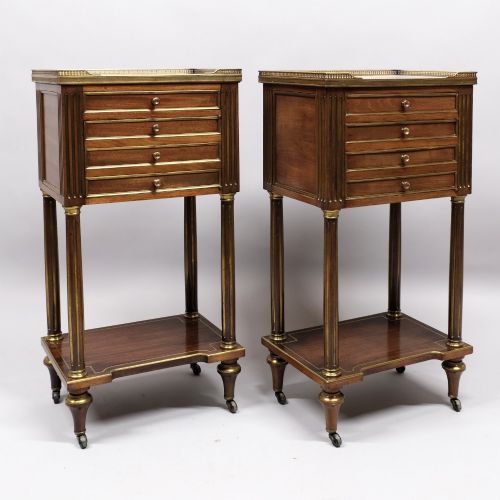


Mahogany Marble Top Nightstands
Mahogany marble top nightstands are solid wood bedside tables topped with stone, built to hold nightly necessities with architectural poise.
Mahogany Marble Top Nightstands
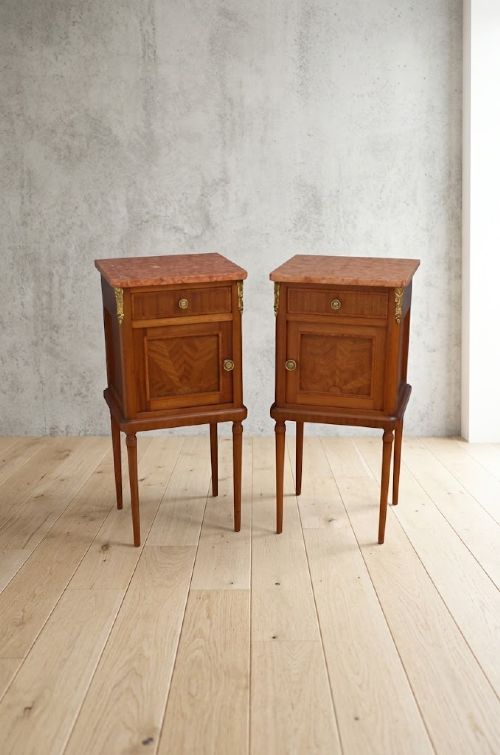
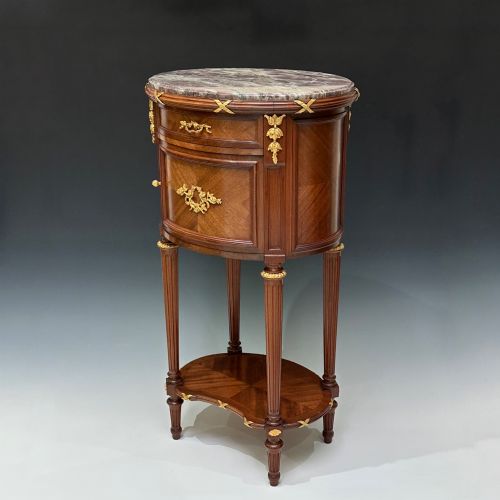
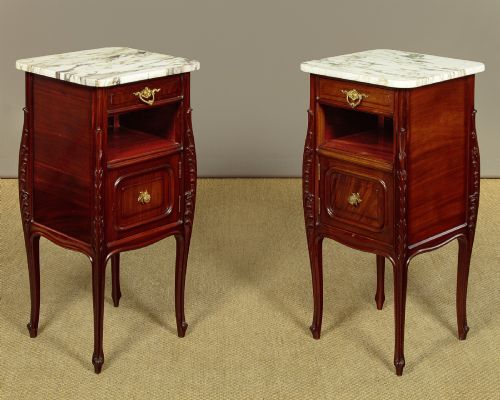
Mahogany marble top nightstands take the form of bedside tables, cabinets, and cylindrical pedestals originating from the nineteenth century into the early twentieth century. You will frequently encounter French examples from the Victorian, Empire, and Louis revival periods designed as paired bedroom storage.
Makers such as François Linke and Edwards & Roberts contributed to this tradition of fitted bedroom furniture alongside numerous anonymous workshops. The forms range from rectilinear bedside chests and kidney bean tables to tall cylindrical cupboards fitted with stone surfaces.
The materials combine rich tropical hardwoods with inset marble surfaces, sometimes supported by brass or ormolu mounts. These pieces served primarily to hold chamber lighting and personal items beside the bed while concealing interior storage space.
How they were made
Makers utilised dense timbers, selecting standard mahogany and flame mahogany veneers over structural carcases to create figured grain patterns. These wooden bodies were paired with heavy slabs of marble, cut and polished to fit tightly within the wooden top rail.
Brass, gilt metal, and ormolu mounts were cast and applied to corners, keyholes, and feet to accent the architectural lines. Cabinetmakers employed precise joinery, occasionally incorporating cylindrical tambour doors or curved wooden panels that required exact curvature in the timber.
Materials recorded across the inventory include flame mahogany, white marble, brass, ceramic, and cane.
What varies in quality
The refinement of the carving and the choice of timber determine the standing of each piece, distinguishing simple utility items from high-style furnishings. Flame mahogany veneers selected for dramatic grain symmetry elevate the visual weight of a bedside cabinet.
The integration of the marble top and the crispness of the cast brass or ormolu mounts show the original maker's investment in detail. Superior examples maintain smooth operation in doors, drawers, and tambour tracks, reflecting careful initial construction.
François Linke·Edwards & Roberts
The Mahogany Marble Top Nightstands Glossary
- Flame mahogany
- A veneer cut from the fork of the mahogany tree that yields a distinctive flame-like pattern. This figured wood appears frequently on high-end nineteenth-century cabinet fronts.
- Ormolu
- Gilded bronze mounts applied to furniture for decorative enrichment. These metallic accents define French Empire and revival pieces.
- Tambour
- A sliding door made of narrow vertical strips of wood glued to a canvas backing. It allows access to curved cabinet interiors without requiring swing clearance.
- Petit commode
- A small chest of drawers or bedside cabinet. The term appears often in descriptions of French neoclassical bedroom furniture.
- Etagere
- An open shelving unit used for display. These occasionally incorporate marble surfaces and match larger bedroom suites.
Mahogany Marble Top Nightstands: Frequently Asked Questions
What is a marble top nightstand used for?
These cabinets served historically beside the bed to hold lighting, water, and personal belongings while keeping chamber items enclosed below. The stone surface provided a durable, stain-resistant workspace that withstood the daily use of oil lamps and jugs.
Today they function flexibly in modern bedrooms as bedside storage or in living spaces as small lamp tables. Their compact footprints allow them to fit easily into tight corners while offering both surface display and concealed storage.
How do I identify French Empire nightstands?
French Empire pieces rely on classical architectural proportions, often featuring cylindrical pedestals, dark mahogany surfaces, and heavy cast brass or ormolu mounts. The hardware frequently depicts military trophies, wreaths, or classical rosettes.
These cabinets often hide a single door opening to a shelved interior or a marble-lined compartment. Their austere dignity separates them from the more florid carved curves of later revival styles.
Are these nightstands usually sold in pairs?
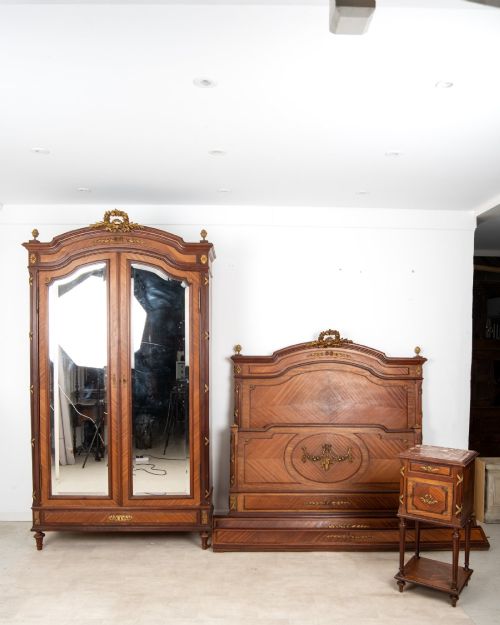
Many listings present these cabinets as matched pairs intended to flank a double or super king size bed. Makers originally constructed them together to balance the symmetry of grand nineteenth-century bedroom suites.
Single examples also appear frequently, surviving independently from their original pairs. Both single units and matched sets function well depending on bedroom layout and spatial requirements.
What distinguishes Louis XVI revival pieces?
Louis XVI revival furniture draws inspiration from eighteenth-century neoclassical restraint, featuring straight tapered legs, fluted columns, and subtle geometric brass mounts. The mahogany is often lighter in tone, accented by crisp mouldings.
These cabinets prioritize vertical lines and understated elegance over heavy baroque curves. They bring a refined architectural structure to bedroom interiors.